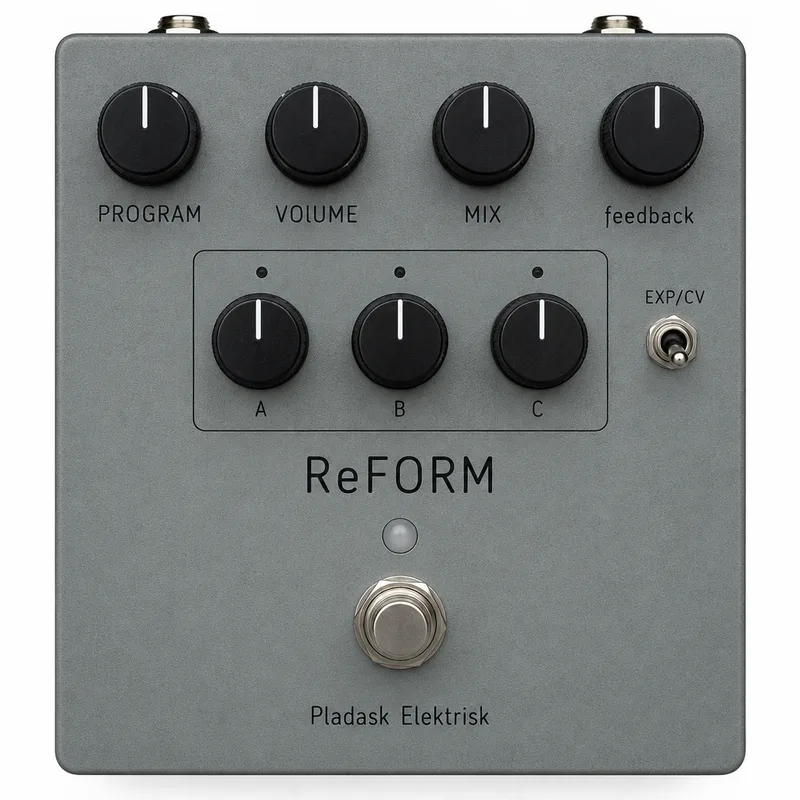
The Pladask Elektrisk ReFORM is a programmable effect pedal built around the Spin FV-1 digital signal processor, a DSP chip that designers write their own effect algorithms for. Rather than a single-effect stompbox, it is a multi-effect: it ships with 24 factory programs plus 8 empty program slots, 32 programs in 4 banks in total, covering time stretch, freeze, sample playback, granular synthesis, reverb, delay, ring modulator, filter, vibrato and pitch effects1. Pladask Elektrisk has discontinued the pedal and does not sell it any more2.
The Spin FV-1 and how the pedal is built
The FV-1 is a self-contained DSP chip that small builders use as the heart of custom effects. Its instruction set includes LOG and EXP instructions for programming audio expansion and compression routines, and it carries integrated digital LFOs and ramp generators that make chorus, flanger and pitch shift programs possible3. In the ReFORM, Pladask Elektrisk paired that DSP core with what the manual calls a "wrapper": an analog dry/wet mixer with various parameters and two programmable knobs, so the analog knobs sit outside the digital engine1.
That architecture matters to a player because it shapes what the knobs do. Three of the controls are programmable per program, while the analog layer handles the dry/wet blend and master volume1.
Programs and what they do
The 32 programs divide into banks with distinct characters:
- Bank 1 and bank 2, algorithms 1 to 5: variable speed sample playback systems, described in the manual as similar to manipulating a tape recorder's playback speed. Combined with the feedback knob, they can produce ascending or descending pitch shifting effects1.
- The remaining 11 programs (all of bank 1 plus algorithms 6, 7 and 8 of bank 2): granular synthesizers. These can perform time stretching and scrubbing without changing pitch, though the manual notes it affects timbre1.
Two examples from the manual show how the programmable knobs map to each algorithm. On Bank 1 program 1, a Time Stretch program, knob II sets buffer size from 100 to 1000 ms, similar to a delay time knob, and knob III sets the time stretching speed, with frozen audio at the middle position, forward playback clockwise, reverse counterclockwise and original speed at min and max1. On the Freeze/Scrub program, which uses a 1000 ms buffer, knob II adjusts grain randomization for the fluidity of the freeze effect, static at minimum, and knob III sets the window position for manual sample scrubbing and time stretching1.
On the bank 1 and 2 programs, buffer size parameters are destructive: adjusting the buffer size permanently manipulates the content of the memory buffer. All other knob II and III parameters on those banks are non-destructive1.
The LOOP parameter, assigned to knob I for all programs in banks 1 and 2, decides whether new audio is recorded to the buffer, how long it remains there, and whether the DSP outputs audio. At maximum, audio is stored undisturbed indefinitely because the DSP input is muted, which turns the pedal into a hold function1.
Controls, bypass and expression
The VOLUME knob is the master volume from the pedal, with unity gain around noon and a maximum gain of +16dB1. The ENGAGE switch is the bypass switch, using relay-based true bypass1.
The pedal also offers a trail bypass option, which the manual describes as useful for the ambient and reverb algorithms. Trails are activated by pushing the PROGRAM knob. In trail bypass the VOLUME knob remains active, MIX sets the wet signal volume, and the dry signal outputs at the volume equal to MIX minimum1.
For external control, the EXP/CV socket on the back panel accepts an external expression pedal or a control voltage source from 0 to 3.3V. It automatically overrides one of the three programmable knobs, selected with the EXP/CV toggle. The analog knobs cannot be controlled by EXP/CV or the switch1.
Power and specifications
The ReFORM runs on 9VDC with center negative polarity, the standard Boss, Ibanez and 1Spot supply format, and draws 90 mA1. Its input impedance is 1 MΩ and its output impedance is approximately 1kΩ1. The enclosure measures 250 x 220 x 55 mm and weighs 650 g1.
Where the ReFORM sat in Pladask Elektrisk's range
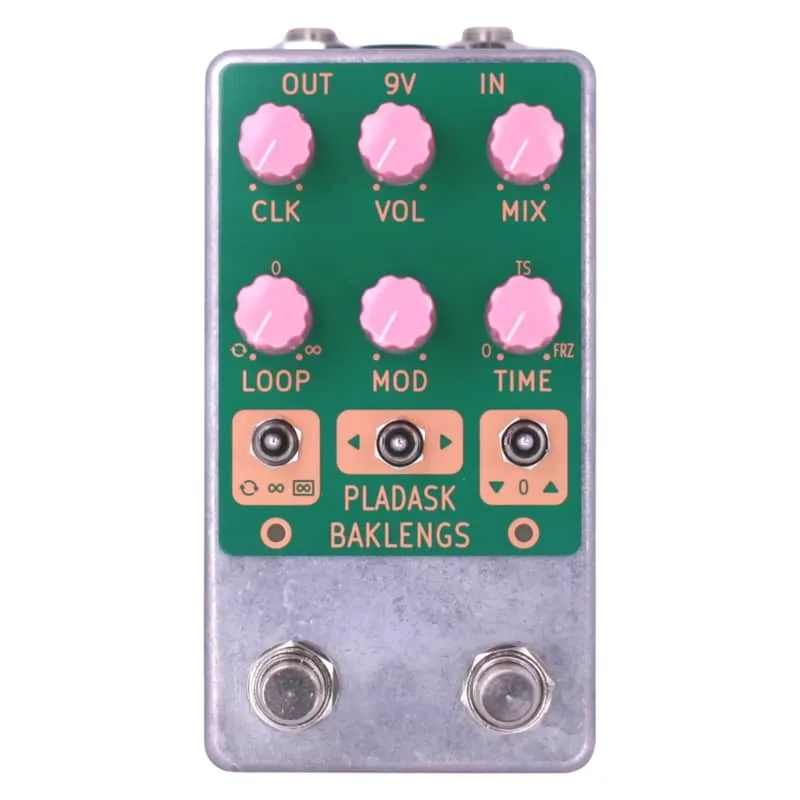
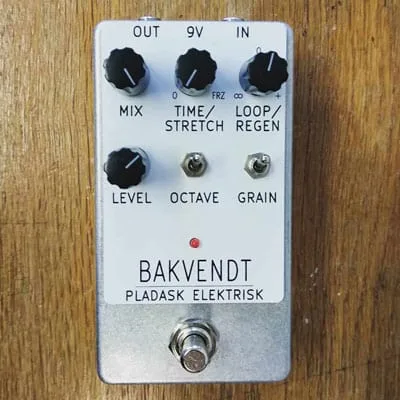
Pladask Elektrisk, a Norwegian builder, used the same granular and time-manipulation ideas across several pedals. The Baklengs is a granular synth glitch delay, and the Bakvendt is a reverse granular pedal. The ReFORM gathered related algorithms, including delay and reverb alongside the granular programs, into one programmable unit in the spirit of multi-effects pedals1.
Pladask Elektrisk states that the FORM, FORM2 and ReFORM pedals and the associated workshop "has been discontinued," and the company does not sell them2.
Questions
Is the Pladask Elektrisk ReFORM still being made?
No. Pladask Elektrisk states that the FORM, FORM2 and ReFORM pedals and the associated workshop have been discontinued, and the company does not sell them. The pedal was documented in the maker's manual from 2023, and used units are the only way to find one now.
What chip does the ReFORM use?
The ReFORM is built around the Spin Semiconductor FV-1 digital signal processor. According to Spin's documentation, the chip's instruction set includes LOG and EXP instructions for programming expansion and compression routines, plus integrated digital LFOs and ramp generators for chorus, flanger and pitch shift effects.
How many presets does the ReFORM hold?
The ReFORM holds 32 programs in four banks: 24 factory programs plus 8 empty program slots you can fill yourself. Bank 1 and the first five algorithms of bank 2 cover time stretch, freeze, sample playback and related effects, while the remaining 11 programs are granular synthesizers.
Does the ReFORM have trail bypass?
Yes. The bypass switch uses relay-based true bypass, and the pedal also offers a trail bypass option aimed at the ambient and reverb algorithms. You activate trails by pushing the PROGRAM knob. In trail bypass the VOLUME knob stays active and MIX sets the wet signal volume.
Can I use an expression pedal with the ReFORM?
Yes. The EXP/CV socket on the back panel accepts an external expression pedal or a control voltage source between 0 and 3.3V. It automatically overrides one of the three programmable knobs, chosen with the EXP/CV toggle. The analog knobs cannot be controlled by EXP/CV or the switch.
What power supply does the ReFORM need?
The ReFORM runs on 9VDC with center negative polarity, the same standard used by Boss, Ibanez and 1Spot power supplies, and draws 90 mA. Check that your supply can deliver that current on the output you use.
Sources (3)
- ReFORM_manual_ENG.pdf, Pladask Elektrisk, 2023
- F.A.Q. | PLADASK ELEKTRISK, Pladask Elektrisk, 2019-02-22
- Taxi '23, Jeds Peds (jedspeds.co.uk)