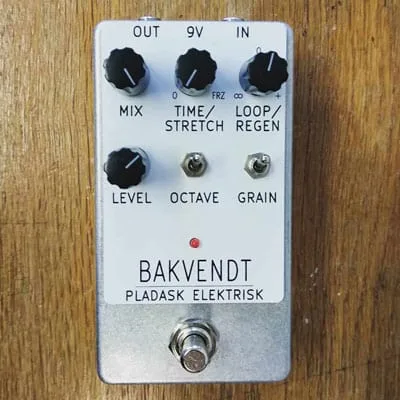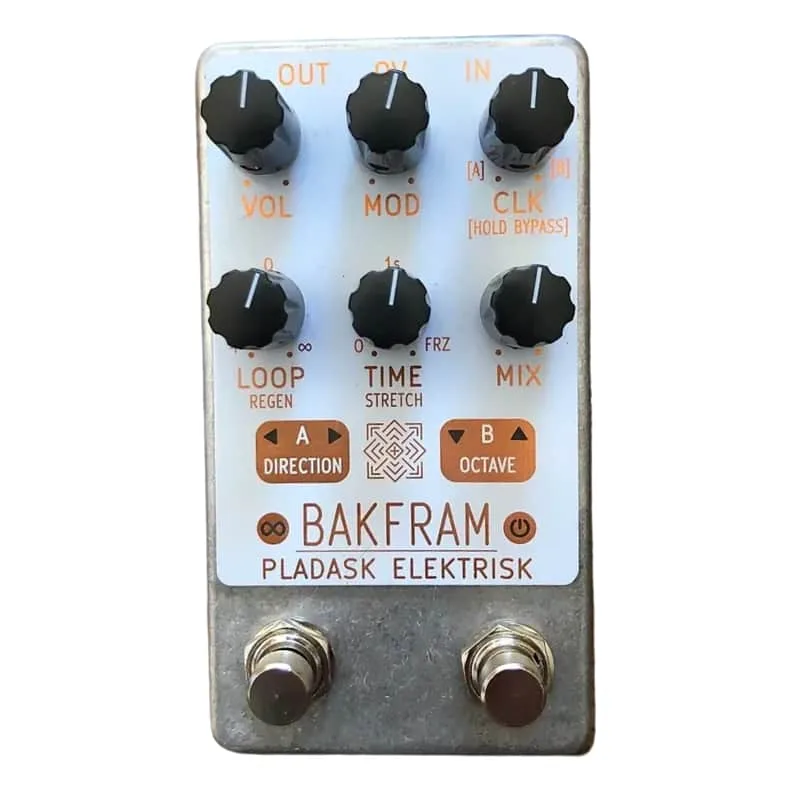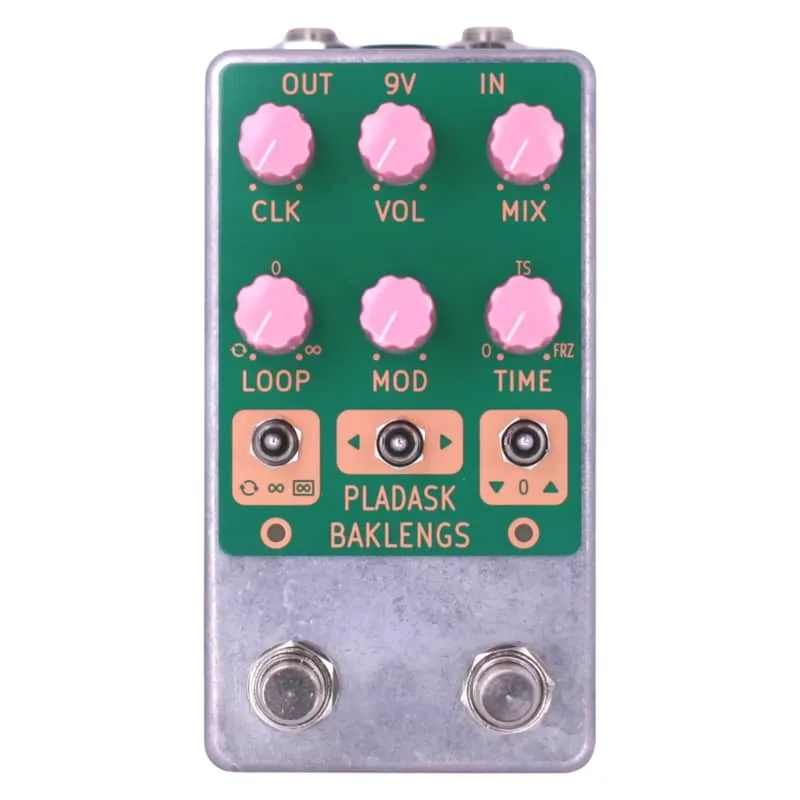


The Pladask Elektrisk BAKLENGS is a granular synthesizer pedal: instead of a conventional delay that repeats what you played, it chops your signal into tiny grains of audio and reassembles those grains into delays, time-stretches, shuffles, freezes and pitch shifts. The maker describes it in the manual as a box that "can delay stuff, timestretch stuff, shuffle stuff, freeze stuff, pitch stuff upwards, pitch stuff downwards, fold back on itself through feedback"1. It is the final entry in what the manual calls the backwards trilogy, preceded by the BAKVENDT and BAKFRAM pedals1.
Delicious Audio's Christopher Scapelliti characterized it as "a 2nd generation granular pedal with greater dynamic control through footswitch options," including delay, time-stretch, a pitch transposer, modulation, forward-reverse modes and a granular looper, with a configurable footswitch that delivers two momentary effects2. Pedal of the Day, which reviewed it in October 2021, called it "a glorious noise machine for those who thrive on experimentation, not a delay that adds a little color"3.
What the BAKLENGS does: granular delay, stretch and freeze
Granular synthesis works by capturing short grains of your audio and playing them back at rates and in orders of the pedal's choosing. On the BAKLENGS that translates into a set of behaviors a normal delay cannot do. The manual lists its capabilities as delaying, time-stretching, shuffling, freezing, pitching up and down, and folding back on itself through feedback1. Time-stretch holds a moment of your playing and drags it out; freeze holds a grain in place as a sustained pad; shuffle reorders grains so repeats come back scrambled.
The mid toggle, labeled DIR, selects between three directions: reverse, shuffling and forward granular delay/stretch1. One point the manual is careful to make: the reverse mode is not a true reverse delay. It is an effect where the grains of audio are arranged in reverse, so you get a granular, chopped-up backwards character rather than a clean tape-style reverse of your phrase1. Adjusting this toggle resets the memory buffer, so switching direction clears what is stored1.
Pedal of the Day summed up the pedal's range as "modulation, looping, robots, outer space and more trapped inside," and placed it among the best granular synth glitch delay pedals they had covered3.
The controls: VOL, MIX, MOD, TIME, CLK and LOOP
The six knobs each control one part of the granular engine, and the manual explains them precisely.
| Control | What it does |
|---|---|
| VOL | Master volume. Unity gain is around noon; max gain is +16dB. |
| MIX | Analog dry/wet mixer. |
| MOD | Random frequency modulation depth, applied only to the wet signal. |
| TIME | Delay time control. |
| CLK | Digital signal processor system clock frequency, approximately 10kHz to 50kHz. |
| LOOP | Decay parameter (see below). |
The CLK knob is the deep one. It sets the sampling rate, grain size, modulation speed and delay buffer length all at once, from roughly 10kHz to 50kHz. The maximum buffer length varies from approximately 2700 milliseconds counter-clockwise down to 550 milliseconds clockwise1. Turning CLK therefore changes the whole character of the effect, not just one parameter.
LOOP is a decay parameter with three zones. At noon there is no regeneration. Turning clockwise from noon adds non-destructive looping feedback, and at maximum the audio repeats indefinitely while still allowing new audio to be written into memory. Turning counter-clockwise from noon adds destructive direct feedback1. One detail worth knowing: with looping feedback, the modulation and octave effects are not regenerated, so each repeat cycle stays at the same modulation depth and pitch rather than compounding1.
Two footswitches and two toggles shape how you interact with all of this1:
- Left footswitch: overrides the LOOP parameter according to the left toggle. Holding it down for more than 500 milliseconds only changes the status momentarily1.
- Right footswitch: relay-based true bypass. Holding it for more than 500 milliseconds also works momentarily1.
- Left toggle (LOOP): selects max direct feedback (left) or max looping feedback (middle and right). For looping feedback you can also choose whether new audio is written to memory; the "boxed" infinity symbol mutes incoming audio1.
- Mid toggle (DIR): selects reverse, shuffling or forward granular delay/stretch, and resets the memory buffer when changed1.
Power and connections
The BAKLENGS runs on a 9V DC center-negative supply with a standard 2.1mm plug, drawing 150mA4. There is no battery operation, per the manual1.
No battery compartment and a 150mA draw mean the BAKLENGS needs a dedicated 9V output on a pedalboard power supply. It is not a candidate for a battery, and its draw is high enough that sharing a low-current daisy chain output with several other digital pedals can be a problem.
Input impedance is 1MΩ and output impedance is under 1kΩ, standard figures that let it sit anywhere in a chain without loading passive pickups1.
Versions and the backwards trilogy
Pladask Elektrisk frames BAKLENGS as the final entry in the backwards trilogy, preceded by BAKVENDT and BAKFRAM1. Pedal of the Day called it "the third pedal in an odd trilogy of effects, taking after its brothers Bakvendt and Bakfram"3. Compared with BAKVENDT, the earlier reverse granular pedal, BAKLENGS is the more complete second-generation design: delay, time-stretch, pitch transposition, modulation, forward and reverse modes, a granular looper, and a configurable footswitch giving two momentary effects2.
The current pedal has also received a small revision. The modulation function now uses the same method as the maker's DRADD, with a slightly different voicing that adds little to no noise to the signal4.
Availability
As of 29 September 2026 the BAKLENGS is in production, listed by the maker at a price of 275.00 USD4.
What reviewers said
Pedal of the Day, which had previously demoed Pladask Elektrisk's Tåken, Fabrikat and Draume pedals, reviewed the BAKLENGS in October 2021 with a demo video covering its controls3. Their verdict:
"this glorious noise machine has modulation, looping, robots, outer space and more trapped inside"
They called it "one of the best granular synth glitch delay pedals yet" and "an absolute dream for those who thrive on experimentation"3. Delicious Audio included it in its roundup of glitch, stutter and granular pedals, highlighting the second-generation footswitch control2.
Videos
Ponderer Sounds
Ambient Endeavors
Nick Rees
Questions
Is the Pladask BAKLENGS true bypass?
Yes. The BAKLENGS uses relay-based true bypass, switched by the right footswitch. Holding that switch down for more than 500 milliseconds only changes the bypass status momentarily, so you can dip into the effect and back without latching it on.
Can the BAKLENGS run on a battery?
No. The manual states plainly that there is no battery operation. The pedal runs on a 9V DC center-negative supply with a standard 2.1mm plug, drawing 150mA, so it needs a proper pedalboard power supply rather than a battery or a low-current daisy chain.
Is the BAKLENGS reverse mode a true reverse delay?
No. The manual is explicit that the reverse mode is not a true reverse delay but an effect where the grains of audio are arranged in reverse. Instead of playing your whole phrase backwards, it chops the signal into grains and reorders those grains in reverse, which gives a related but distinct character.
How does BAKLENGS differ from BAKVENDT?
BAKVENDT came first as Pladask Elektrisk's reverse granular pedal, while BAKLENGS is the final entry in the backwards trilogy that also includes BAKFRAM. BAKLENGS is a second-generation granular pedal with delay, time-stretch, pitch transposition, modulation, forward and reverse modes and a granular looper, plus a configurable footswitch for two momentary effects.
Sources (4)
- BAKLENGS_Manual.pdf, Pladask Elektrisk, 2023
- The Best Glitch, Stutter And Granular Pedals In 2024, Delicious Audio, 2024-05-27
- Pladask Elektrisk Baklengs Granular Synth Glitch Delay, Pedal of the Day, 2021-10-10
- BAKLENGS, Pladask Elektrisk, 2021-08-25