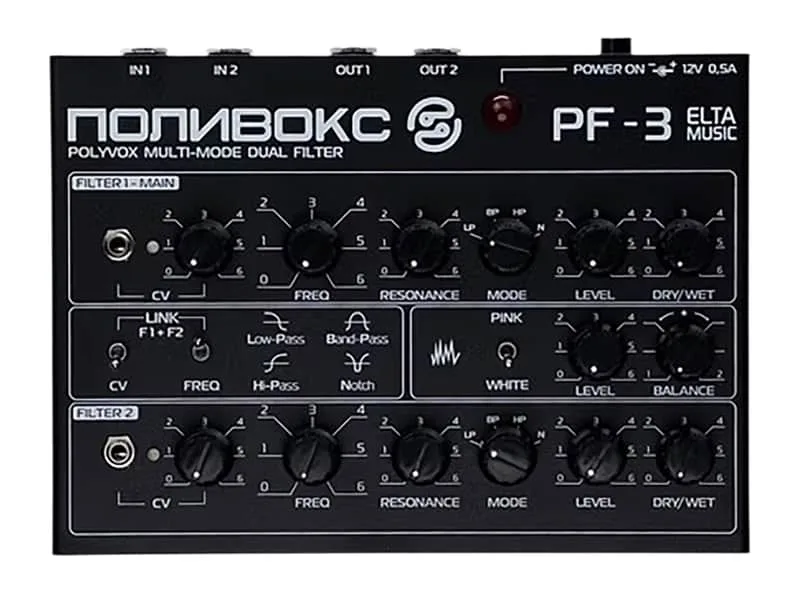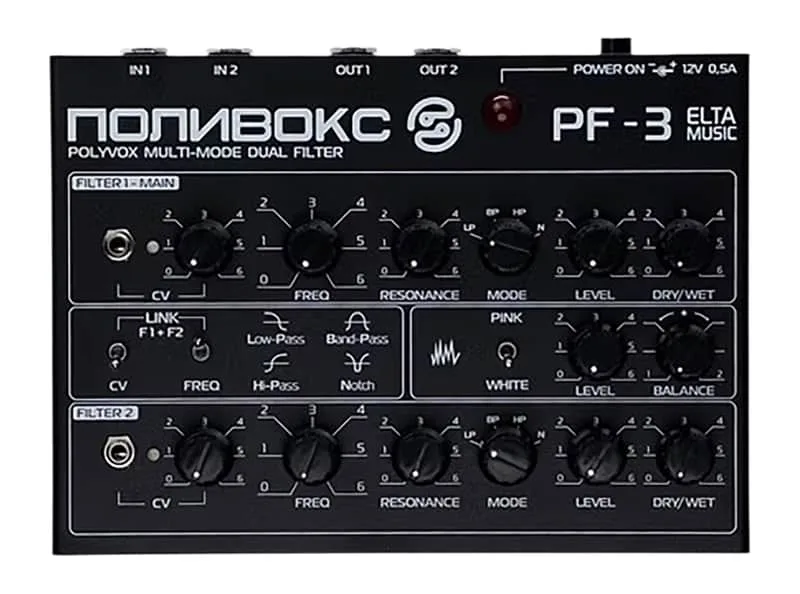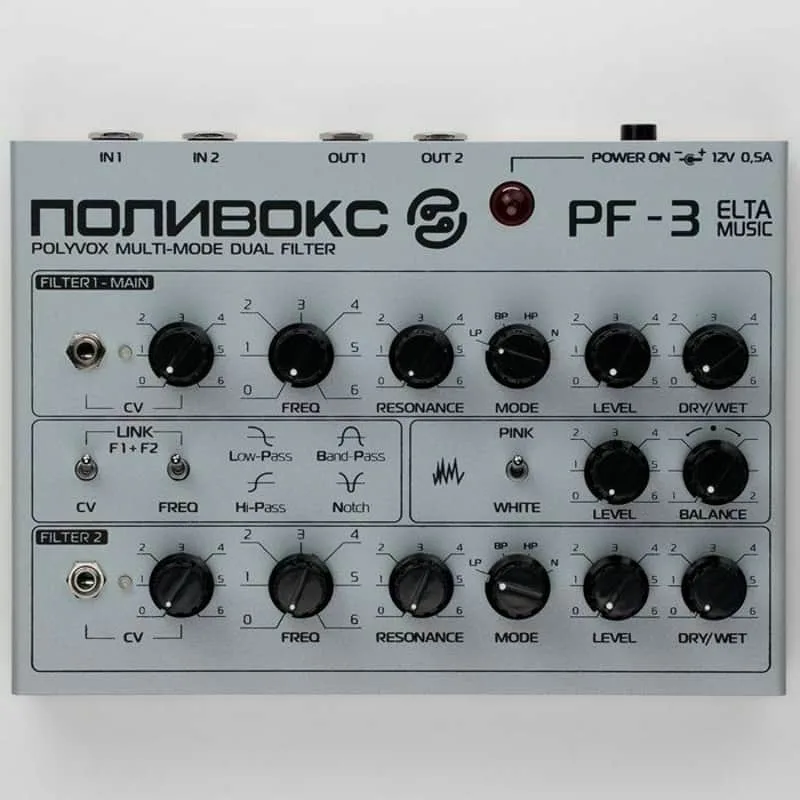


A double-stereo filter on the Soviet Polivoks chip
The PF3's sound comes from the Soviet filter chip used in the original Polivoks synthesizer. Elta Music notes that the UD1208 chips used in the filter "are very sensitive and are never the same," which means two units will not be mathematically identical. The maker frames this as a feature rather than a flaw: "Which is an advantage when using the unit in stereo"2. In practice, each unit has its own slight character, and the left and right channels of a single unit can differ a little too.
Because it is a double-stereo design, you get two full filter paths. As Robin Vincent put it on Gearnews: "It's in stereo, which essentially means you get two full filter paths which you can use totally independently or linked"3. That opens up options a single mono filter pedal cannot offer: running two different settings on a stereo source, filtering two instruments at once, or linking both channels for matched stereo sweeps.
The current version of the unit is the Elta Music Polivoks PF3 Dual Filter MK2, which shares the same double-stereo design, chip, modes and specifications4. The earlier ELTA Music POLIVOKS PF-3 is the version Gearnews covered at launch3.
The controls
Each filter offers four selectable modes: lowpass, bandpass, hi-pass and notch. Gearnews notes these "are selectable for each channel rather than having individual outputs for every mode," so you pick one mode per filter path rather than patching from separate outputs3.
| Control | What it does |
|---|---|
| FILTER modes | Lowpass, Bandpass, Hi-pass, Notch, selectable per channel1 |
| SOFT/HARD | Cutoff control1 |
| FILTER 1 / FILTER 2 | CV controls for each filter1 |
| NOISE generator | Pink, white and channel balancing1 |
| LINK | Switches to control two filters and CV at the same time with one cutoff knob1 |
The LINK switches are the key to stereo operation: with them engaged, a single cutoff knob sweeps both filters and their CV settings together, so the two channels track as a pair. With them off, FILTER 1 and FILTER 2 are set independently1.
The cutoff can also be controlled via CV, with an attenuator for the incoming control voltage3. The modulation CV input accepts -5 to +5 V or 0 to +10 V, which covers the ranges put out by common modular and CV sources1.
Series connection and the noise generator
Running the two 12dB filters in series turns the unit into a 24dB filter, doubling the cutoff slope for a steeper, more aggressive character than either filter alone1. That gives the PF3 two distinct personalities: gentle 12dB sweeps with the filters independent or linked, or a 24dB wall with them chained.
A noise generator sits on board pre-filter and can be used separately as a source of white and pink noise1. As Gearnews described it: "In the middle is a noise generator with pink or white noise that you can mix into the signal and balance between the two" channels3. For a guitarist, that means anything from subtle texture behind a filtered riff to full noise-sweep effects, with the filters shaping the noise itself.
Inputs, power and size
The modulation CV input accepts -5 to +5 V or 0 to +10 V, and the input audio signal level is rated at a maximum of 1.5 V1.
The PF3 is a mains-powered desktop unit rather than a pedalboard pedal. It runs on a universal mains adapter rated 100 to 220V input with a 12V 1A output, so it needs its own adapter and a mains outlet rather than a spot on a standard daisy chain1.
Physically it measures 175 x 135 x 50 mm and is available in black, white or gray finishes1. Those dimensions place it alongside desktop synths and effects rather than on a pedalboard, though players do mount units of this size on larger boards.
Videos
BoBeats
ELTA music
Starsky Carr
Questions
What filter modes does the Polivoks PF3 have?
Each of the two filters offers four selectable modes: lowpass, bandpass, hi-pass and notch. The modes are selected per channel rather than having individual outputs for every mode, so you choose one mode at a time for each filter path.
Can the PF3 run its two filters in series?
Yes. Connecting the two 12dB filters in series turns the unit into a 24dB filter, giving a steeper cutoff slope than either filter alone. Run unlinked, the two filters work as two independent paths or as a stereo pair.
Can the PF3 be used as a noise generator?
Yes. A noise generator sits on board pre-filter and can be used separately as a source of white and pink noise. It can be mixed into the signal and balanced between the two channels, with controls for pink, white and channel balancing.
What power supply does the Polivoks PF3 use?
It runs on a universal mains adapter rated 100 to 220V input with a 12V 1A output. This is a mains-powered desktop unit rather than a battery or standard 9V pedalboard pedal, so it needs its own adapter and mains outlet.
Does the PF3 accept CV modulation?
Yes. There is a modulation CV input accepting -5 to +5 V or 0 to +10 V, and the cutoff can be controlled via CV with an attenuator. FILTER 1 and FILTER 2 each have their own CV controls, and LINK switches let one knob control both filters and CV at once.
How much does the Polivoks PF3 weigh?
The filter itself weighs 0.7 kg, and the packed weight is 1 kg. Its dimensions are 175 x 135 x 50 mm, which puts it in desktop unit territory rather than the footprint of a typical stompbox.
Sources (4)
- PF3 | eltamusic, eltamusic
- PF3 mk.2, eltamusic
- ELTA Music reveals POLIVOKS PF-3 stereo filter in a box, gearnews.com, 2022-08-17
- POLIVOKS PF3 Dual Filter MK2, eltamusic.com