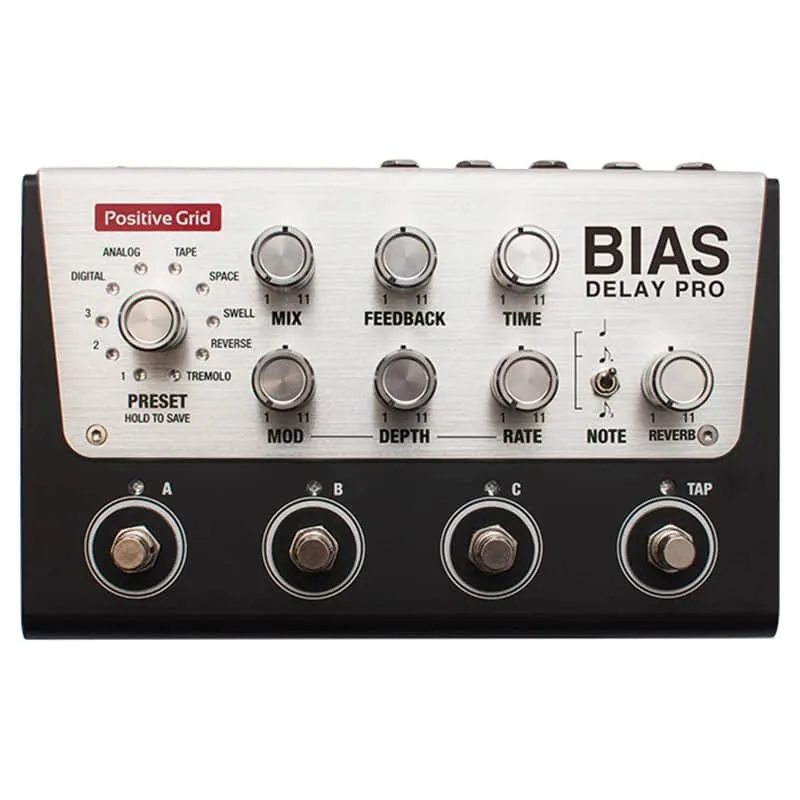


The Positive Grid BIAS Delay is a delay and reverb pedal announced in March 2017 by Positive Grid, the maker of the BIAS Amp and BIAS FX amp processors1. MusicRadar described it at launch as "the world's first cross-platform delay pedal," a hardware unit that integrates with desktop and iPad software2. It was priced at $349 and scheduled to reach stores worldwide in Spring 20173.
What sets it apart from a conventional delay stompbox is the hybrid approach. The pedal works standalone on a board, but it also connects to the BIAS Pedal software so players can design delay and reverb sounds on a computer or iPad, then load them back onto the hardware. Gearnews described it as a follow-on from the company's hybrid of hardware and software, as used in the BIAS Distortion pedal and the BIAS Head amps4.
Delay and reverb modes with two banks of ten presets
The BIAS Delay covers a wide range of vintage and contemporary time-based effects. Positive Grid's announcement lists eight delay types plus reverb1:
| Mode | What it is |
|---|---|
| Digital | Clean, modern digital delay |
| Analog | Darker, vintage-style analog delay character |
| Tape | Tape echo character |
| Space | Spacious ambient delay |
| Reverse | Reversed-signal delay |
| Ping Pong | Delay bouncing between left and right outputs |
| Swell | Swelling volume effect |
| Tremolo | Tremolo delay |
Presets live in two banks of ten each on the hardware pedal, and players can design sounds in the software and transfer them back into those banks1. Three favorite presets can each be assigned to one of the pedal's built-in footswitches for instant recall1. The same two-bank, twenty-preset structure appeared earlier on the BIAS Distortion, which stored up to 20 presets via an A/B bank system5, and later on the BIAS Modulation567.
Footswitches, tap tempo and the tap time switch
Tap tempo gets its own footswitch, so guitarists can enter bpm delay times directly with their feet12. A three-way tap time switch adjusts between quarter, dotted-eighth and eighth-note triplet tap times, which sets the subdivision the tapped tempo produces2.
Positive Grid also emphasized build quality in the announcement, describing a rugged, all-metal chassis with what it called "bombproof knobs, switches and jacks"1.
Power, USB, MIDI and stereo connections
The rear panel carries a 9V DC power-input jack, and the Micro USB port can power the pedal as well1. That USB port is also the link to the BIAS Pedal desktop software and iOS app, used for deep customization, offline preset storage, remote control and access to ToneCloud, Positive Grid's preset-sharing platform16.
For control beyond the footswitches:
- An Expression Pedal input on a ¼" TRS jack provides real-time control of any parameter1.
- Separate MIDI In and Thru connectors let MIDI Program Change messages switch presets and MIDI CC messages adjust key parameter values1.
- The pedal syncs with other BIAS pedals using MIDI Clock, locking the tempo of all time-based effects across Positive Grid's integrated pedal system1.
The separate ¼" unbalanced (tip-sleeve) instrument input and line output jacks for left and right channels provide mono or wide stereo sound1, which gives the Ping Pong mode somewhere to go.
There is no battery option. Power comes from the 9V DC jack or the Micro USB port1, so players used to battery-powered pedals will need a supply or a USB connection.
Built on the BIAS Distortion and BIAS Head approach
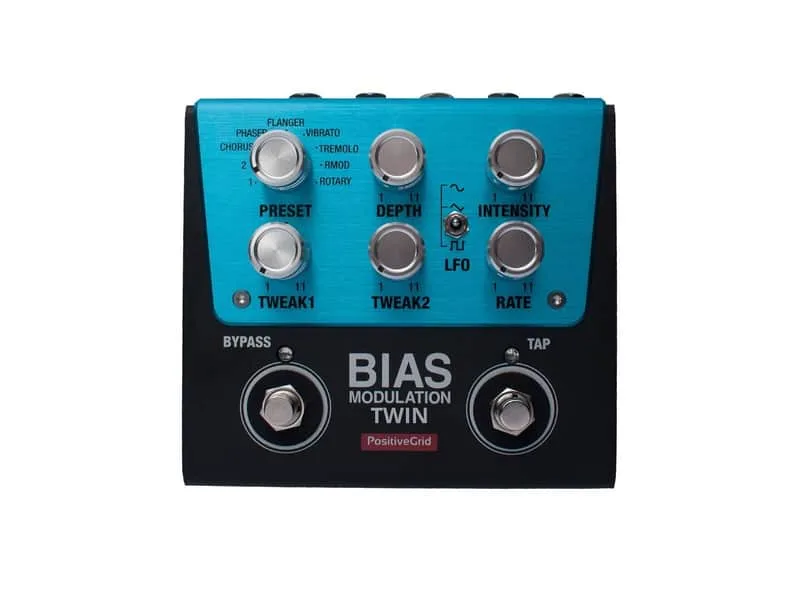
The BIAS Delay was not Positive Grid's first pedal. The BIAS Distortion, announced in 2016, let players design and modify custom distortion pedals in software, from input volume to distortion stages, gain control and pre and post EQ8, then load their collections of distortion, fuzz and overdrive models onto the hardware8. It carried four footswitches, rear-panel jacks for input, output and expression pedal, MIDI in/out, and USB or 9V power supply operation85. The BIAS Delay applies the same hardware-plus-software idea to time-based effects, and the BIAS Modulation that followed at Musikmesse 2017 completed the family, slotting into the existing BIAS pedal format with what Gearnews called "strong echoes of previous releases Distortion and Delay"9.
What reviewers said
Gearnews reviewed the BIAS Delay around its announcement and took a measured view of the concept4:
"The Positive Grid Bias Delay is an interesting concept, I personally haven’t seen or heard anything yet that would make me part with my money for one."4
The same reviewer found it flexible but a tad bland overall, at an RRP of $3494. It is a verdict worth weighing against the pedal's flexibility: the reviewer's reservation was about the sound and value as much as the feature set.
Videos
Positive Grid
Positive Grid
Guitar Bonedo
Questions
Does the Positive Grid BIAS Delay run on a battery?
No battery operation is part of its design. The pedal takes its power from a 9V DC power-input jack, and the Micro USB port can also power the pedal. Players building a pedalboard around it will want a 9V supply or a USB power connection.
Can the BIAS Delay be powered over USB?
Yes. Alongside the 9V DC power-input jack, the Micro USB port can power the pedal. The same port also connects the pedal to a computer for editing and preset management through the BIAS Pedal software.
Does the BIAS Delay work in stereo?
Yes. It has separate quarter-inch unbalanced tip-sleeve instrument input and line output jacks for left and right channels, which provide mono or wide stereo sound. Ping Pong and other stereo delay types make use of the two outputs.
Can I control the BIAS Delay with an expression pedal?
Yes. An Expression Pedal input on a quarter-inch TRS jack provides real-time control of any parameter, so a player can sweep delay time, mix or any other setting while playing.
How do I sync the BIAS Delay with other BIAS pedals?
The BIAS Delay syncs with other BIAS pedals using MIDI Clock, locking the tempo of all time-based effects across Positive Grid's integrated pedal system. It also has separate MIDI In and Thru connectors, with Program Change messages switching presets and MIDI CC messages adjusting parameter values.
Does the BIAS Delay have tap tempo?
Yes. A dedicated Tap Tempo footswitch lets guitarists enter bpm delay times directly, and a three-way tap time switch adjusts between quarter, dotted-eighth and eighth-note triplet subdivisions.
Sources (9)
- Positive Grid Announces the BIAS Delay Pedal, Guitar World, 2017-03-28
- Positive Grid unveils BIAS Delay, "the world's first cross-platform delay pedal", MusicRadar, 2017-03-16
- Positive Grid Announces the BIAS Delay Pedal, Premier Guitar, 2017-03-27
- Positive Brid BIAS Delay pedal: Echoes of the same?, gearnews.com, 2017-03-17
- Positive Grid launches BIAS Distortion, the world's first tone match distortion pedal, MusicRadar, 2016-10-04
- Positive Grid Unveils BIAS Modulation, Premier Guitar, 2017-04-06
- Musikmesse 2017: Positive Grid unveils the BIAS Modulation Pedal, MusicRadar, 2017-04-05
- Positive Grid BIAS Distortion Pedal: Virtually every distortion on tap?, gearnews.com, 2016-10-04
- Musikmesse 2017: Positive Grid BIAS Modulation guitar pedal, gearnews.com, 2017-04-05