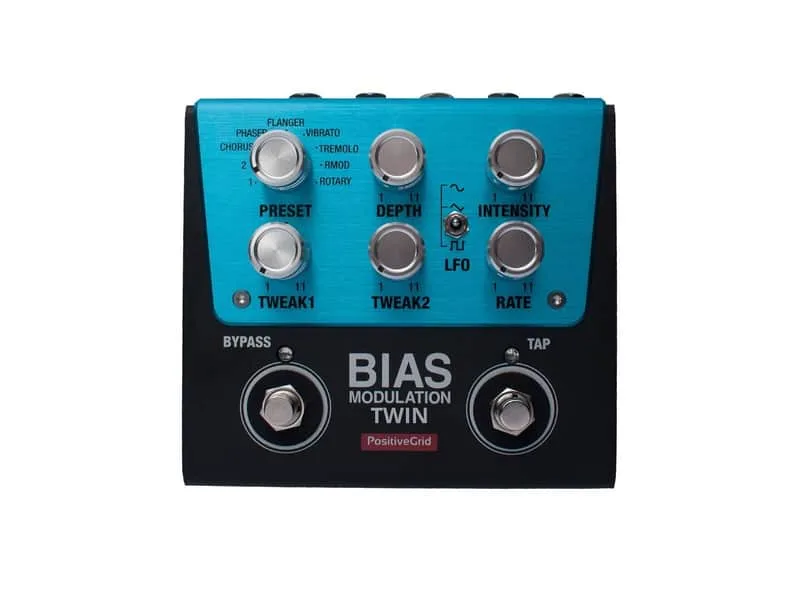


The Positive Grid BIAS Modulation is a modulation pedal that packs nine effect types into one box: Flanger, Chorus, Phaser, Tremolo, Vibrato, Rotary, RingMod, AutoSwell and Pan1. It covers both time-based modulation (chorus, flanger, phaser and the like) and amplitude modulation (tremolo, pan, auto-swell)12. It was announced with a list price of $349 and a release set for the second quarter of 201723.
What set it apart from a typical single-effect pedal was its software link. It works both as a standalone pedal and as part of an integrated desktop and mobile system: you start with the nine onboard factory presets, then use the included BIAS Pedal software to design your own effects and transfer them back into the pedal14.
Nine modulation effects in one pedal
The nine built-in effects span the two families of modulation. Time- and filter-based effects (Chorus, Flanger, Phaser, Vibrato, Rotary) shift or delay the signal to create movement in the tone; amplitude-based effects (Tremolo, Pan, RingMod, Autoswell) raise and lower the volume over time. MusicRadar's Musikmesse coverage highlighted that you can mix and match one of each type, a time/filter-based effect and an amplitude-based effect, to create sounds that a single-effect pedal cannot3.
For a player, that means one box can cover the chorus, flanger, phaser, tremolo and vibrato duties that would otherwise take five pedals, with the option of combinations such as tremolo on top of a rotary sound. The pedal's product listing also notes that both time-based and amplitude modulation can be mixed for hybrid effects4.
The controls and LFO shapes
Every modulation effect is driven by an LFO, a low-frequency oscillator whose shape determines how the effect moves. The BIAS Modulation gives you direct control over that movement13:
| Control | What it does |
|---|---|
| Intensity | Sets how strong the modulation effect is1 |
| Depth | Sets how wide the modulation swings1 |
| Rate | Sets the speed of the modulation1 |
| (Output) Level | Sets the output volume1 |
| Shift, Wobble, Offset | Three types of LFO modification1 |
| LFO waveshape switch | Selects the LFO's wave shape1 |
| Tap Tempo switch | Sets tempo by foot, over a 40 to 400 bpm range1 |
The waveshape itself is a three-way toggle. Positive Grid's announcement describes the shapes as round (sine), sharp (sawtooth) or pulse (square)1; gearnews' report from Musikmesse described the same switch as covering Sine, Triangle and Square shapes2. The two reports disagree on the middle position, so treat the exact second shape as uncertain.
The pedal carries five control knobs alongside the three-way LFO toggle4, and three footswitches can each be assigned a favorite preset for instant recall1. Tap tempo over a 40 to 400 bpm range means you can lock a tremolo or pan speed to a song's tempo exactly rather than approximating it by ear13.
Stereo, MIDI and expression connections
The BIAS Modulation was built with performing and recording guitarists in mind, and its connections reflect that1.
- Stereo I/O: Separate 1/4" unbalanced (tip-sleeve) high-impedance instrument inputs and line-level outputs for left and right channels, providing mono or wide stereo sound13.
- Expression pedal: A 1/4" TRS expression pedal input gives real-time control of any parameter1.
- MIDI In and Thru: Separate MIDI connectors1.
- MIDI Clock sync: Locks the tempo of all time-based effects across connected BIAS pedals1.
- MIDI Program Change: Switches presets remotely13.
- MIDI CC: Continuous controller messages adjust key parameter values in real time13.
The MIDI Clock feature is the one that matters most if you run other BIAS pedals: it locks the tempo of every time-based effect in the chain together, so a delay and a tremolo on the same board can pulse in time from one clock source1. The pedal also fits into the wider MIDI pedals approach to board control.
Presets and the BIAS Pedal software
The pedal ships with nine onboard factory presets to start from4. Positive Grid's announcement describes the storage two ways: three preset banks that store up to ten presets each, and two banks of ten presets each into which custom designs can be transferred, with three favorite presets assignable to separate footswitches for instant recall1. MusicRadar reported the same arrangement: two banks of ten presets, with three presets assignable to separate footswitches3.
The design workflow runs through the included BIAS Pedal software: tweak or build an effect on desktop or mobile, then transfer it back into the pedal's banks14. This is the same approach Positive Grid used across its BIAS hardware line, and gearnews noted that the Modulation uses similar technology to the BIAS amp head and the two earlier pedals in the range2.
The third BIAS hardware pedal
Positive Grid announced the BIAS Modulation as the third product in its BIAS hardware pedal line, following the BIAS Distortion and BIAS Delay13. Gearnews' Angus Baigent observed that it "slots into the existing BIAS pedal format, with strong echoes of previous releases Distortion and Delay"2.
The build follows the premium positioning of the line: a rugged all-metal chassis, knobs and switches described by Positive Grid as bombproof, and sturdy I/O jacks1. MusicRadar summed it up as the strongest possible build quality, with a rugged, all-metal chassis3.
What the press said
Coverage at launch was largely descriptive, since the pedal was announced rather than shipped. Gearnews' Angus Baigent offered one of the few verdicts, and a measured one12:
"But at this price, a pedal should really inspire you when you explore it. This is one to check out and try at a store to make sure it pushes your buttons before parting with your cash."
He estimated the European price at probably around EUR 399, on top of the $349 US retail price21. MusicRadar and Premier Guitar both reported the $349 price and the Q2 2017 release window without passing judgment on the sound13.
Videos
Positive Grid
Guitar Bonedo
Sound On Sound magazine
Questions
Can you design custom effects for the BIAS Modulation with software?
Yes. The pedal ships with nine onboard factory presets, and the included BIAS Pedal software lets you design your own effects. Custom designs can then be transferred back into the pedal's preset banks, and three favorites can be assigned to separate footswitches for instant recall.
Does the Positive Grid BIAS Modulation sync to MIDI clock?
Yes. MIDI Clock sync locks the tempo of time-based effects across connected BIAS pedals. MIDI Program Change messages switch presets, and MIDI CC (continuous controller) messages adjust key parameter values. The pedal has separate MIDI In and Thru connectors.
How many presets does the BIAS Modulation hold?
Positive Grid's announcement lists three preset banks storing up to ten presets each, and also describes two banks of ten presets that custom designs can be transferred into. Three favorite presets can be assigned to separate footswitches for instant recall.
What is the tap tempo range on the BIAS Modulation?
The Tap Tempo switch covers a range of 40 to 400 bpm, which sets the rate of the modulation's low-frequency oscillator in time with your music rather than by ear against a knob.
Is the BIAS Modulation pedal stereo?
Yes. It has separate 1/4-inch unbalanced tip-sleeve, high-impedance instrument input jacks and line-level output jacks for left and right channels, providing either mono or wide stereo sound.
Sources (4)
- Positive Grid Unveils BIAS Modulation, Premier Guitar, 2017-04-06
- Musikmesse 2017: Positive Grid BIAS Modulation guitar pedal, gearnews.com, 2017-04-05
- Musikmesse 2017: Positive Grid unveils the BIAS Modulation Pedal, MusicRadar, 2017-04-05
- BIAS Modulation Twin by Positive Grid, RockBoard (PedalPedia), 2026