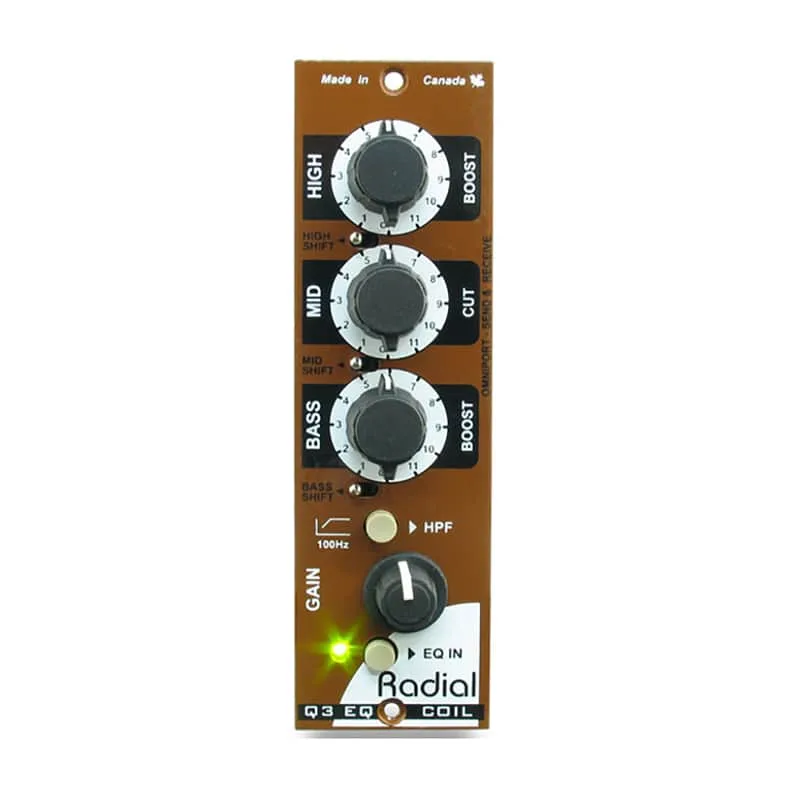


The Radial Q3 is a passive inductor coil EQ, a pedal that shapes tone with coils, capacitors and resistive boost and cut filters rather than the sweepable bands of an active equalizer1. Instead of asking the player to dial in a frequency, it works from preset curves chosen on Grayhill switches, with a high-pass filter for clearing out unwanted low end. Radial frames the design intent plainly: "The Radial Q3 is not about clinical, it is about creatively applying the effect of a coil to add excitement to your music"2.
The controls
The Q3's front panel is built around a small set of switches, each with a defined job:
| Control | What it does |
|---|---|
| Bass Boost | 12-position Grayhill switch with a series of preset curves designed to boost bass and add warmth, body and punch to the audio track1 |
| High Boost | 12-position Grayhill switch with a wide variety of high-frequency preset curves designed to add clarity, shimmer and presence to the voice of the instrument1 |
| Shift | Changes the amplitude of the preset curve to reduce the effect on the signal1 |
| Gain | Adjustable level control providing gain make-up after the audio signal passes through the inductor coil circuit1 |
| On | Lets you compare the original program material with the effect introduced by the passive inductor coil EQ circuit1 |
| High-pass filter | Helps clean up excessive bottom end that can cause resonant feedback on a live stage or clutter up the bottom end of a track when tracking1 |
The two boost switches are the heart of the design. Because the curves are preset rather than swept, the player chooses a voicing and then uses Shift to dial back how hard it acts on the signal, with Gain restoring level lost through the coil circuit1.
The OmniPort
The Q3 carries Radial's OmniPort feature2. On this pedal it is assigned as an effects send and return, using a standard 1/4-inch TRS connector with tip-send and ring-receive1. That means one TRS cable can patch the Q3 into an external effect and back again, which is how players typically route an overdrive, delay or compressor into an EQ's loop.
Specifications
Radial's specification sheet gives the Q3 the following figures2:
| Specification | Value |
|---|---|
| Audio circuit type | Coil/Capacitor/Resistive Boost and Cut Filters |
| Gain | 7dB (maximum output, no filters) |
| Maximum input | +20dBu |
| Input impedance | 12k Ohms, balanced |
| Output impedance | 440 Ohms balanced |
| Frequency response | 20Hz-20KHz +/- 1dB in non EQ positions |
| Dynamic range | 112dB |
| Total harmonic distortion | 0.003% @ -0dBu @ 1kHz |
| Intermodulation distortion | 0.002% (0dBu input) |
| Noise floor | -90dBu filters off (-87dBu filters on) |
| High-pass filter | -3dB @ 150Hz |
| Current draw | 25mA |
| Construction | 14-gauge steel |
| Size (L x W x D) | 9" x 6.25" x 2" (228 x 159 x 51mm) |
| Weight | 1.5lbs (0.7kg) |
| Warranty | Radial 3-year, transferable |
A few of these are worth a player's attention. The 112dB dynamic range and the low distortion figures describe a clean, quiet path through the pedal, and the frequency response is flat to within +/- 1dB across 20Hz to 20kHz when the EQ positions are not engaged2. The high-pass filter is fixed at -3dB at 150Hz2, and the sheet also notes the unit is API and WHOS-Doc compliant2.
Radial specifies the Q3 for use in dry locations only, between 5°C and 40°C2.
Where it sits
As a passive inductor coil design, the Q3 takes a different approach from the graphic and parametric EQs elsewhere in equalization pedals: the tone shapes are fixed curves, and the player's choices are which curve, how much of it, and how much make-up gain to apply1. Radial also makes the related Radial Phaze-Q for players exploring the maker's other tone-shaping pedals.
Videos
Sweetwater
musicianews
Czar
Questions
What is a passive inductor coil EQ?
A passive inductor coil EQ shapes tone using coils, capacitors and resistive boost and cut filters rather than an active, op-amp-driven equalizer. Radial describes the Q3 as being about creatively applying the effect of a coil to add excitement to music, rather than about clinical correction. The circuit works on preset curves selected by switches, with a Shift control to reduce the amplitude of the curve and a Gain control for make-up.
What does the OmniPort on the Radial Q3 do?
On the Q3, the OmniPort is assigned as an effects send and return. It uses a standard 1/4-inch TRS connector with tip-send and ring-receive, so a single TRS cable can route the signal out to an external effect and back into the Q3.
Does the Radial Q3 have a high-pass filter?
Yes. The Q3 includes a high-pass filter set at -3dB at 150Hz. Radial says it helps clean up excessive bottom end that can cause resonant feedback on a live stage or clutter up the bottom end of a track when tracking.
How much current does the Radial Q3 draw?
Radial's specification sheet lists the Q3's current draw at 25mA.
What is the warranty on the Radial Q3?
The Q3 carries Radial's 3-year warranty, which is transferable.
Is the Radial Q3 balanced?
Yes. The Q3 has a balanced input impedance of 12k Ohms and a balanced output impedance of 440 Ohms, according to Radial's specification sheet.
Sources (2)
- Q3 Features, Radial Engineering, 2018-05-10
- Q3 Specifications, Radial Engineering, 2018-05-08