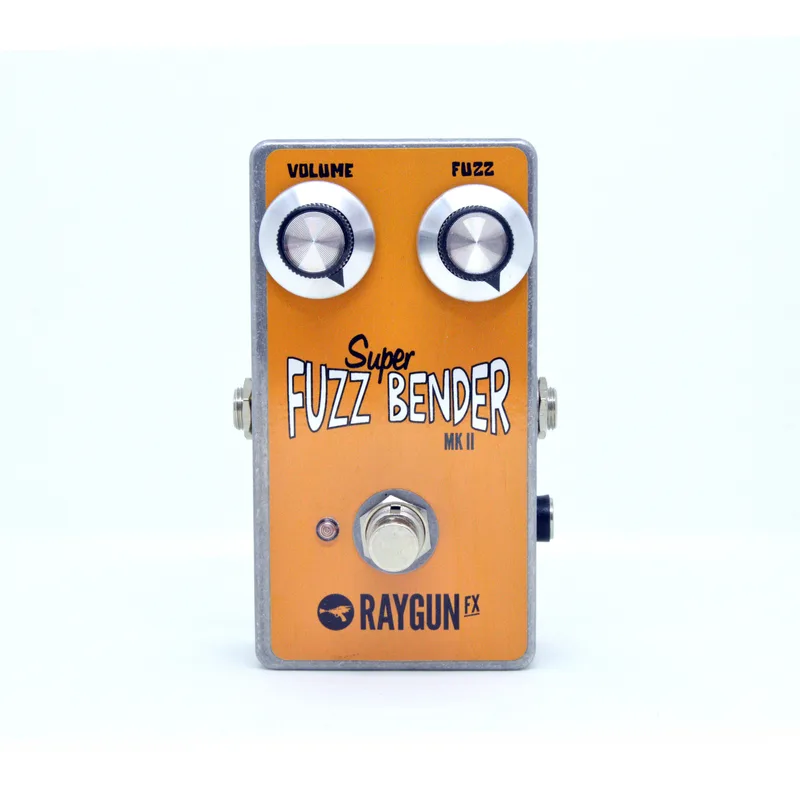


The RayGun FX Super Fuzz Bender MKII is a fuzz pedal for guitar or bass, described by its maker as covering a range from "slight distortion to full-on Fuzz"1. It is an analog pedal built around silicon BC108/BC109 transistors, which places it in the family of fuzz circuits descended from the British Tone Bender pedals of the 1960s, but with silicon rather than the germanium transistors the originals used.
The name points at that lineage. The original Tone Bender MkII was a three transistor fuzz circuit2, and the Super Fuzz Bender MKII follows the same three transistor template with modern silicon devices. RayGun FX also makes a MKIII version of the pedal, an updated take with more fuzz and an added tone control3.
What it is and what it does
RockBoard's PedalPedia lists the Super Fuzz Bender MKII simply as a "Guitar or Bass Fuzz Fx Pedal," with a fuzz range that runs from light breakup to saturated fuzz1. The maker does not publish a control list for the MKII, so the knob layout cannot be described here beyond what the circuit's history suggests: the original Tone Bender MkII carried a dual level and attack control setup, two knobs setting output volume and fuzz intensity4.
The choice of BC108 and BC109 silicon transistors is the pedal's defining spec. Silicon transistors behave differently from germanium, and players comparing silicon and germanium versions of the same basic circuit often hear the silicon take as more aggressive1.
Powering it
The MKII runs on a 9V DC supply with a center negative plug, the common standard for modern pedals1. Its listed current draw is 100mA1, which is worth noting: a simple three transistor fuzz normally draws only a few milliamps, so 100mA suggests the pedal may include additional circuitry such as buffering or indicator circuitry beyond the bare fuzz stage. On a small isolated power supply with limited per output current, that figure is the one to plan around.
Both the MKII and the MKIII are listed at 100mA current draw13. If you run a dense pedalboard on a compact supply, check that the output feeding this pedal can deliver at least that much.
MKII and MKIII: what changed
RayGun FX's MKIII is described as an "updated version of the MK II super Fuzz Bender, more fuzz and added tone control"3. Two changes stand out:
| Super Fuzz Bender MKII | Super Fuzz Bender MKIII | |
|---|---|---|
| Circuit type | Analog1 | Analog3 |
| Transistors | Silicon BC108/BC1091 | Not listed |
| Tone control | No3 | Yes, added3 |
| Fuzz character | Slight distortion to full-on fuzz1 | More fuzz than the MKII3 |
| Power | 9V DC center negative, 100mA1 | 9V DC center negative, 100mA3 |
The added tone control is the meaningful difference for a player. The original Tone Bender MkII had only its level and attack controls4, and it was the later Tone Bender MKIII that introduced a tone control alongside volume and fuzz knobs45. RayGun FX's MKIII follows that historical pattern: the MKII keeps the simpler two knob format, while the MKIII adds the third control. The maker also describes the MKIII as a "Retro Super fuzzy Guitar or Bass Fx Pedal" suited to "Fuzz loving fans of Hendrix, Weezer, Smashing Pumpkins, Dinosaur Jr and Foo Fighters (debut album)"3.
Where the circuit comes from
The Super Fuzz Bender's name traces back to the Tone Bender family, the British fuzz pedals that followed the Maestro Fuzz Tone. The Tone Bender MkII was a three transistor fuzz circuit2, and Premier Guitar's history of the Tone Bender notes that the MkII carried the same dual level and attack control setup as its forebears4. The MkII's run ended when Sola Sound moved on: as Fuzzboxes.org's history puts it, "the demise of the MKII resulted in Sola Sound's invention of the Vox Tone Bender MKIII"6, the version that added a tone control and a different cast metal housing7.
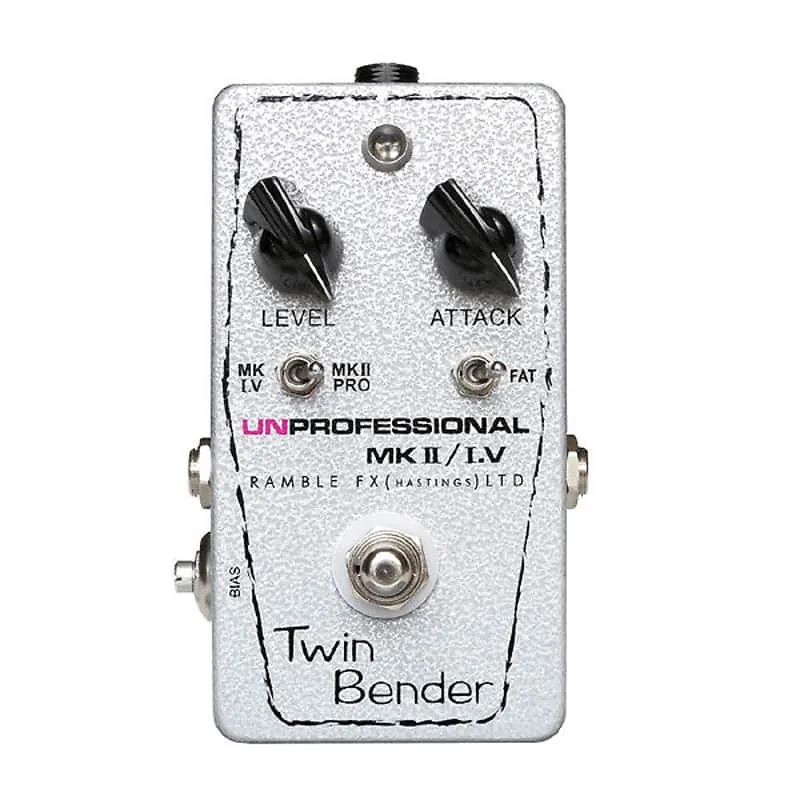
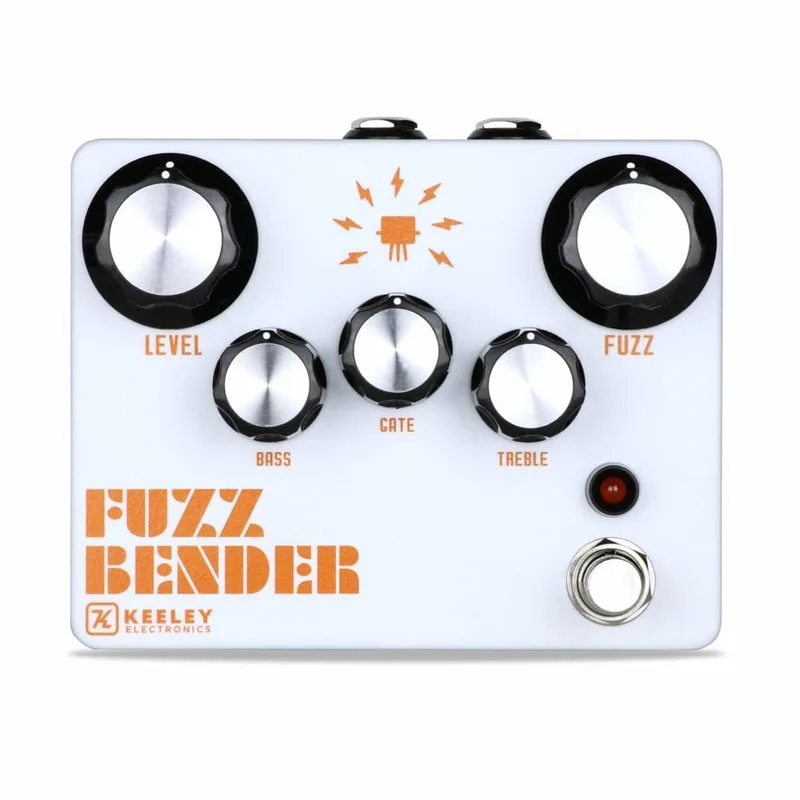
Modern builders approach that lineage in different ways. The Ramble FX Twin Bender Fuzz puts MKII and MK1.5 circuits in one pedal via a toggle switch, with the MKII mode based on three NOS germanium transistors and the MK1.5 mode using only two for less fuzz8. Keeley's Fuzz Bender takes another route, reviewed by Guitar.com as "a sophisticated combination of two modern silicon and one vintage Japanese germanium transistors and an intuitive five-knob" control set9. The Super Fuzz Bender MKII sits apart from both by going all silicon with BC108/BC109 devices1.
For more on the effect category as a whole, see the fuzz pedals page.
Videos
RaygunFX
RaygunFX
RaygunFX
Questions
What transistors does the Raygun FX Super Fuzz Bender MKII use?
The Super Fuzz Bender MKII uses silicon BC108/BC109 transistors, according to RayGun FX's product listing. That sets it apart from most modern Tone Bender recreations, which typically use hand selected NOS germanium transistors to match the vintage circuits.
What power does the Super Fuzz Bender MKII need?
It runs on 9V DC with a center negative plug, the same standard supply as most modern pedals. The maker lists its current draw as 100mA, so it draws more than a typical simple fuzz and is worth checking against a small isolated supply's per-output budget.
Does the MKIII have a tone control that the MKII lacks?
Yes. RayGun FX describes the Super Fuzz Bender MKIII as an updated version of the MKII with more fuzz and an added tone control. The MKII itself has no tone control, which follows the original Tone Bender MkII layout of level and attack controls only.
How much current does the Super Fuzz Bender draw?
RayGun FX lists the current draw as 100mA for both the MKII and the MKIII. That is the figure to use when planning a power supply, since it is higher than the few milliamps a basic three transistor fuzz normally needs.
Is the Super Fuzz Bender MKII analog?
Yes. RayGun FX lists the MKII as an analog circuit, and the MKIII is listed as analog as well. The MKII's fuzz comes from silicon BC108/BC109 transistors rather than digital processing.
Sources (9)
- Super Fuzz Bender MKII by Raygun FX, RockBoard PedalPedia, 2026
- Sola Sound Tone Bender Professional MKII • Fuzzboxes, Fuzzboxes.org, 2021-05-18
- Super Fuzz Bender MKIII by Raygun FX, RockBoard PedalPedia, 2026
- The Mighty Tone Bender Fuzz: A 50-Year Legacy, Premier Guitar, 2018-12-13
- Vox Tone Bender MKIII • Fuzzboxes, Fuzzboxes.org, 2021-05-30
- Vox Tone Bender Professional MKII • Fuzzboxes, Fuzzboxes.org, 2021-05-20
- Stompbox Classics: Tone Bender, Part 2, Premier Guitar, 2009-10-21
- Ramble FX Twin Bender Fuzz, Delicious Audio, 2023-08-31
- Review: Keeley Electronics Fuzz Bender, Guitar.com, 2019-07-09