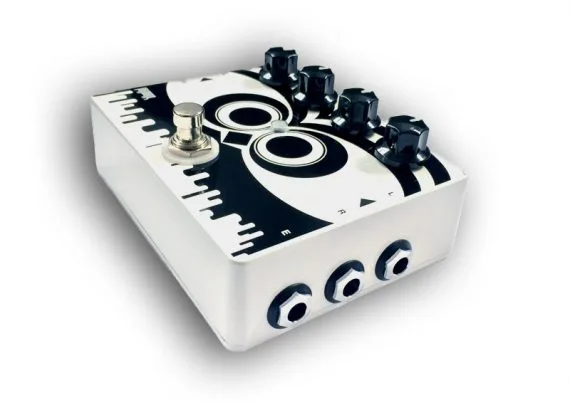


The OWL Pedal is an open source, programmable stage effects pedal made by Rebel Technology, aimed at guitarists, musicians, hackers and programmers1. Instead of being fixed to one circuit, it runs patches: digital effect programs you can write yourself or download from Rebel Technology's online patch library, which the company says holds well over 300 patches, including phasers, flangers, glitchers, loopers, droners, delays and reverbs2. Forty of these patches come pre-loaded, with room to store your own selection on the device1.
The original OWL Pedal has been superseded by the OWL Pedal mkII, a remake Rebel Technology describes as having "more memory, more signal, and less noise, thanks to improved hardware specs and new firmware"2. The mkII carries a list price of € 249.002.
What it does: a programmable, open-source effects pedal
The OWL Pedal is a multi-effects unit in the sense that one box can become many different effects, but it goes further than a preset-switching multi-effects: the effects themselves are programs, and anyone can write new ones. Rebel Technology positions it as Open Source and Open Hardware, published under the Gnu GPL, so the design is meant to be studied, modified and extended1.
Under the hood, the original pedal uses a 168MHz 32 bit ARM Cortex M4 microcontroller with a 24 bit stereo codec, a 48kHz sampling rate, and DSP power Rebel Technology rates at 3500 operations per sample. It carries 192Kb of RAM and 1Mb of flash memory1. The mkII steps this up considerably, with an STM32F439 high performance microcontroller (integrated DSP, FPU and DMA), 8 Megabyte fast SDRAM, 8 Megabyte serial flash memory, and a CS4271 high performance stereo codec2.
The patch library is the practical draw for players who do not program. Rebel Technology describes it as boasting "well over 300 patches, including phasers, flangers, glitchers, loopers, droners, delays, reverb" and more2.
The controls and patch selection
The mkII's firmware handles patch selection with a footswitch, a pushbutton and a knob. The maker's instructions2:
- Select Bypass with the footswitch2.
- Press the pushbutton2.
- Select from any of the stored patches using a knob2.
The LED pushbutton blinks to indicate the selected patch2. The mkII also has a configurable expression pedal / footswitch input, so a second footswitch can take the place of an expression pedal where that suits your board2.
Power and connections
Both versions run on standard 9V DC or USB power. The mkII's 9V DC supply is not included2. Neither version lists a battery option, so this is a powered-pedalboard item.
| Connection | Original OWL Pedal1 | OWL Pedal mkII2 |
|---|---|---|
| Audio inputs | 2 x 1/4 inch | 2 x 1/4 inch |
| Audio outputs | 2 x 1/4 inch | 2 x 1/4 inch |
| Expression | 1 expression pedal input | Configurable expression pedal / footswitch input |
| USB | 1 Micro USB, USB MIDI | Micro USB, USB MIDI, USB audio |
The stereo input and output pairs mean the pedal can sit in a stereo chain, and the expression input opens up real-time control of patch parameters2.
Original OWL Pedal and the mkII
The mkII is a remake rather than a new product line. Rebel Technology frames it this way2:
"OWL Pedal Mark Two is the remake of a classic. Mark Two has more memory, more signal, and less noise, thanks to improved hardware specs."2
Rebel Technology product page2
The company also states that "not only [is] the OWL Pedal back in production, but also that it is now better than ever"2. The mkII lists for € 249.002.
A firmware feature on the mkII turns it into a class compliant 48kHz stereo USB audio interface as well as a stereo effects processor, so you can monitor, record and playback while using it as an effects unit2. The original pedal's USB port carries MIDI but is not listed with audio interface functionality1.
Max Gen and the OWL family
In November 2016, Rebel Technology announced support for running Cycling 74's Max Gen patches on the OWL hardware range, meaning Gen patches run on the pedal itself without a laptop34. The company demonstrated patches written in Max Gen running on the OWL Pedal in May 20174.
The OWL platform extends beyond the pedal. The OWL Modular, a Eurorack module based on the OWL Pedal, uses the same patches while adding CV control and DC-coupled inputs and outputs; Rebel Technology notes it retains "full patch compatibility" with the pedal5. It is no longer manufactured5. For DIY builders, Rebel Technology also offers the OWL Digital Board, "the digital board that powers the OWL Pedal and OWL Modular"6.
Videos
Rebel Technology
Rebel Technology
Rebel Technology
Questions
How do I load patches onto the OWL Pedal?
New patches are loaded over USB. The pedal ships with 40 patches pre-loaded, and you can store your own selection of patches on the device. Rebel Technology also maintains an online patch library with well over 300 ready-made patches, including phasers, flangers, delays, reverbs, loopers and glitch effects, which you can download and load onto the pedal.
Can the OWL Pedal run Max Gen patches?
Yes. In November 2016 Rebel Technology introduced support for running Cycling 74's Max Gen patches on the OWL hardware range, so Gen patches can run on the pedal without a laptop. The company demonstrated patches written in Max Gen running on the OWL Pedal in May 2017, and the official OWL package for Max followed in June 2017.
Can the OWL Pedal work as a USB audio interface?
The OWL Pedal mkII can. A firmware feature turns the mkII into a class compliant 48kHz stereo USB audio interface as well as a stereo effects processor, so you can monitor, record and playback while using it as an effects unit. The original OWL Pedal has a Micro USB port with USB MIDI but is not listed with USB audio.
Are OWL Modular patches compatible with the OWL Pedal?
Yes. The OWL Modular is based on the OWL Pedal and retains full patch compatibility, using the same patches while adding CV control and DC-coupled inputs and outputs for Eurorack use. A patch written for one works on the other. The OWL Modular is no longer manufactured.
Where are the OWL Pedal schematics and source code?
The pedal is Open Source and Open Hardware, published under the Gnu GPL. For the original OWL Pedal, code and schematics are available on GitHub in the pingdynasty/OwlWare repository. For the mkII, code and schematics are available on OpenWareLaboratory.
Sources (6)
- OWL Pedal, Rebel Technology, 2017-08-30
- OWL Pedal mkII, Rebel Technology, 2021-12-03
- Max Runs on the OWL, Rebel Technology, 2016-11-10
- Max Gen on the OWL Pedal, Rebel Technology, 2017-05-10
- OWL Modular, Rebel Technology, 2017-08-30
- OWL Digital Board, Rebel Technology, 2017-12-29