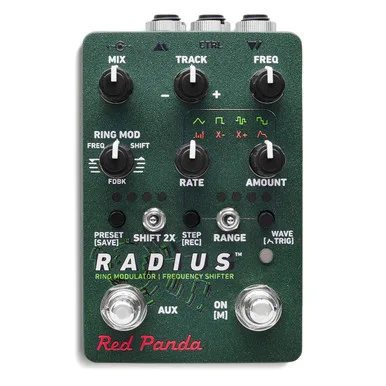


The Red Panda Radius is a stereo ring modulator and frequency shifter pedal from Red Panda, designed and assembled in the USA by Curt Malouin, who is credited with its design, engineering, web editor and documentation1. It runs digital DSP algorithms rather than modeling an analog ring modulator, and Red Panda describes its range as spanning "from adding subtle depth and movement to broken alien transmitter sounds, complex harmonic structures, bell-like tones, and metallic textures"1. It sells for $349.00 from the Red Panda Lab webstore, as of October 20262.
At its core is what Malouin calls an "eight-quadrant multiplier": the result of unpacking the math behind ring modulation and frequency shifting into a circuit that can morph between the two1. The RING MOD / FREQ SHIFT mix knob adjusts the balance between upper and lower harmonics and adds feedback, so a player can move from classic ring mod clang to a pure frequency shift within one knob turn1.
What it does: ring modulation and frequency shifting
A ring modulator multiplies the input signal by a carrier frequency and outputs both the sum and the difference of every frequency pair, which is why the result sounds bell-like and metallic rather than harmonic. A frequency shifter outputs only one set of sidebands, shifting everything by a fixed offset instead. The Radius does both, and blends between them15.
The carrier frequency (FREQ) is adjustable from 0.65 to 4,000 Hz, and the LFO runs from 0.1 to 55 Hz15. RATE and DEPTH apply modulation to the carrier frequency, so the carrier itself can wobble, sweep or follow your playing rather than sitting still6. The manual describes the X-mod AMOUNT control as setting the width of the frequency window for fading in and out: smaller amounts create unstable warbling, while higher settings sweep up to ±3 octaves above and below the FREQ setting and produce an endless glissando similar to Shepard-Risset tones1.
The pedal is line-level friendly, with a maximum input level of +8 dBu, 1 MΩ input impedance and under 1 KΩ output impedance, so it works with synths and studio gear as well as guitars2.
Modulation types and one-shot mode
The modulation section offers several shapes for the carrier, selected with the WAVE button67:
| Modulation type | What it does |
|---|---|
| TRIANGLE | Smooth transition between two values6 |
| SQUARE | Abrupt transition between two values6 |
| RANDOM | Alternate random modulation6 |
| SWEEP DOWN | Multi-octave sweep or endless glissando, down6 |
| ENVELOPE FOLLOWER | Follows the envelope; RATE controls release time6 |
| STEP MODULATOR | Programmable 8-step modulation sequence6 |
Holding the WAVE button enables envelope-triggered one-shot mode for each modulation type, so a single note attack can fire the modulation once rather than cycling continuously7. The envelope LED blinks green when triggered, giving a visual check that the one-shot is firing7.
Pitch tracking
Ring modulators are famously unpredictable with pitched instruments, because the output is inharmonic unless the carrier relates to the note you play. The Radius addresses this with pitch tracking, which holds the pitch relationship while you play up and down the scale, monophonically15. The manual also lists a push-to-tune footswitch and a stepped frequency setting, which Red Panda says "make it responsive and predictable in concert"1.
MIDI, presets and the CTRL input
The Radius carries two footswitches, ON and AUX. The ON switch toggles between active and bypass1. The PRESET switch handles the four onboard preset locations: tap to cycle through presets 1 to 4, then press and hold for two seconds to save, with the main LED blinking once to confirm8. Over MIDI, 100 preset locations are available, saved by holding the PRESET button while sending a Program Change message9.
MIDI and firmware updates come through a USB mini B receptacle, with USB MIDI in/out and a 1/4" TRS MIDI input1. The CTRL input is the most flexible jack on the pedal, accepting1:
- An expression pedal
- Control voltage (CV) in a 0 to 3.3V range, with over and under-voltage protection
- TRS MIDI in, with the tip active
- A remote switch
For an expression pedal, Red Panda specifies one with a linear potentiometer of 10 to 25 kΩ5. The CV path is protected: the tip accepts 0 to 3.3V, the ring provides a 3.3V output with current limiting, and the sleeve is ground1.
Power needs attention. The product page specifies a 9V DC 200 mA supply (not included), while the manual's front panel states a supply rated 200 mA or higher and its power section recommends 250 mA or more, with a 2.1mm inside diameter, 5.5mm outside diameter plug and negative tip124. There is no battery option, and the 200 mA draw rules out sharing a small daisy chain with low-current analog pedals.
What reviewers said
Gearnews covered the launch in February 2024, noting the digital architecture and its 96kHz sampling rate3. Guitar Pedal X called it "probably the most potent ring modulator and frequency shifter currently out there" at release4, and in a December 2024 roundup of the year's modulation, pitch and utility pedals, Stefan Karlsson wrote:
"The Red Panda Radius has you fully covered for all your Ring Mod needs, but then also massively expands into other complementary modulation effects"10
In that same roundup, Karlsson compared it directly against the Dr Scientist Phreak and preferred the Radius overall10.
Videos
Red Panda Lab
The Pedal Zone
Harp Lady
News
Questions
Is the Red Panda Radius true bypass?
No. The Radius offers buffered analog bypass or DSP bypass, selectable in the web editor. It is not true bypass, so the signal path runs through the pedal's circuitry even when the effect is off, in either bypass mode.
Is the Red Panda Radius stereo?
Yes. The input and output configuration is configurable as mono in/mono out, mono in/stereo out, or stereo in/stereo out, with stereo in/stereo out as the default. Both the TRS input and output carry tip as left or mono and ring as the right channel.
Does the Radius track pitch?
Yes. Pitch tracking holds the pitch relationship while you play up and down the scale, monophonically. The manual also lists a push-to-tune footswitch and a stepped frequency setting, which Red Panda says make the pedal responsive and predictable in concert.
What is the difference between a ring modulator and a frequency shifter?
A ring modulator multiplies your signal by a carrier and outputs both the sum and difference frequencies, producing inharmonic sidebands. A frequency shifter outputs only one of those, shifting all frequencies by a fixed amount. The Radius can morph between the two, and its mix knob adjusts the balance of upper and lower sidebands.
How many presets does the Red Panda Radius have?
Four presets can be selected and saved onboard using the PRESET footswitch: tap to cycle through locations 1 to 4, then press and hold for two seconds to save. Over MIDI, 100 preset locations are available, saved by holding the PRESET button while sending a Program Change message.
What expression pedal works with the Red Panda Radius?
Use an expression pedal with a linear potentiometer of 10 to 25 kΩ, connected to the CTRL input on a TRS jack. The same input also accepts control voltage in a 0 to 3.3V range, TRS MIDI in with the tip active, and a remote switch.
Sources (10)
- Radius Owners Manual.pdf, Red Panda LLC, 2024-02
- Red Panda Radius, Red Panda Lab
- Red Panda Radius: MIDI Ring Modulator/Frequency Shifter, gearnews.com, 2024-02-16
- Guitar Pedal X, Guitar Pedal X, 2024-01-22
- Radius QuickStart, redpandalab.com, 2024
- MODULATION, Red Panda Lab, 2024
- MODULATION WAVEFORM + TRIGGER, Red Panda Lab, 2024
- PRESET, Red Panda Lab, 2024
- Radius QuickStart, redpandalab.com, 2024
- Guitar Pedal X, Guitar Pedal X, 2024-12-19