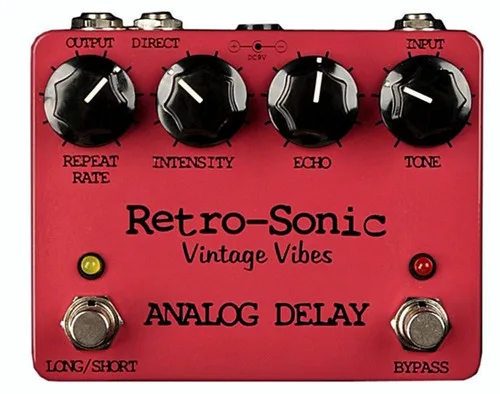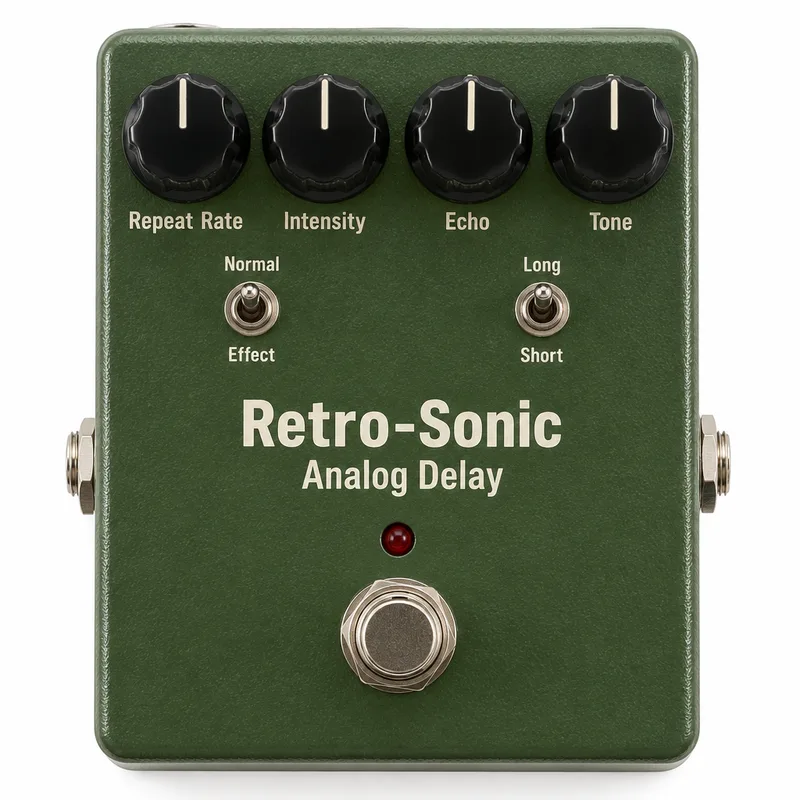


The Retro-Sonic Analog Delay is a compact analog delay pedal built around bucket brigade device (BBD) chips, the same class of circuit used in the classic analog delays of the late 1970s and 1980s. Bucket brigade chips pass your signal along a chain of tiny capacitors step by step, and each step costs a little high end, which is why analog repeats tend to sound warmer, thicker and slightly darker than digital ones, blending into your playing more naturally1. Retro-Sonic's version uses two 4096-stage BBDs, which is what allows it to reach a maximum delay time of about 800ms, longer than most compact analog delays manage2.
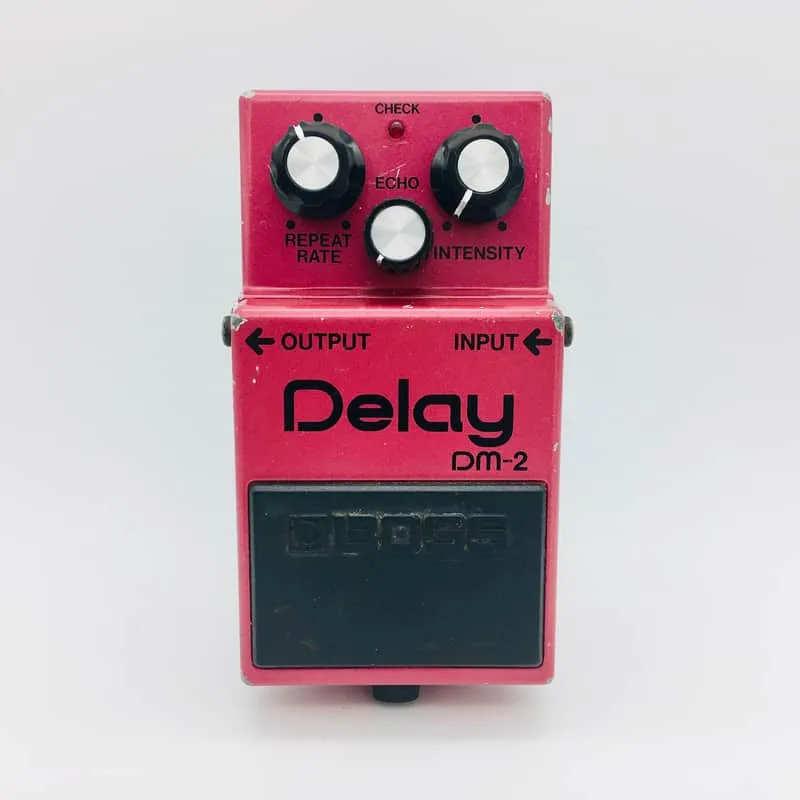
The pedal is best understood as a modern take on the Boss DM-2, the first analog delay in Boss's compact lineup, whose BBD circuit produces lush delays that become more saturated with each repeat3. Pedal of the Day's reviewer put it directly: "the folks at Retro-Sonic have managed to create a pedal that has everything we love about the DM-2"2.
The maker's current product page lists the Retro-Sonic 800ms Analog Delay (checked October 26, 2026)4. If you are shopping for one, it may take some searching on the used market.
An analog delay with long, warm repeats
Two things set this pedal apart from the average compact analog delay. The first is delay time. About 800ms is generous for a BBD design: many small analog delays offer around 300ms, and even some well-regarded modern analog pedals stop at 600ms. The second is noise. One of the trade-offs of bucket brigade chips is that long delay lines can get noisy, and Pedal of the Day singled the pedal out for "quiet operation, longer-than-normal analog delay times and lush, warm repeats"256.
The repeats themselves sit in the classic analog territory: warm and full rather than crisp and exact. As GuitarPlayer's buying guide puts it, analog delays "tend to sound warmer, thicker, and slightly darker, with repeats that blend into your playing more naturally"1. Where a digital delay reproduces your playing faithfully, a BBD delay softens each repeat, which is a large part of the appeal for players chasing vintage echo sounds.
The controls
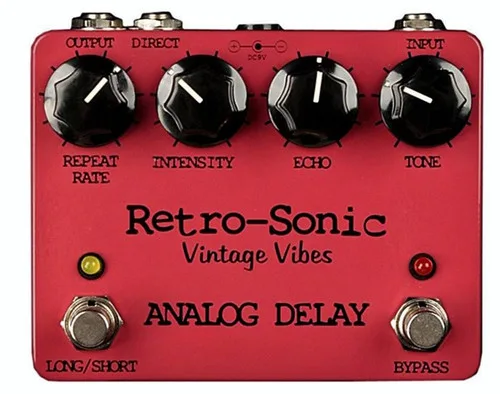
The control layout follows the vintage formula: four knobs and two switches, all doing familiar delay jobs4.
| Control | What it does |
|---|---|
| Repeat Rate | Sets the overall delay time2 |
| Intensity | Sets the level of the delayed effect2 |
| Echo | Sets the number of times the delay repeats2 |
| Tone | A hi-cut filter for the repeats2 |
The switches are where the pedal earns its flexibility. The Normal/Effect switch is the bypass, taking the pedal in and out of your signal chain4. The Long/Short switch is a footswitch, so you can jump between delay ranges mid-song: Long mode for the full 800ms of space, Short mode for tighter, quicker repeats2.
The Tone control deserves its own mention, because it is the knob that shapes the pedal's character. Pedal of the Day called it "what really makes this metallic box stand out from its peers." Turned back, the repeats go dark, ambient and classic-analog; turned up, they become clear and punchy, "a little more digital-sounding without harshness"2. In effect it lets you dial the pedal between a vintage echo voice and a more modern, articulate one, which is not something every analog delay offers.
Where it came from
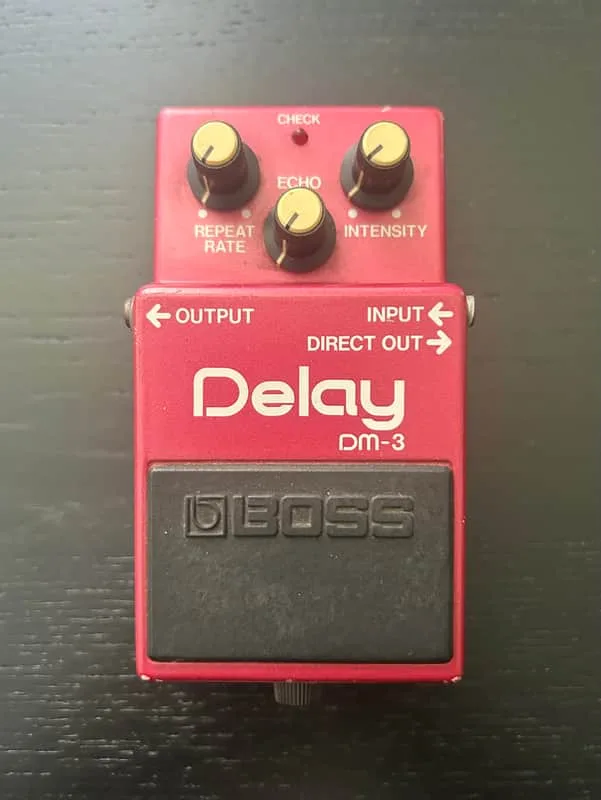
The pedal's lineage is the Boss DM-2, Boss's first compact analog delay, a pedal with a long-standing reputation among players. Boss's own history of the pedal notes its "retro BBD circuit produces lush delays that become more saturated with each repeat"3. The DM-2 was later developed into the DM-3, which kept the DM-2 circuit and added an extra filter and high-speed noise reduction, and which was the last analog delay Boss produced7.
Retro-Sonic's contribution was to take that circuit concept and push the delay time further, using two 4096-stage BBDs to reach about 800ms where the original designs were more limited2. The result, in the reviewer's words, is a pedal that recreates the DM-2's tones while adding the longer delay times and quiet operation2.
What reviewers said
Published coverage of the Retro-Sonic Analog Delay is limited, but the main review is enthusiastic. Pedal of the Day's 2017 review praised the pedal's quiet operation, its longer-than-normal delay times and its lush, warm repeats, and concluded that the Tone control's range was its standout feature2.
"The range they managed to capture is truly astounding, making this one for the experimenter in us all."
That verdict points at the pedal's real strength: not just one good echo sound, but a wide spread of them, from dark ambient washes to clear, punchy repeats, all from a single knob. For a player who likes to set a delay differently for different parts, that range is the argument for this circuit over a simpler one-knob vintage clone2.
Videos
ProGuitarShopDemos
musictoyznetwork rasch
musictoyznetwork rasch
Questions
Is the Retro-Sonic Analog Delay based on the Boss DM-2?
Yes, in spirit. Pedal of the Day's reviewer wrote that Retro-Sonic managed to build a pedal with everything they love about the Boss DM-2, calling the DM-2 one of the finest analog delay pedals ever created. The Retro-Sonic uses two 4096-stage bucket brigade chips and stretches the maximum delay time to about 800ms, beyond what the original DM-2 offered.
How long is the maximum delay time on the Retro-Sonic Analog Delay?
About 800ms, which Pedal of the Day described as longer than normal for an analog delay. That figure comes from the pedal's Long delay mode; the Short mode covers shorter delay times. Many compact analog delays top out lower, with some vintage-style units reaching only around 300ms.
What does the Long/Short switch do on the Retro-Sonic Analog Delay?
It selects between Long and Short delay modes, and it is a footswitch rather than a toggle, so you can change delay ranges with your feet while playing. Long mode reaches the pedal's maximum of about 800ms; Short mode covers shorter delay times suited to tighter repeats and slap-back style echoes.
What does the Tone knob do on an analog delay like this?
On the Retro-Sonic it is a hi-cut filter for the repeats. Turned back, the echoes go dark, ambient and classic-analog; turned up, they become clear and punchy, a little more digital-sounding but without harshness. Pedal of the Day found the range it covers remarkably wide, suiting players who like to experiment.
Sources (7)
- Best delay pedals 2026: from slapback to space age, GuitarPlayer (www.guitarplayer.com), 2023-07-26
- Retro-Sonic Analog Delay, Pedal of the Day, 2017-01-26
- BOSS - PX-1 | Plugout FX, BOSS (www.boss.info)
- Delay | retro-sonic, retro-sonic.com
- Analog Man Analog Delay, analogman.com, 2017
- Supro Delay Hi-Fi Analog Echo, Pedal of the Day, 2021-11-28
- Boss DM-3 Analog Delay, Pedal of the Day, 2024-02-24