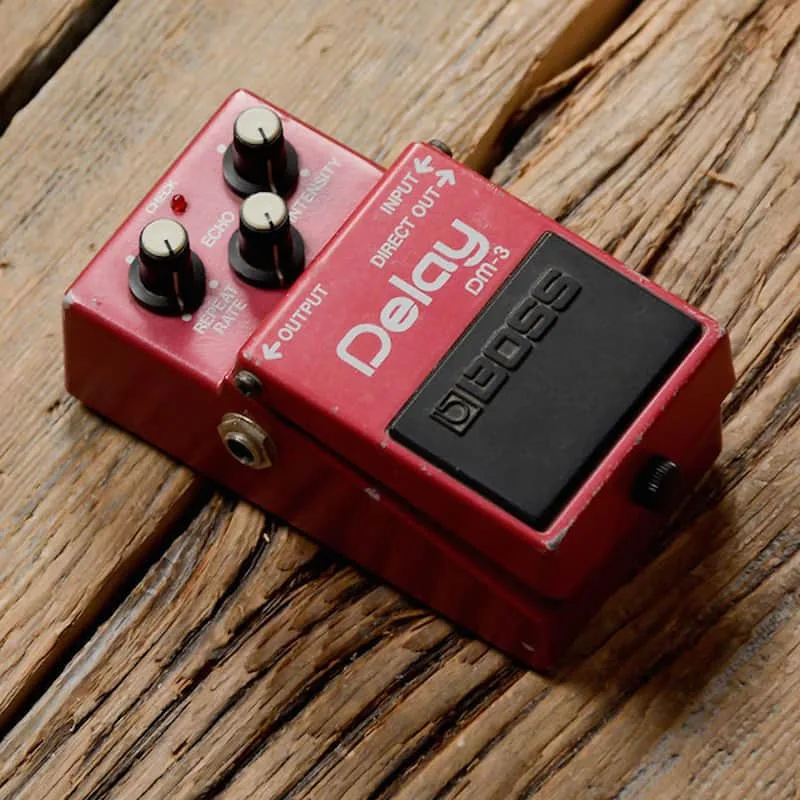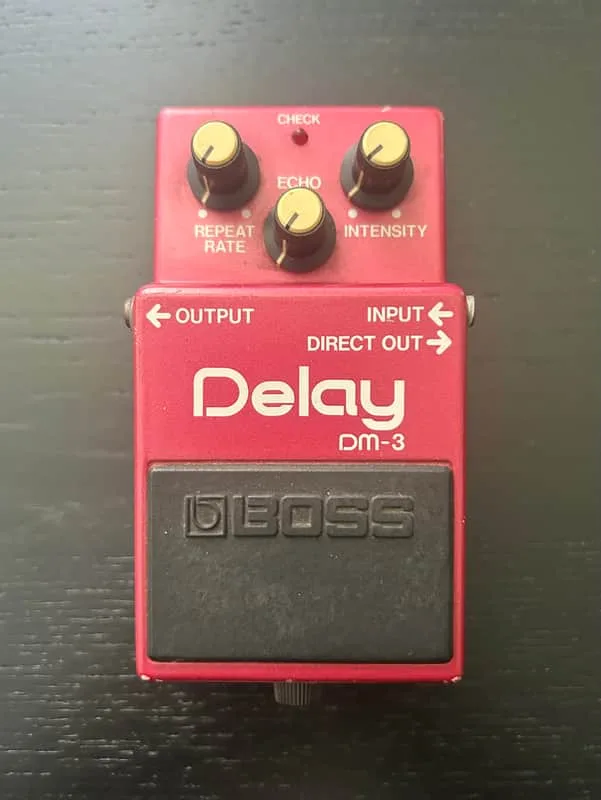


The Boss DM-3 is an analog delay pedal made by Boss in the 1980s, and it was the last analog delay the company produced in that decade1. It arrived in 1984, replacing the Boss DM-2, and stayed in production until 19882. It is long discontinued, so units on the used market are the only way to find one.
What it does to your sound
The DM-3 is a short-delay analog design. Its delay range only goes up to around 300ms, which puts it in the territory of slapback and compact rhythmic repeats rather than long ambient trails1. Pedal of the Day's reviewer, Mike B., described the character of the repeats this way:
"There really is a beautiful musical quality to the subtle degradation of the repeats"
That degradation is the hallmark of analog delay: each repeat loses a little fidelity as it recirculates, and in the DM-3's case the reviewer found that quality musical rather than muddy. Even within the limited delay range, he noted "there's a TON of gorgeous tones to be found here"1.
Controls
The DM-3 keeps things to three knobs, the same layout as the DM-2 before it13:
| Control | What it does |
|---|---|
| Repeat Rate | Controls the delay time of the delay effect1 |
| Echo | Controls the mix of the delay effect1 |
| Intensity | Controls the feedback of the delay effect1 |
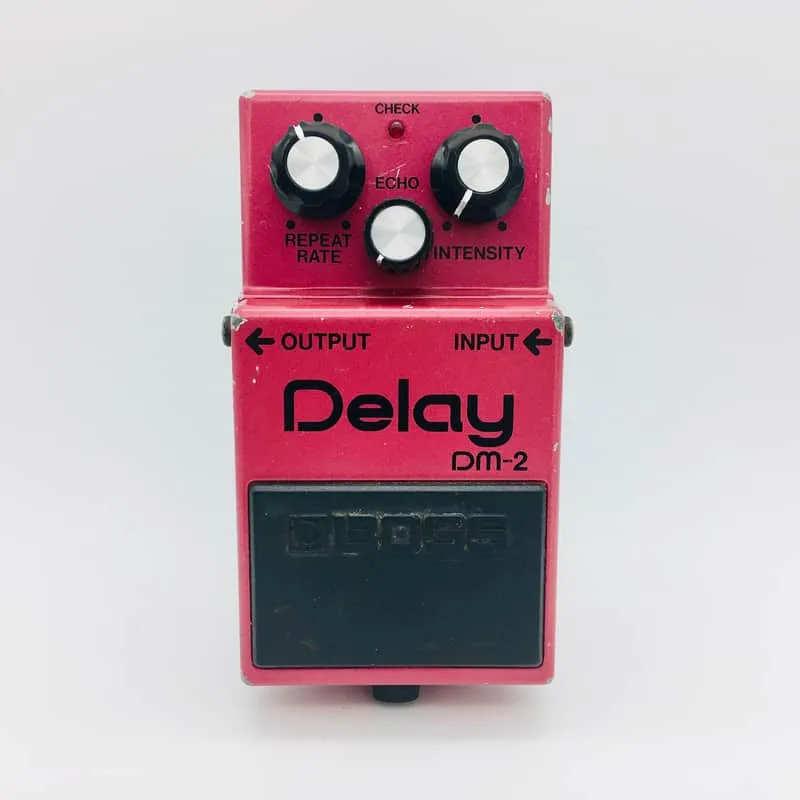
The DM-2 used the same echo, intensity and repeat rate controls, so players moving between the two pedals will find the layout familiar3.
The Direct Out jack
Alongside the standard input and output, the DM-3 features a Direct Out jack, which lets you run two amps for a pseudo-stereo effect1. One amp gets the delayed signal and the other the dry signal, spreading the sound across the stage without needing a stereo delay or an external splitter. It is a simple feature but an unusual one on a compact delay of this era.
DM-3 compared with the DM-2
The DM-3 is directly descended from the DM-2, Boss's earlier analog delay. Pedal of the Day describes it as building on the now-vintage sounds of its older sibling, the DM-2, by adding an additional filter and high-speed noise reduction1. Boss's own history of its delay pedals, written by Jim Bybee, notes that the DM-3, still analog, was slightly more affordable than the pedal it replaced4.
| Boss DM-2 | Boss DM-3 | |
|---|---|---|
| Type | Analog delay14 | Analog delay1 |
| Controls | Echo, Intensity, Repeat Rate1 | Repeat Rate, Echo, Intensity1 |
| Status | Discontinued2 | Discontinued (1984 to 1988)2 |
The DM-2 is the better-known pedal of the pair, but the DM-3 has its advocates. As Mike B. put it1:
"While not as popular as the DM-2, this one holds up in its own right, and, I think, gives that other famous pinkish"
Where it sits in Boss's delay line
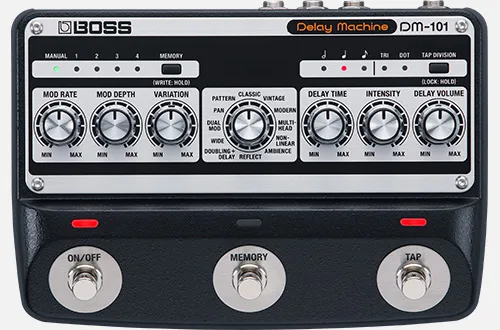
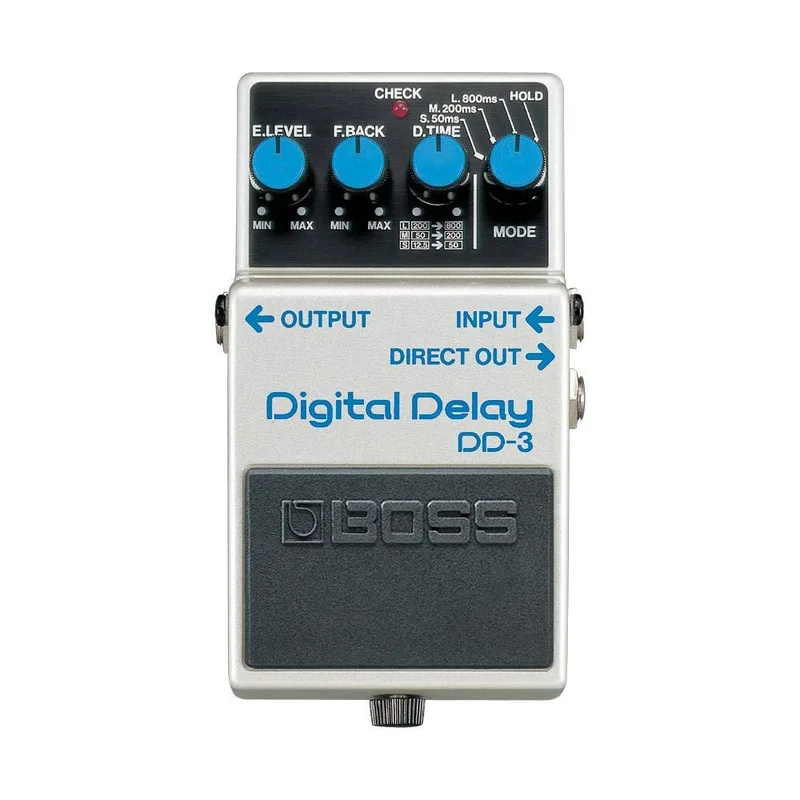
For a current-production take on the analog delay idea, Boss offers the Boss DM-101 Delay Machine, and the company's compact digital delays include the Boss DD-3 Digital Delay. For a broader view of what else is available, the site's Delay Pedals page collects the type.
Videos
Gear Confessions
blondegraemey
Jim Cardoza
Questions
How long is the delay time on the Boss DM-3?
The DM-3's delay range only goes up to around 300ms, according to Pedal of the Day's review. That places it firmly in short-echo territory, suited to slapback and rhythm-boosting repeats rather than long ambient trails. The review notes that even within that range there is a lot of tonal ground to cover.
What is the difference between the Boss DM-2 and DM-3?
The DM-3 builds on the DM-2 circuit with an additional filter and high-speed noise reduction added, and it was slightly more affordable than the DM-2 it replaced. Boss introduced the DM-3 in 1984, and it kept the same echo, intensity and repeat rate control layout. Pedal of the Day's reviewer found it holds up in its own right despite being less popular than the DM-2.
What does the Direct Out jack on the Boss DM-3 do?
The Direct Out jack lets you run two amps at once, one carrying the delayed signal and one the dry signal, for what Pedal of the Day describes as a pseudo-stereo effect. It is a simple way to widen a rig without a stereo delay or a splitter.
Is the Boss DM-3 still in production?
No. The DM-3 was discontinued, having been produced from 1984 to 1988 according to GuitarPlayer, and it was the last analog delay pedal Boss produced in the 1980s. Players looking for a current Boss analog delay can look at the DM-101 Delay Machine.
What do the Repeat Rate, Echo and Intensity knobs do?
The three knobs map directly to the core delay parameters. Repeat Rate controls the delay time, Echo controls the mix of the delay effect against your dry signal, and Intensity controls the feedback, which is how many times the repeats recirculate. The same three-control layout appeared on the earlier DM-2.
Sources (4)
- Boss DM-3 Analog Delay, Pedal of the Day, 2024-02-24
- If You Like Analog Delay You'll Love the New Boss DM-101 Delay Machine, GuitarPlayer (www.guitarplayer.com), 2023-06-22
- The Best Guitar Effects Pedals of All Time, GuitarPlayer (www.guitarplayer.com), 2021-06-25
- Echoes in Time: The History of BOSS Delay Pedals, BOSS (articles.boss.info), 2024-01-10