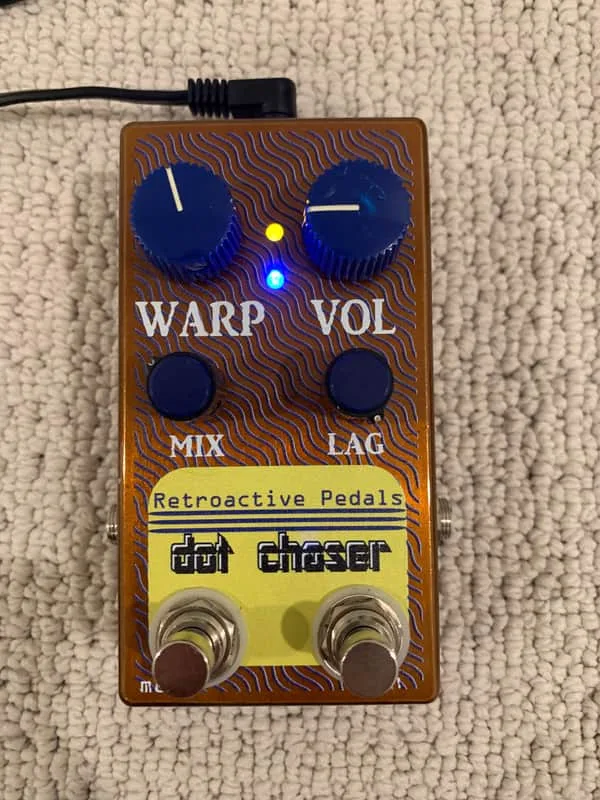


The Retroactive Pedals Dot Chaser is a cassette-style echo pedal with modulation, built around the PT2399 delay chip and an envelope optical modulator. It belongs to the family of delay pedals inspired by old tape machines, where the repeats wobble and drift the way a worn cassette does, and its modulation is driven by your picking: the sensitivity of the modulation is based on input level, so the harder you play, the more the echoes move1.
Delicious Audio's Paolo De Gregorio, writing in August 2021, described the intent behind the layout: "it features a simple set of controls that allows the adventurous guitarist to maximize the fun without having to delve into an intricate user interface"1.
Controls and footswitch
| Control | What it does |
|---|---|
| Lag | Manipulates the single repeat delay time, controlling the length of the delay1 |
| Mix | Blends the wet and dry signal1 |
| Warp | Controls the amount of modulation, adding well beyond what may be considered a "tasteful" amount of warble, pushing into "seasick" territory1 |
| Volume | Acts as level compensation, but also adds a character reminiscent of cassette tape saturation, bordering on overdrive at higher settings1 |
| More footswitch | Momentarily increases the modulation, therefore affecting the Warp settings1 |
The envelope-driven modulation is the heart of the design. Because the modulation sensitivity follows input level, the character of the repeats changes with your dynamics rather than sitting at a fixed rate and depth. The More footswitch lets you lean on that for a moment: "More intense or drastic modulation can be audibly heard when engaging the 'more' switch"1.
The Volume control does more than set level. At higher settings it adds a cassette-like saturation bordering on overdrive, which is worth knowing if you are setting it as a straight wet/dry blend1.
Circuit and context
The Dot Chaser uses the PT2399 chip, which De Gregorio notes "is found in a lot of modulated delay pedals inspired by old tape machines." Its modulation comes from a PT2399-based envelope optical modulator, an LDR (light-dependent resistor) network rather than a standard LFO1. On release, the pedal "has just joined" Delicious Audio's list of the most popular PT2399-based creative echo pedals1.
What reviewers said
Delicious Audio's verdict, from Paolo De Gregorio's August 2021 write-up:
"This is a cool little pedal that can inspire psychedelic-leaning minds."1
Videos
BlankFor_ms
Devon Blue Whitaker (Devon Blue Whitaker music)
thistownneedsmusic
Questions
What chip does the Retroactive Pedals Dot Chaser use?
The Dot Chaser is built around the PT2399 chip, a common delay IC found in many modulated delay pedals inspired by old tape machines. Retroactive Pedals pairs it with an envelope optical modulator, an LDR-based circuit that lets the strength of the modulation follow the level of your playing.
What does the More footswitch do on the Dot Chaser?
The More footswitch momentarily increases the modulation, which affects the Warp settings. Pressing it produces more intense or drastic modulation that can be audibly heard, letting you push the warble for a moment and then let it settle back.
Does the Dot Chaser's modulation respond to how hard I play?
Yes. The sensitivity of the modulation is based on input level, so playing harder drives more modulation and playing softly dials it back. The envelope-driven design is what gives the echo its tape-machine-like, uneven character.
What does the Warp knob control?
Warp controls the amount of modulation. It can add well beyond what might be considered a tasteful amount of warble, pushing into seasick territory, while lower settings keep the effect closer to gentle tape flutter.
Is the Dot Chaser a tape delay?
No, it is not a real tape delay. It is a PT2399-based digital-era chip design styled after old tape machines, with an envelope optical modulator producing the tape-like warble. The Volume knob even adds a character reminiscent of cassette tape saturation.
Sources (1)
- Retroactive Pedals Dot Chaser Cassette-Style Echo With Modulation, Delicious Audio, 2021-08-02