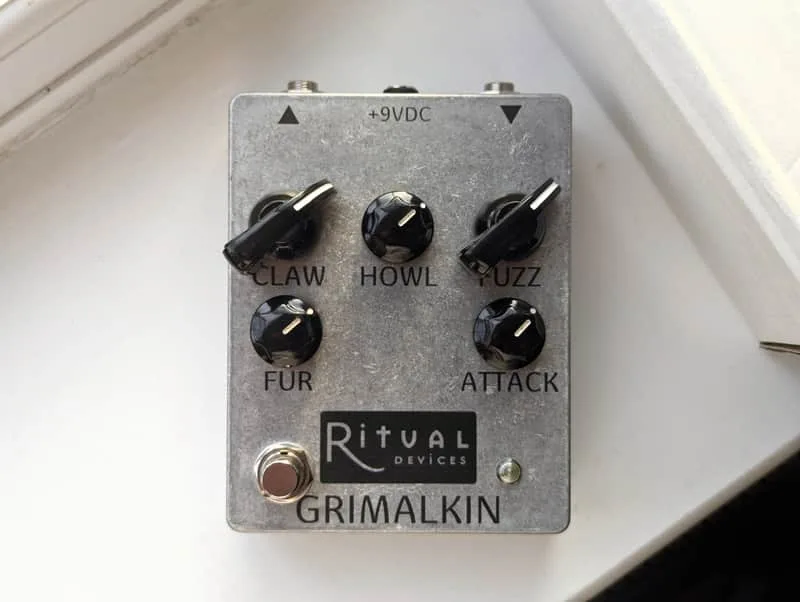



The Ritual Devices Grimalkin is a hybrid octave multi-fuzz, a five-knob fuzz pedal that ranges from overdrive at the low end of its gain sweep to full fuzz with a dialled-in upper octave. Guitar Pedal X describes its span as "ranging from overdrive, to fuzzy-drive, to full-blown fuzz, and with an additional dialled in Upper-Octave"1. In between those extremes, the same reviewer found velcro fuzzes, classic fuzzes, synth fuzzes and octave fuzzes2. It is British-built, with an acid-etched and finished enclosure carrying intricate enamel designs, and it has been listed at £195 GBP direct from the Ritual Devices webstore12.
The controls
The Grimalkin's five knobs are its whole story, and reviewers agree they interact with each other more than most fuzzes do. Guitar.com's reviewer Richard Purvis called out the two chickenhead-type knobs, Claw and Fuzz, as the starting point: Claw on the left is output level and the self-explanatory Fuzz on the right is the fuzz amount3.
| Control | Function |
|---|---|
| Claw | Output level (volume)3 |
| Howl | Voltage control for the transistor stage, setting how thick and gurgly or lean and raspy the distortion is3 |
| Fuzz | Master gain, the fuzz amount13 |
| Fur | Pre-gain, setting the amount of gain at the beginning of the circuit3 |
| Attack | Post-gain, setting the amount of gain at the beginning of the circuit3 |
Fur and Attack interact heavily. Guitar Pedal X found that raising both together overloads the gain and chokes out in a way similar to the Fuzz Mode on LM308 Expandoras2. Howl has a second life beyond tone shaping: with Fur and Attack maxed, it falls into a buzzy self-generated wail that can be manually tuned and reaches higher pitches when the fuzz is turned down low3.
"It's that interactivity between the controls that makes this such a deceptively complex pedal."
For players who want a starting point, Guitar Pedal X shared a preferred monster-output setting: Claw at max, Howl at 3 o'clock, Fuzz at noon, Fur at noon and Attack at 9 o'clock2.
What it sounds like
Guitar.com's review traced the sweep. With all five knobs at 9 o'clock, the starting tone is "a very pleasant conventional fuzz: rich and smooth" in the Tone Bender style, only with a bit more midrange bite3. By the time Howl reaches 12 o'clock, there is already a low octave sneaking into single notes, and the reviewer found the pedal starts to get properly strange there3.
"Our verdict: Frighteningly unruly, but that's what makes it so much fun to mess around with."
Guitar Pedal X called it one of the most versatile fuzzes there is, noting it takes a little due diligence on the dial-in but can be really rewarding, with the one caveat of wanting slightly more output volume overall1.
Circuit and design
The Grimalkin is a hybrid design: an NE5542 dual op-amp and two 2N2222A silicon transistors, which Guitar Pedal X describes as twin dual gain stages, four gain stages in effect12. On its lineage, Guitar.com hears definite echoes of the ZVex Fuzz Factory, but judged the Grimalkin much too unpredictable to be written off as a copy of any existing classic3.
There is no onboard noise gate. Guitar Pedal X suggested a sixth central knob noise gate as the one change worth making, so players running high gain settings may want a separate noise gate pedal2.
Where it sits
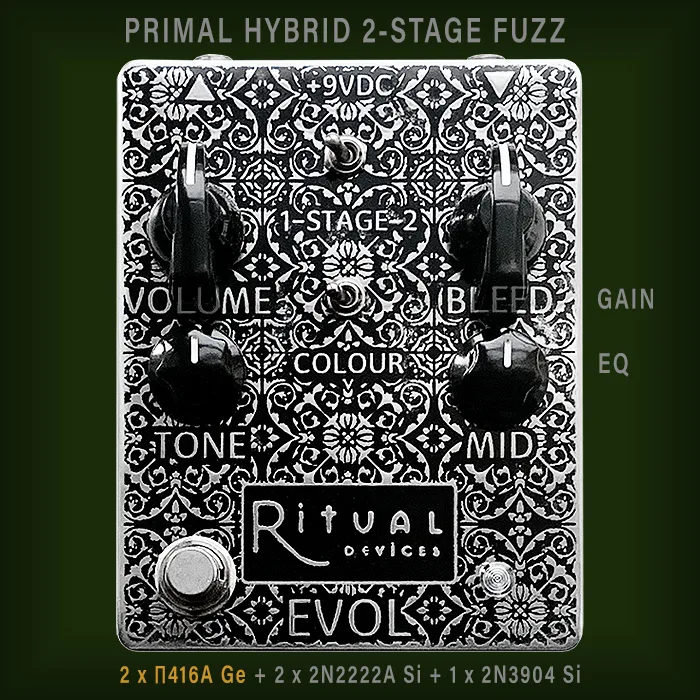
As an octave multi-fuzz, the Grimalkin covers ground that players might otherwise split across an overdrive pedal, a fuzz pedal and an octave and pitch pedal. It sits alongside the Ritual Devices EVOL, the maker's primal hybrid two-stage fuzz, in the same etched Flagship Series enclosure style1.
Videos
Ritual Devices
Ritual Devices
Budget Pedal Chap
Questions
What do the Fur and Attack knobs do on the Ritual Devices Grimalkin?
Fur and Attack set the amount of gain at the beginning of the circuit, with Fur acting as pre-gain and Attack as post-gain. Guitar Pedal X notes that they interact heavily: raising both together overloads the gain and chokes out in a way similar to the Fuzz Mode on LM308 Expandoras. Guitar.com describes them as setting the gain at the start of the circuit, alongside the Fuzz master gain control.
Does the Grimalkin have a noise gate?
No. The Grimalkin has no onboard noise gate. Guitar Pedal X's reviewer suggested that adding one via a sixth central knob would be a nice-to-have change, but as built the pedal ships without gating, so players using high gain settings may want an external noise gate on the board.
What transistors and chips are in the Grimalkin?
The Grimalkin is a hybrid design built around two 2N2222A silicon transistors and an NE5542 dual op-amp. Guitar Pedal X describes the circuit as twin dual gain stages, the op-amp and the transistor pair, giving four gain stages in effect.
Where is the Ritual Devices Grimalkin made?
Guitar.com describes the Grimalkin as British-built, with lo-fi tones to match its brutalistically industrial looks. The enclosure is acid-etched and finished with intricate enamel designs, and the pedal is available direct from the Ritual Devices webstore.
What is the Howl knob on the Grimalkin?
Howl is a voltage control for the transistor stage, setting how thick and gurgly or lean and raspy the distortion will be, according to Guitar.com. With Fur and Attack maxed, Howl lives up to its name, falling into a buzzy self-generated wail that can be manually tuned and reaches higher pitches when the fuzz is turned down low.
Is the Grimalkin a copy of the ZVex Fuzz Factory?
Guitar.com's reviewer Richard Purvis hears definite echoes of the ZVex Fuzz Factory in the Grimalkin, but judged it much too unpredictable to be written off as a copy of any existing classic. It is best understood as its own design that happens to share some territory with that pedal.
Sources (3)
- Guitar Pedal X, Guitar Pedal X, 2026-02-11
- Guitar Pedal X, Guitar Pedal X, 2024-07-24
- Ritual Devices Grimalkin: wild fuzz that’s never knowingly sensible, Guitar.com, 2023-10-23