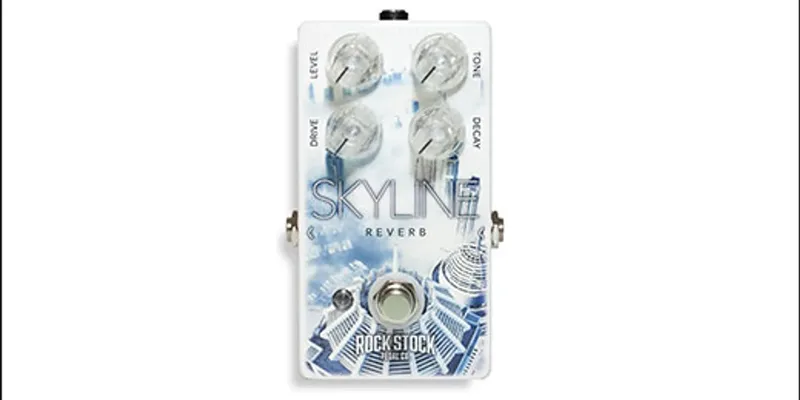


The Rock Stock Skyline Reverb V2 is a spring-style reverb pedal from Rock Stock, a small builder based in Columbus, Indiana1. It sits in the reverb pedal family, but it does something most reverb pedals do not: alongside the reverb it carries a separate Drive circuit that works on the wet signal, giving the trails a pushed, textured character rather than a clean wash1.
A spring-style reverb with a separate Drive circuit
Delicious Audio introduced the V2 as a pedal for players who want "a modern spring-style reverb pedal"1. Spring reverb, the drippy, boingy sound originally built into amp tanks, is the reference point here, and the Skyline aims at that character in a stompbox.
The unusual part is the Drive circuit. It is not an overdrive pedal bolted in front of the reverb; it is an independent circuit inside the pedal that adds clarity to the effect1. Delicious Audio's Paolo De Gregorio described what it does to the sound:
"The Drive control really adds some analog delay vibes to the sound and cranking it up works great for aggressive reggae vibes, skanky funk licks, soulful blues, and much more"1
That puts the Skyline in a small group of reverbs that let you dirty the wet signal on its own, rather than distorting the whole guitar tone12.
The controls
The control set is straightforward, with five knobs covering the wet signal from mix to texture to space. Here is what each one does, based on the press coverage of the original and the V22:
| Control | What it does |
|---|---|
| Level | Balances your output signal; on the original it adjusts the overall presence of the wet reverb signal12 |
| Body | Simulates different room sizes, from small and quick to large and booming, with plenty in between2 |
| Tone | Acts as a high pass filter that only affects the reverb signal, leaving the dry guitar tone untouched and uncolored, for blending wet and dry to taste2 |
| Decay | Sets the length of the reverberated trails, from short and sharp to long, winding and full of sonic wash2 |
| Drive | An independent circuit that adds clarity and pushes the wet signal1 |
The Tone control is worth a closer look for anyone comparing reverbs. Because it filters only the reverb path, your dry tone passes through without coloration, which makes it useful for dialing out muddy low end in the trails without changing the core sound of your guitar2.
How V2 differs from the original Skyline Reverb
The V2 update, reported by Delicious Audio on December 15, 2016, changed three things1:
- More wet signal: an overall increase to the available reverb (wet) signal1
- The Drive circuit: an independent circuit on the wet path that adds clarity1
- Bypass: a move from true bypass to buffered bypass with trails, so the reverb tail rings out after the pedal is switched off12
The original Skyline Reverb used true bypass switching2. If a hard, silent cutoff when you disengage the pedal matters to you, the two versions behave differently: V2 lets the trail decay naturally instead of cutting it dead.
The effect itself is mono, so V2 is a one-in, one-out pedal rather than a stereo reverb1.
What reviewers said
Pedal of the Day reviewed the original Skyline Reverb in January 2016, before the V2 update, and found it "warm and organic," adding "that missing piece of sparkle and luster to your tone"2. The reviewer's overall verdict:
"a welcome addition to anyone to needs easy and great-sounding reverberation"2
The same review noted the hand-built craftsmanship and true bypass switching of the original2, and Delicious Audio called the V2 enclosure "built like a tank"1. Delicious Audio's product coverage is the only published review of the V2's sound, so the Drive circuit's character rests on that one report.
Videos
Rock Stock Pedal Co.
Rock Stock Pedal Co.
Curtis Kent
Questions
Is the Rock Stock Skyline Reverb V2 true bypass?
No. The original Skyline Reverb used true bypass switching, but the V2 update moved to buffered bypass with trails, so the reverb tail continues to ring out after you switch the pedal off. Players who want a fully silent switch may prefer the original's true bypass.
Is the Skyline Reverb mono or stereo?
The effect is mono. It is a single-path reverb pedal, not a stereo unit, so it fits a standard mono pedalboard setup with one input and one output.
What does the Drive control do on the Skyline Reverb?
Drive is an independent circuit that adds clarity and pushes the wet reverb signal. Delicious Audio found it adds analog delay-style vibes to the sound, and reported that cranking it up works well for aggressive reggae, skanky funk licks and soulful blues.
What does the Body knob do?
The Body knob simulates different room sizes, from small and quick to large and booming, with plenty of range in between. It shapes the character of the reverb space rather than the length of the trails, which is handled by the Decay control.
How is V2 different from the original Skyline Reverb?
V2 brought an overall increase to the available reverb (wet) signal, an independent Drive circuit on the wet path, and a switch from true bypass to buffered bypass with trails. The original was hand-built with true bypass switching.
Sources (2)
- New Pedals: Rock Stock Skyline Reverb V2, Delicious Audio, 2016-12-15
- Rock Stock Pedals Skyline Reverb, Pedal of the Day, 2016-01-17