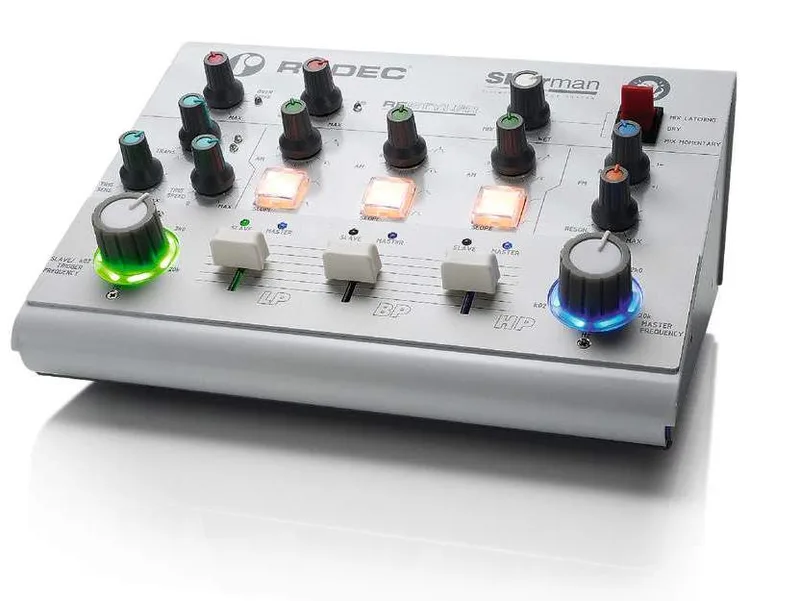



The Rodec / Sherman Restyler is an analog desktop stereo filter unit, the second product from Sherman and a collaboration with the Belgian manufacturer Rodec1. Sherman describes it as no regular effects unit or filter bank, but a one of a kind "RESTYLER" that redefines the dynamic, punch, groove and sound of your music, instrument or musical production2. Future Music's review called it "the love child of this relationship is a tidy desktop stereo filter unit with the look of a precision piece of lab equip[ment]"1.
Inside is a multimode three-way filter with low-pass, band-pass and hi-pass modes, and the three band faders can be combined in any way1. Sherman says it can be used by deejays, musicians, producers, remixers and musical freaks worldwide2, so while it is a line-level desktop unit rather than a filter pedal, a player with a studio or desk rig can run an instrument through it.
The controls
Future Music's review walks the panel from left to right. The three band faders can be combined in any way and are all connected to the same Master Frequency dial on the right, so one knob sweeps the cutoff of every active band together1.
| Control | What it does |
|---|---|
| Band faders | Select and combine the low-pass, band-pass and hi-pass bands |
| Master Frequency dial | Sets the cutoff for all three connected band faders at once |
| Trigger section dials | Set the sensitivity, speed and slope of the envelope follower |
| AM dials (three, green) | Add amplitude modulation to each frequency band, in positive and negative directions, affected by the shape of the envelope follower |
| Slope buttons (three) | Attenuate the slope of each frequency band and switch between the two audio processor modes |
| Resonance and FM rotaries | Set resonance and frequency modulation |
| Three-position rocker switch | Sits above the resonance and FM rotaries |
| Mix, input and make up gain dials | The last three dials, for the mix, input level and make up gain |
The envelope follower is a central part of the design. Its sensitivity, speed and slope dials shape how the unit tracks the incoming signal, and the AM dials then use that envelope shape to modulate the amplitude of each frequency band in positive or negative directions1. When the unit is in Trigger mode, the big dial can be used to hone in on the selective frequency range that triggers the envelope1.
Inputs, outputs and power
Round the back are the inputs and outputs of this stereo filter. Future Music notes you can connect in with XLR, 1/4-inch jack and RCA cables, and the outputs are the same minus the XLRs, which are available as an expansion, with holes cut in the unit ready for fitting1.
| Connection | Level / impedance |
|---|---|
| Input, asymmetrical (RCA) | 50mV to 10V / 100k3 |
| Input, symmetrical (jack) | 50mV to 10V / 200k3 |
| Input, symmetrical (XLR) | 50mV to 10V / 200k2 |
| Output, asymmetrical (RCA) | 0V to 3.3V / 1503 |
| Output, symmetrical (jack) | 0V to 6.6V / 3003 |
| Output, symmetrical (XLR, optional) | 0V to 6.6V / 6003 |
The Restyler runs on 230VAC at 50Hz, drawing 18.5W, with the external power supply attached via a thread screw connector12. That is a European mains specification, so a US player needs appropriate voltage conversion rather than a direct plug into 120V wall power.
Other maker specifications include a frequency response of +/- 0.50dB from 20Hz to 20kHz, crosstalk left to right of >47dB at 1kHz, and a maximum resonance / oscillation level of +15dBm on the asymmetrical outputs and +21dBm on the symmetrical outputs2. The unit measures 222.0mm x 172.0mm x 115.0mm (W x D x H) and weighs 1.90kg without the transfo, 2.60kg with it, and 3.10kg packed23. Operating temperature is 0°C to 40°C (32°F to 104°F) and operating humidity is 5% to 90% with no condensation2. A manual also comes in the box1.
What reviewers said
Future Music's overall verdict was positive on the unit's filtering range and its appeal to players who like to work manually: the reviewer found it "a good choice for simple and advanced filtering work," suited to "anyone who prefers to do things by hand," and noted that it "does not disappoint once you hone in on the sweet spot with the AM and FM"1.
"Overall, the Restyler lives up to its looks, and is a good choice for simple and advanced filtering work."
The review found it suits anyone who prefers to do things by hand, and that it does not disappoint once you hone in on the sweet spot with the AM and FM1.
Videos
WebDeeJayTV
darksideothetune
Audiofanzine in English
Questions
Can you use the Sherman Restyler with a guitar?
Yes. Sherman describes the Restyler as usable by deejays, musicians, producers, remixers and musical freaks worldwide, and says it redefines the dynamic, punch, groove and sound of your music, instrument or musical production. It is a line-level desktop unit rather than a stompbox, so it sits in a studio or desk rig rather than on a pedalboard.
Does the Restyler work on 120V US power?
The maker specifies a 230VAC power supply at 50Hz, with 18.5W consumption, delivered through an external power supply attached with a thread screw connector. That is a European mains specification, so a US player would need appropriate voltage conversion rather than a straight plug into 120V wall power.
Is the Restyler analog or digital?
It is analog. Sherman describes the Restyler as the result of a collaboration between two high-end analog Belgian manufacturers, and Future Music's review describes it as a tidy desktop stereo filter unit with the look of a precision piece of lab equipment.
Who made the Restyler, Rodec or Sherman?
Both. Sherman calls it a collaboration between two high-end analog Belgian manufacturers, and Future Music describes the Restyler as Sherman's second product, made in collaboration with Rodec. Sherman is the company behind the unit, with Rodec as the partner.
Sources (3)
- Sherman Rodec Restyler review, MusicRadar, 2009-10-20
- Restyler, Sherman (www.sherman.be)
- Features, Sherman (www.sherman.be)