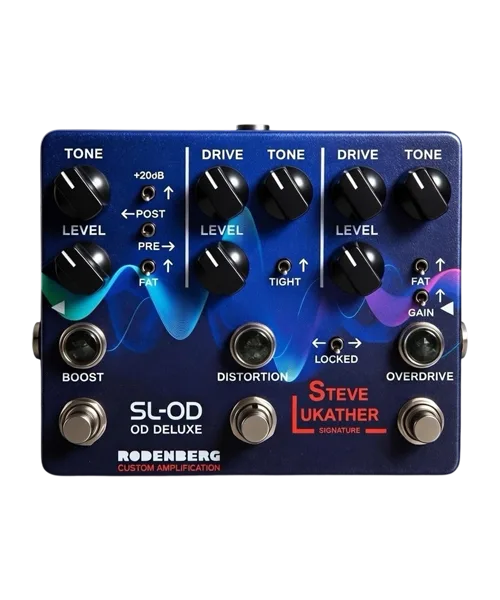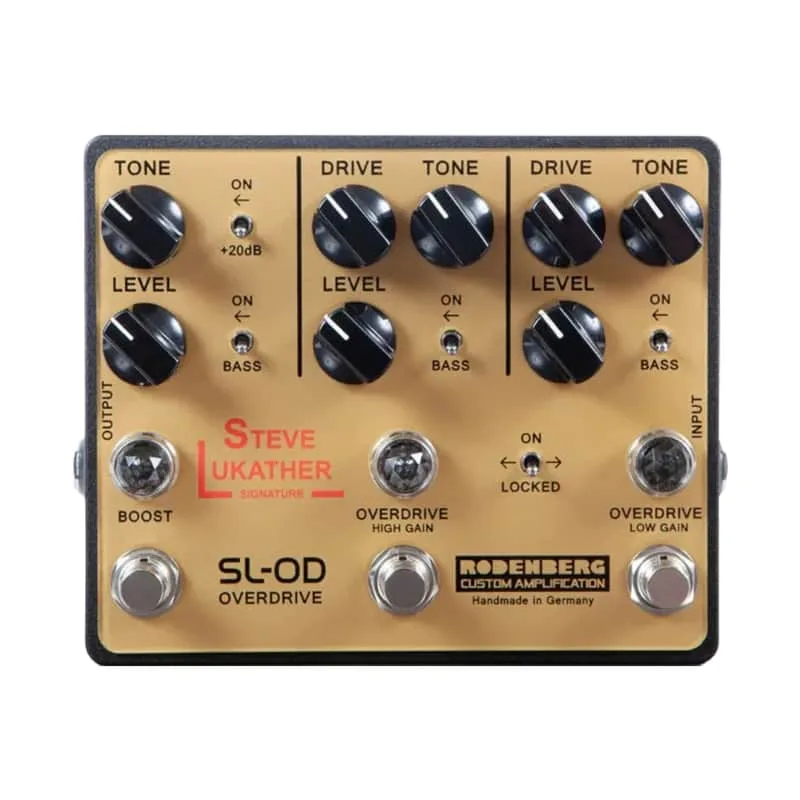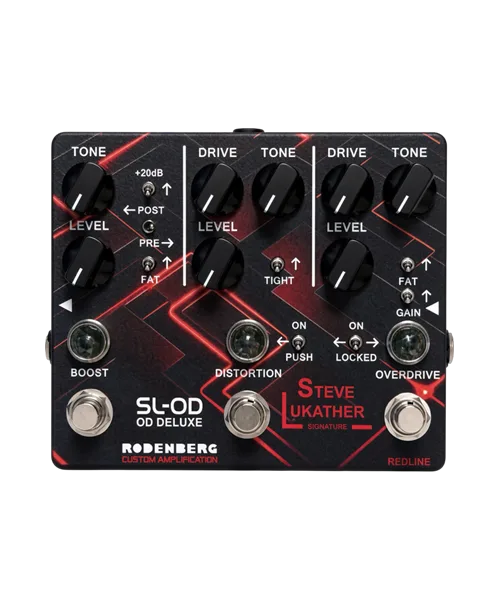


The Rodenberg SL-OD DELUXE REDLINE is an overdrive pedal that also carries distortion and boost in the same enclosure. Rodenberg describes it as a no-compromise stage pedal combining three fully independent sounds: a LOW to HIGH GAIN Overdrive, a Distortion, and a Boost1. The sound design is credited to Steve Lukather and Uli Rodenberg, and Rodenberg lists the pedal as the SL-OD DELUXE REDLINE Overdrive, Steve Lukather model2.
The pedal cannot run on a battery. It draws 60 to 100 mA, so plan your supply accordingly if you share power across a board1.
Three channels in one box
Each of the three sounds is independent, so the pedal can cover rhythm and lead parts without a second unit on the board. The Overdrive channel runs from low to high gain and carries two preset toggle switches of its own, FAT BOOST and GAIN1. The Boost is described by Rodenberg as a lively level boost, almost like an exciter, meaning it lifts the signal in a way that adds presence rather than just volume1.
The controls
| Channel | Controls |
|---|---|
| LOW to HIGH GAIN Overdrive | Level, Tone, Drive, plus FAT BOOST and GAIN preset switches1 |
| Distortion | Level, Tone, Drive1 |
| Boost | Level, Tone1 |
The three footswitches and their indicators work like this:
- The Overdrive channel shows its state with a blue jewel LED1.
- The LOCKED switch links the Overdrive and Distortion in a locked mode, so one foot press switches between both sounds1.
- PUSH mode makes the Distortion momentary: it is active only while your foot stays on the switch, and releasing it returns the pedal to its previous state, OFF1.
- The PRE/POST toggle switch places the Boost at the beginning or the end of the pedal's internal signal chain1.
That PRE/POST switch changes where the Boost hits the chain:
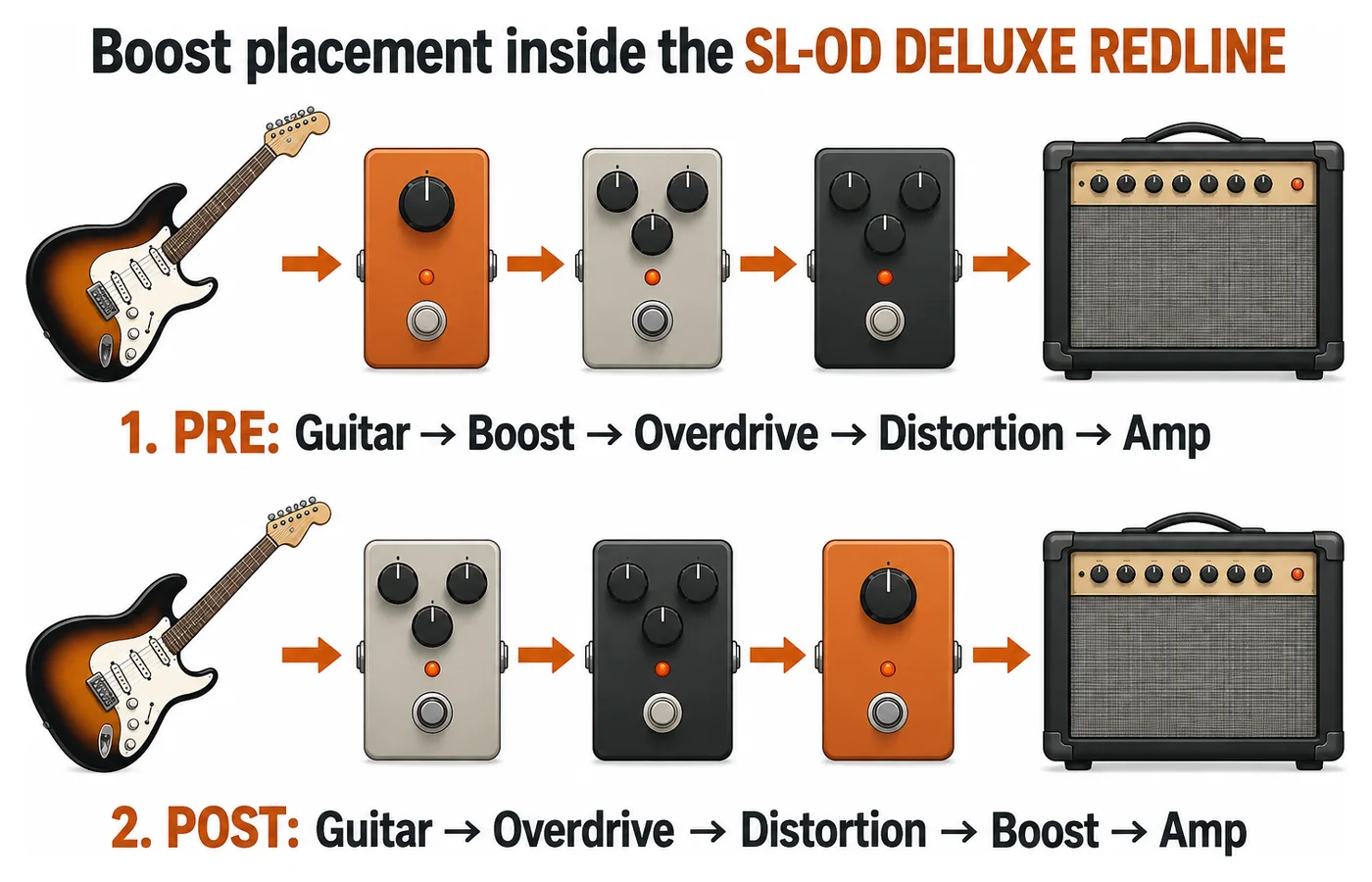
In PRE, the Boost pushes the Overdrive and Distortion, the way a clean boost driving a gain stage works. In POST, it sits last and simply lifts the finished sound on the way to the amp1.
Where it comes from
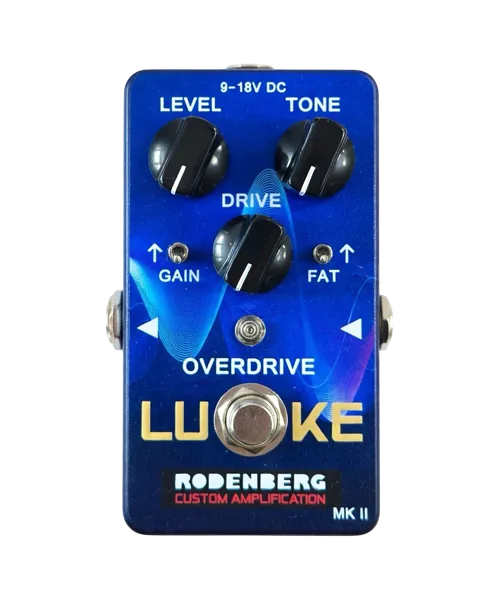
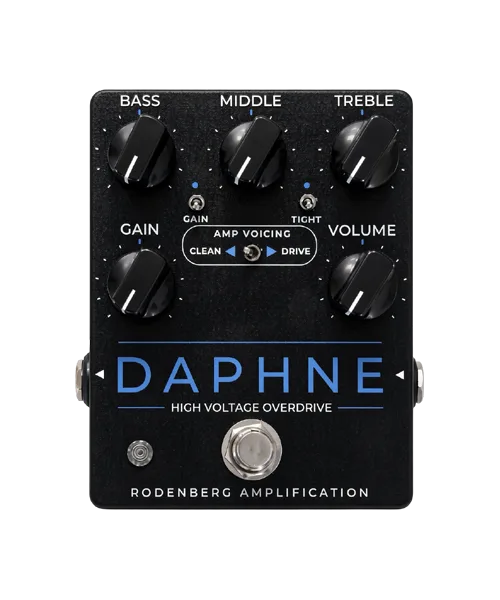
Rodenberg builds the pedal by hand in Germany in small quantities1. Steve Lukather, the Toto guitarist whose name the model carries, is credited alongside Uli Rodenberg for the sound design1. Rodenberg also makes related signature and overdrive pedals, including the Rodenberg SL-OD DELUXE, the Rodenberg SL-OD, the Rodenberg LUKE Overdrive MK II and the Rodenberg Daphne High Voltage Overdrive1.
Videos
RODENBERG amplification
RODENBERG amplification
RODENBERG amplification
Questions
Can the Rodenberg SL-OD Deluxe Redline run at 18V?
Yes. Rodenberg specifies a power range of 9 to 18V DC with a current draw of 60 to 100 mA. The standard supply is 9V DC, and the pedal accepts up to a maximum of 18V DC. There is no battery operation, so a power supply is required either way, and the current draw means a shared daisy-chain supply should be chosen with care.
What does the LOCKED switch do on the SL-OD Deluxe?
The LOCKED switch links the Overdrive and Distortion channels in a locked mode. In that mode, a single foot press switches between the two sounds rather than turning each channel on and off separately, which lets a player move from overdrive to distortion and back with one switch during a song.
Is the Rodenberg SL-OD Deluxe Redline true bypass?
Yes. Rodenberg describes the pedal as using a special mechanical true bypass circuit with optimized noise suppression, and says the switching is nearly click-free. That is intended to keep the pedal out of the signal path when it is off while avoiding the loud pop some true bypass switches produce.
Where are Rodenberg pedals made?
Rodenberg pedals are handcrafted in Germany, in small quantities. The SL-OD DELUXE REDLINE carries a three-year warranty and sits in a black powder-coated aluminum enclosure.
Sources (2)
- SL-OD DELUXE REDLINE, rodenberg-amplification.com
- SL-OD DELUXE REDLINE Overdrive, RODENBERG amplification
 Steve Lukather