

The Rodenberg SL-OD is an overdrive pedal from German maker Rodenberg Amplification, with its sound design credited to Steve Lukather and Uli Rodenberg. Its core idea is putting three fully independent sounds in one enclosure: a low gain overdrive, a high gain overdrive and a boost, each with its own controls and its own preset switches1.
Rodenberg describes the result as an open overdrive sound that reaches up to high gain in front of a clean amp, with a clear and structured tone, while stopping short of endless distortion territory. In front of an already driven amp, the maker says the tone becomes faster, more differentiated and more lead-like, with more gain, without changing the existing sound too much1.
Three sounds in one pedal
The SL-OD is built around the idea that a player might want a rhythm overdrive, a lead overdrive and a clean-ish level boost available at one stomp each, without stacking three separate boxes. Rodenberg's page presents the three sections as fully independent: the low gain and high gain overdrives each have their own character, and the boost is its own circuit rather than a byproduct of the drive channels1.
The boost is described by the maker as a lively level boost, "almost like an exciter"1. For players who use a boost to push an amp harder rather than to add its own color, that description suggests the SL-OD's boost leans toward adding life and presence rather than being completely transparent.
The controls on each channel
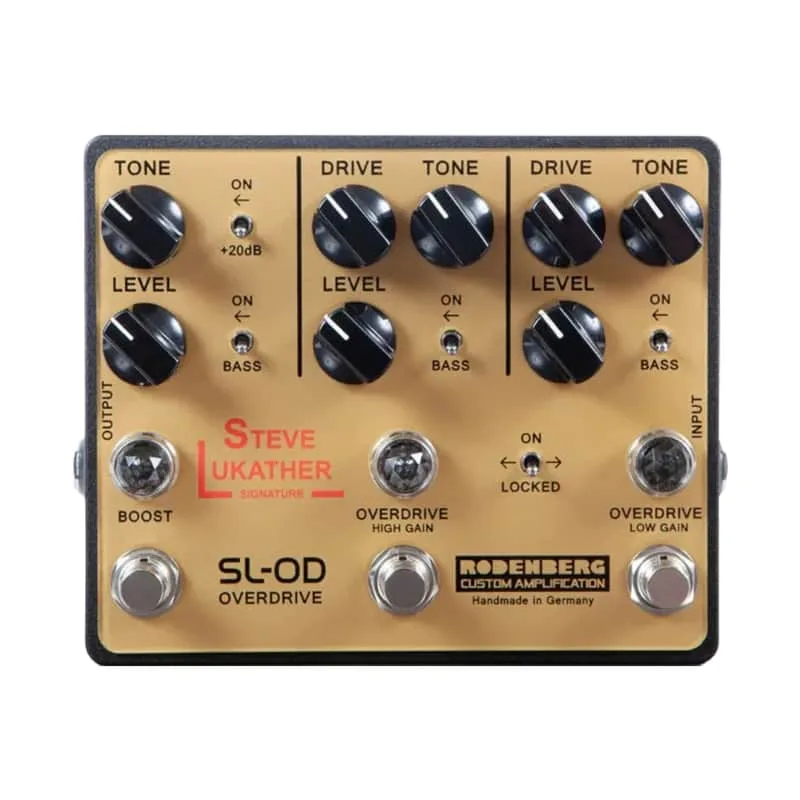
Each overdrive channel gets its own set of Level, Tone and Drive controls, so the two drive sounds can be dialed in completely independently. The boost channel is simpler, with Level and Tone only, which fits its role as a level boost rather than a drive stage1.
Beyond the knobs, each channel carries preset toggle switches that shift its character134:
| Channel | Knobs | Preset switches | Jewel LED |
|---|---|---|---|
| Low gain OD | Level, Tone, Drive | Bass Boost | Blue |
| High gain OD | Level, Tone, Drive | Bass Boost | Red |
| Boost | Level, Tone | +20 dB level boost | 1 |
The bass boost switches are separate for the low gain and high gain overdrives, so one channel can run thick in the low end while the other stays tighter. The boost channel's +20 dB preset switch adds a large level jump for solos1.
The jewel LEDs do more than light up: the blue jewel marks the low gain overdrive and the red jewel marks the high gain overdrive, so on a dark stage you can tell at a glance which drive channel is active1.
Power and bypass
The SL-OD runs on 9 to 18V DC, with 9V as the standard supply and 18V as the maximum, drawing 60 to 100 mA1.
There is no battery operation, so the pedal needs a power supply from day one. At up to 100 mA it is also hungrier than a typical analog overdrive, worth checking if you run a small or fully loaded daisy chain.
The bypass is a mechanical true bypass circuit with what Rodenberg calls optimized noise suppression, designed to switch nearly click-free. True bypass means the signal path is out of the circuit entirely when the pedal is off, and the noise suppression work addresses the switching pop that mechanical true bypass can otherwise produce1.
Steve Lukather and the SL-OD family
The line has since grown into several versions, each reshuffling the same basic idea of independent sounds in one box143:
| Version | Sounds | Notes |
|---|---|---|
| SL-OD | Low gain OD, high gain OD, boost | The original three-channel format1 |
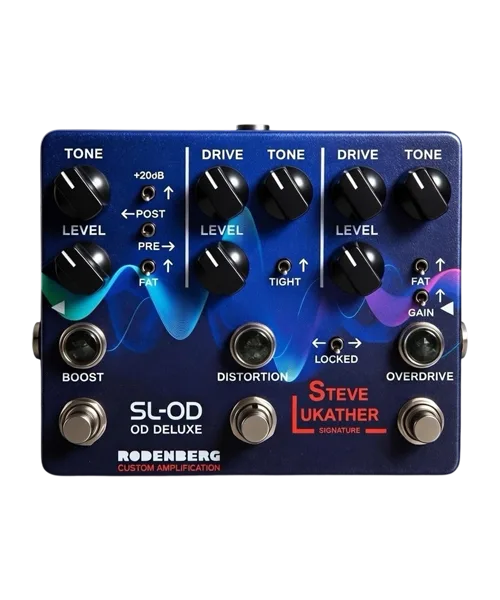
| SL-OD DELUXE | Overdrive and distortion | LOCKED mode links both so one footswitch press switches between them5 |
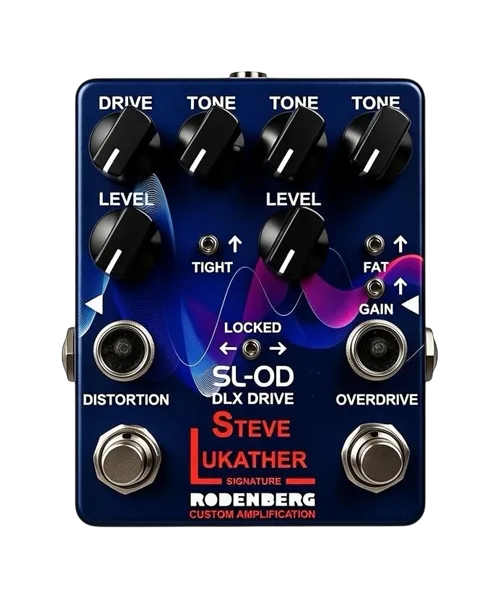
| SL-OD DLX DRIVE | Low to high gain overdrive, distortion | Two independent sounds, 50 to 80 mA draw3 |
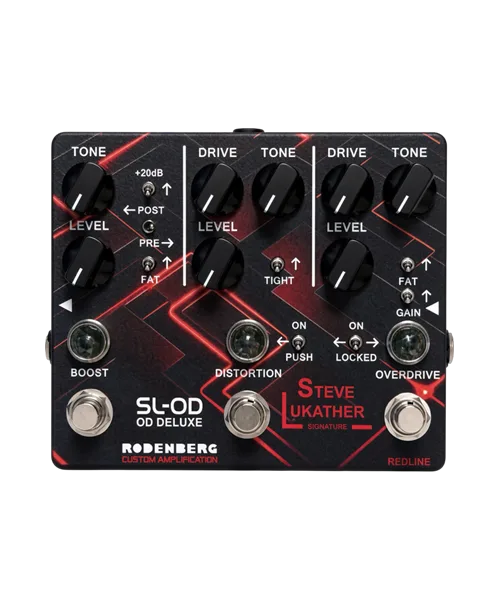
| SL-OD DELUXE REDLINE | Low to high gain OD, distortion, boost | PRE/POST switch moves the boost to the start or end of the chain4 |
The Deluxe Redline goes back to three sounds, combining low to high gain overdrive, distortion and boost in what Rodenberg calls an uncompromising stage pedal. Its distinctive extra is the PRE/POST toggle, which places the boost either at the beginning or the end of the pedal's internal signal chain, so the boost can push the drive channels harder or sit after them as a pure level lift. Its overdrive channel has Fat Boost and Gain preset switches, and it runs on the same 9 to 18V DC, 60 to 100 mA supply as the original4.
All of these versions share the same pedigree: sound design by Steve Lukather and Uli Rodenberg, handcrafted construction in Germany in small quantities, mechanical true bypass with noise suppression, and no battery operation345.
Where it sits among Rodenberg's pedals
Videos
ChoptonesOfficial
Elmo Karjalainen
Fabian Ratsak - Guitar Tone and Gear
Questions
Does the Rodenberg SL-OD run on a battery?
No. Rodenberg specifies no battery operation for the SL-OD, so it needs an external power supply. It runs on 9 to 18V DC and draws 60 to 100 mA, which means a standard 9V pedalboard supply works, but the draw is high enough that a small daisy chain may be stretched if it shares with other hungry pedals.
Is the SL-OD true bypass?
Yes. Rodenberg describes a special mechanical true bypass circuit with optimized noise suppression that switches nearly click-free. When the pedal is off, the signal passes through without buffering, and the switching design is intended to avoid the loud pop some mechanical true bypass pedals produce.
What does the bass boost switch on the SL-OD do?
The bass boost is a preset toggle switch, and there is a separate one in the low gain and the high gain overdrive channels. That means you can thicken the low end of one drive channel without changing the other, so the two overdrives can be set up with different low end responses.
Does Steve Lukather use the SL-OD?
The pedal carries his name and its sound design is credited to Steve Lukather and Uli Rodenberg together. Rodenberg's page states that Lukather has used Rodenberg pedals continuously since 2017, both live and in the studio.
Where is the Rodenberg SL-OD made?
In Germany. Rodenberg states the SL-OD is handcrafted in Germany, and the same applies to the Deluxe, DLX Drive and Deluxe Redline versions, which the maker describes as handcrafted in small quantities. The pedal comes with a 3 year warranty.
Sources (5)
- SL-OD - RODENBERG amplification, rodenberg-amplification.com
- SL-OD Overdrive, rodenberg-amplification.com
- SL-OD DLX DRIVE, RODENBERG amplification
- SL-OD DELUXE REDLINE, rodenberg-amplification.com
- SL-OD DELUXE, rodenberg-amplification.com
 Steve Lukather