

The Roger Mayer Visage is a distortion pedal from Roger Mayer. It is a simple design to operate: the controls are simply Gain and Output, one knob for drive and one for level1. Mayer describes the pedal as carrying 45 studio variations of the genuine sounds used, drawn from his own work as an effects builder2. GuitarPlayer reported that Mayer released a revamped Visage in a more pedalboard-friendly casing1.
What the Visage does
The pedal's central feature is access to the circuit's internal stages. Mayer's product page describes 45 parameter combinations that give players access to the internal stages of the design, which the page also calls 45 studio variations of the genuine sounds used2. On the panel, that range is handled simply: GuitarPlayer notes that "the controls are simply Gain and Output"1, so the deeper variations are reached through the pedal's internal parameter control rather than a row of knobs.
The controls and hardware, as the maker and press give them:
| Item | Detail |
|---|---|
| Gain | Sets the amount of distortion1 |
| Output | Sets the pedal's output level1 |
| Internal parameter control | Reaches the 45 parameter combinations2 |
| Footswitch | Genuine USA Carling footswitch2 |
| Battery life | 200 hours2 |
Mayer describes the result in his own terms on the product page:
"The result is a remarkably quiet and fast reacting device that responds very well to the players touch and retains the character of the original guitar even with lots of distortion"
As with any maker's description, that is how Mayer characterizes the pedal, not an independent verdict.
Circuit background
The Visage's lineage runs through Mayer's work with Hendrix. As he told GuitarPlayer12:
"It's based upon the modifications I did on the Fuzz Face type of pedals during my period of working with Jimi Hendrix"
JHS Pedals' history of that era describes how Mayer "famously took these Fuzz Face enclosures, messed with them, took out the circuitry, put in his own stuff"3. The Visage carries that approach forward with one clear break from the vintage parts bin: it uses silicon transistors. Mayer's explanation, in the same GuitarPlayer piece:
"It utilizes silicon transistors; we don't use germanium transistors anymore because they're too noisy and unpredictable"
Players expecting the germanium character of a period Fuzz Face should note the Visage is a silicon design by intent, a choice Mayer ties directly to noise and consistency1.
The maker
Roger Mayer was building effects long before the Visage. GuitarPlayer's classic gear feature on the Octavia notes that he "had already started building treble boosters and experimenting with guitar tones while still in school"4. His company is still active: Delicious Audio's buying guide records that "his company is still going today, and he builds his classic effects, like the Octavia, with studio-grade components"5. Mayer has been skeptical of digital alternatives, telling Premier Guitar, "if you know anything about digital modeling, it's basically painting by numbers"6.
Points a player can take from that history:
- Mayer was experimenting with guitar tones and building treble boosters while still in school4
- His company builds its classic effects, such as the Octavia, with studio-grade components5
- The 2022 revamp put the Visage and other designs in a more pedalboard-friendly casing1
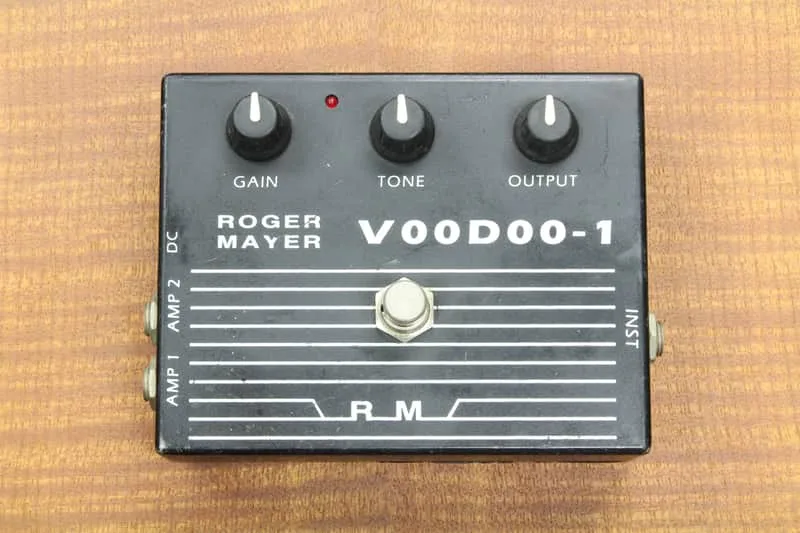
Other current designs in his range include the Roger Mayer Voodoo-1.
Videos
Electric Mojo Guitars
carlygtr
Electric Mojo Guitars
Sources (6)
- What Might Hendrix's Pedalboard Look Like If He Were Alive Today? Roger Mayer Reveals His Thoughts and Talks New Jimi-Inspired Effects Pedals, GuitarPlayer (www.guitarplayer.com), 2022-04-01
- Guitar Effects Pedals & Recording by Roger Mayer, Roger Mayer (roger-mayer.co.uk)
- MINI FUZZ FACES, JHS Pedals
- Classic Gear: Roger Mayer's Octavia Pedal, GuitarPlayer (www.guitarplayer.com), 2021-11-02
- The Best Octavia Fuzz Pedals In 2023: Clones And Evolutions, Delicious Audio, 2023-03-09
- Roger and Me: A conversation with Roger Mayer, Premier Guitar, 2008-12-16