The Octavia is an octave-up fuzz circuit: a fuzz pedal that also doubles the frequency of the note you play, producing a sound an octave higher than the input. It was designed by Roger Mayer in early 1967 and built specifically for Jimi Hendrix, who used it on "Purple Haze" and "Fire"1. The debut of that frequency-doubled tone on "Purple Haze" in 1967 was the first time the Octavia sound was heard on record234.
The name is worth clearing up first. Roger Mayer always called the boxes Octavia, but Jimi and a few others called them Octavio, and the boxes were never labeled by Mayer himself1. Both names refer to the same circuit, and you will see both spellings across vintage listings and modern clones.
Where the Octavia came from: Roger Mayer and Hendrix
Roger Mayer was a British engineer who had been working on Jimi Hendrix's guitar sound when he designed the Octavia in early 1967. In his own account, the debut of the frequency doubled tone by Hendrix on "Purple Haze" in 1967 began his relationship with Jimi2. Mayer describes the design plainly:
"ANYWAY YOU LOOK AT IT I DESIGNED THE ORIGINAL"
Roger Mayer1
The pedal was created specifically for Jimi Hendrix, who used it on tracks such as "Purple Haze" and "Fire"5. Mayer went on tour to the USA with Jimi from January 30, 1968 until April 19, 1968, where the first wedge shaped Octavia was used on a few special gigs1.
Mayer's own history fills in the rest of the timeline. The first runs of the commercial Octavia were made in the U.S., before he departed New York to return to England in 19806. The Octavia itself was reissued in the early 1980s, when demand and pressure from other players encouraged Mayer to put out the last version Jimi had used7.
How it works: frequency doubling and ring modulation
Electronically, the Octavia is an analog circuit with the properties of a frequency doubler, an envelope generator and an amplitude modulator, plus additional frequency shaping filter circuits1. In plain terms, it is a fuzz whose clipping and transformer coupling interact to generate strong second harmonics, so the output contains a component at double the input frequency. That is what gives the octave-up effect: the OCTAVIA produces a sound that is an octave higher than the note you are presently playing1.
What the circuit does to your sound depends heavily on what feeds it, and Mayer describes the two distinct behaviors himself:
- A fuzz unit in front of the Octavia produces an upper octave double1.
- A clean tone with the tone control rolled off produces "ring modulated" overtones instead1.
That second behavior is why the Octavia is often described alongside ring modulation. The amplitude modulator section of the circuit behaves like a ring modulator when the input is clean and dark, generating inharmonic overtones that change with the note you play. With a fuzz driving it, the waveform is already so squared off that the doubling dominates and the octave-up component comes forward. This is the practical answer to where the pedal belongs in a chain: it is designed to sit after a fuzz, not before one. The current Roger Mayer Octavia also contains a feedforward and gating effect1.
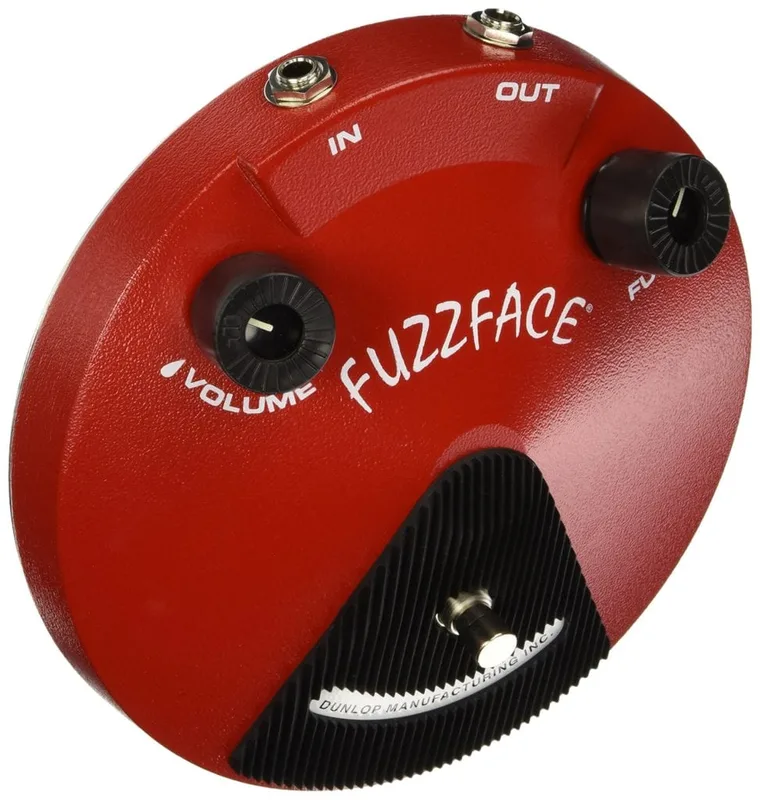
For a player comparing circuits, the Octavia sits apart from a standard fuzz like the Fuzz Face: a Fuzz Face changes the character of the note, while the Octavia adds a new pitch component on top of it. It also differs from modern digital octave pedals, which track the note and synthesize a clean octave. The Octavia's octave is a byproduct of analog clipping and modulation, so it is strongest on single notes high on the neck and breaks up into harmonics on chords and low notes14.
Early versions, the transformer and the Rocket
The Octavia went through several distinct designs, and the differences matter to anyone chasing a particular version4.
The early Evo1 unit used germanium transistors and a ferrite transformer, and had limited drive capabilities1. The latest evolution of the Octavia was then housed in the new wedge enclosures, and still used germanium transistors and ferrite transformers1. A later Tycobrahe version, which Mayer considers an incorrect knock-off of an earlier 24-volt version of his circuit, was not designed by him1.
The Rocket version is the end of that development line. Mayer describes it as the latest version connected with Jimi, and it does not use a transformer1. The reissue in the early 1980s debuted the futuristic looking Rocket casting, which did not exist before then, and became the enclosure for the whole Rocket Series7.
| Version | Transistors | Transformer | Notes |
|---|---|---|---|
| Evo1 | Germanium | Ferrite | Limited drive capabilities1 |
| Wedge series (1969) | Silicon, NPN/PNP complementary | Iron audio driver | Run of units sent to named players1 |
| Rocket Octavia | Not stated | None | Last version connected with Jimi1 |
| Octavia Classic | Not stated | Not stated | Rocket tones plus added tone control section8 |
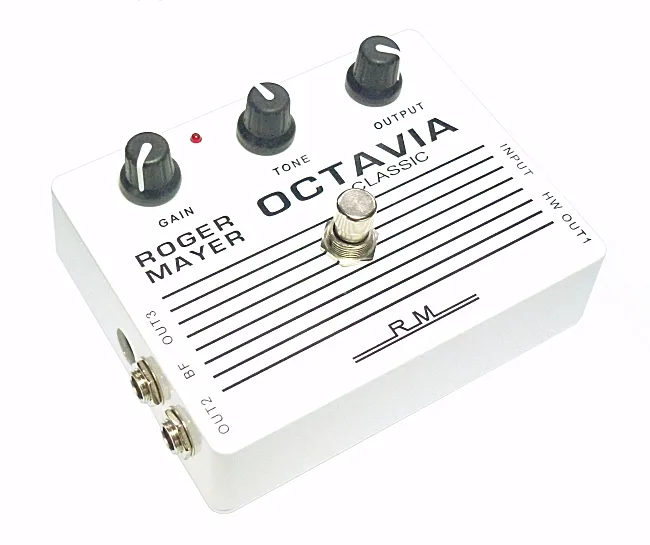
The current Roger Mayer range reflects this evolution. The Octavia TC is described by Mayer as his most famous creation, first heard on "Purple Haze", with the TC version adding performance control of Drive3. The Octavia Classic carries the same tones as the Rocket Shape Octavia with an added tone control section, in a smaller standard enclosure with hard wire and dual buffered outputs8. The Vision Octavia is the latest version, an evolution inspired by Mayer's memories of Jimi and his music1. The pedals are now power supply friendly2.
The Tycobrahe Octavia
The Tycobrahe Sound Company Octavia is the version most modern players actually encounter, because it is the one nearly every clone copies. Roger Mayer's account of it is blunt1:
"The modern clones today often copy the Tycobrahe unit that in fact was a rip off of my earlier 24 volt versions1."
Roger Mayer1
Mayer describes the Tycobrahe clone, more correctly an inaccurate copy, as based on a 1969 variation of the Octavia for 24 volt operation, copied from the example Keith Relf had, and not designed to work optimally with 9 volts1. Tycobrahe was only around for a few years and did not make a lot of units, which is why originals are incredibly hard to find910. Voodoo Lab describes the Tycobrahe Octavia as one of the most desired pedals by vintage collectors, and as the model used by Stevie Ray Vaughan1112. Voodoo Lab also credits the Octavia sound with giving the "Purple Haze" solo its unique, stringy sting12.
The practical difference between the two lineages comes down to this: Roger Mayer's own designs evolved past the transformer into the Rocket version, while the Tycobrahe copy froze a 1969, 24-volt-oriented transformer design and became the template almost everyone else builds1.
Pedals based on the Octavia
The Octavia circuit has one of the longest clone lists of any fuzz. Some notable examples13:
| Pedal | Maker | Basis |
|---|---|---|
| Proctavia | Voodoo Lab | Exact replica of the Tycobrahe Octavia11 |
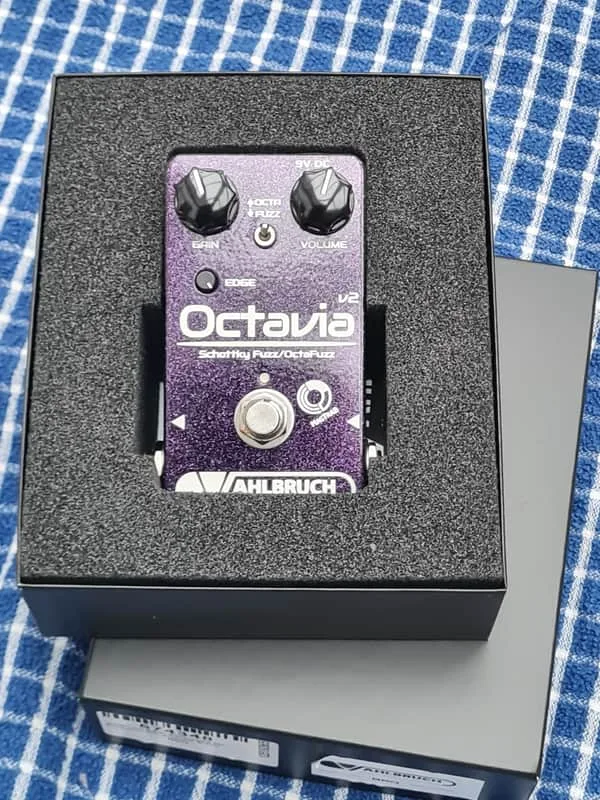
| Octavia v2 | Vahlbruch FX | Tycobrahe style, transformer with downstream clipping diodes14 |
| Octavus | Function f(x) | Take on the Tycobrahe Octavia octave up fuzz15 |
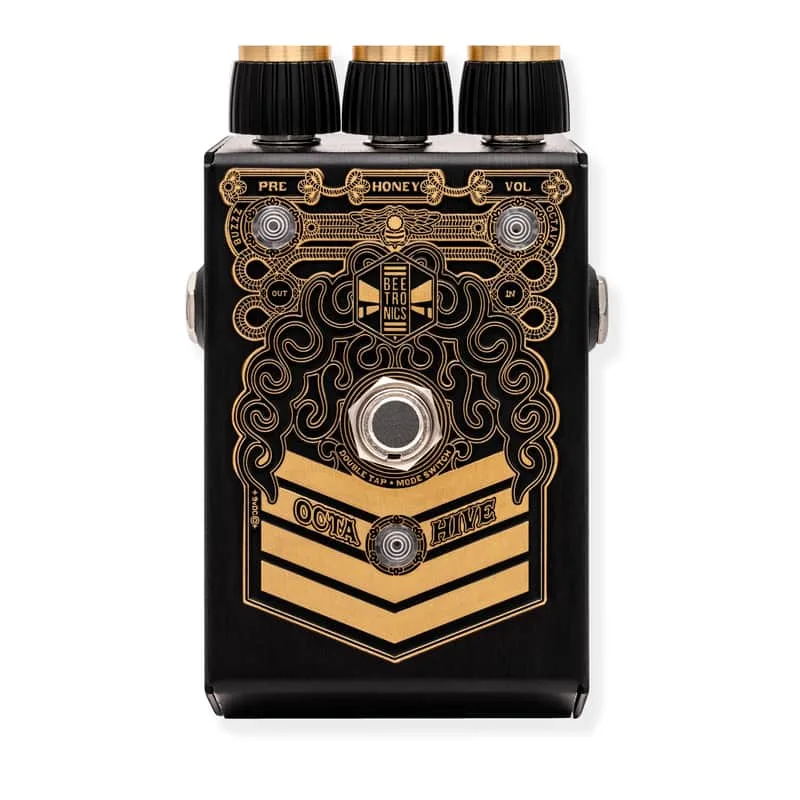
| Octahive | Beetronics | The 1970's Tycobrahe Octavia16 |
| Octavia Fuzz | Tru-Fi | Tycobrahe Octavia10 |
| Compact Octavia | Tru-Fi | Tycobrahe Octavia, with the right transistors and the right transformer inside9 |
| OLD TIMER | ThorpyFX | Tycobrahe Octavia octave fuzz section17 |
| Octone | Pedal Pawn | A very rare vintage 1970s Octavia1819 |
| SLOB | BLAMMO! Electronics | Classic Octavia circuit plus a blend control and more output volume20 |
| Bloup! | GUP Tech | Roger Mayer 1967 build, tweaked around the Tycobrahe revision21 |
| Retrograde24 | madbeanpedals | Tycobrahe Octavia22 |
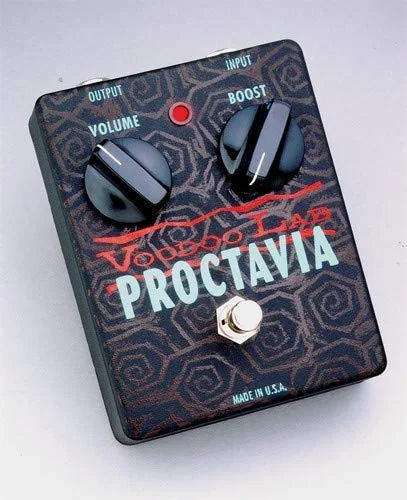
The Voodoo Lab Proctavia is an exact replica of Tycobrahe Sound Company's Octavia, a fuzz which creates the octave doubling effect one octave higher11. The Vahlbruch Octavia v2 is a Fuzz / OctaFuzz pedal made in Germany, using a special transformer with downstream clipping diodes in the style of the Tycobrahe, with a toggle switch for OctaFuzz or pure Fuzz mode without the octave-up; version 2 added the MagTraB switch, an additional Edge control and Schottky diodes instead of germanium14. The Beetronics OctaHive was based on the 1970's Tycobrahe Octavia and can produce classic and modern sounds16. The Tru-Fi Compact Octavia is built with the right transistors and the right transformer inside9. Pedal Pawn's Octone came out of the makers deeming a very rare vintage 1970s Octavia the gold standard18.
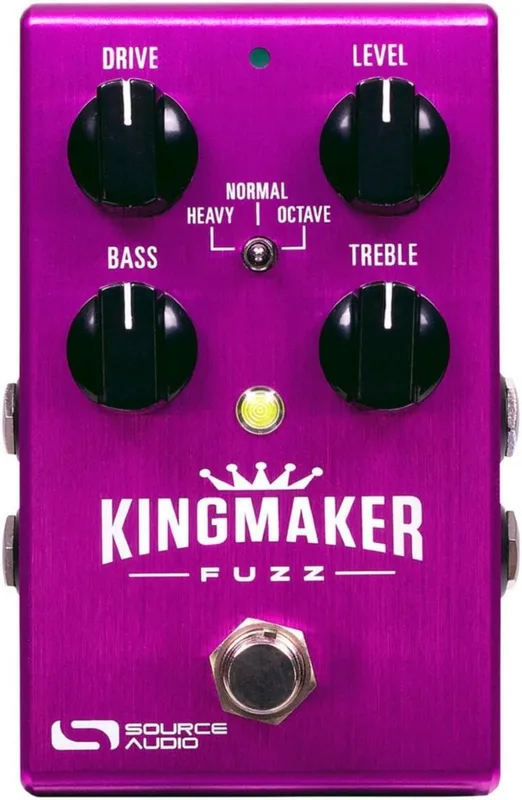
The circuit has also spread beyond standalone fuzz boxes. Source Audio's Kingmaker Fuzz includes an OCTAVE engine based on an Octavia23. Kemper's Fuzz distortion effect lists the Roger Mayer Octavia among its models24. Jed's Peds sells an Octavio kit, noting the circuit was famously used by Jimi Hendrix and Stevie Ray Vaughan in their day25.
DIY layouts for the transformerless Octavia
The Octavia is a popular DIY build, and the circuit splits into two camps that mirror the commercial versions: transformer-based Tycobrahe copies and the transformerless Roger Mayer design261.
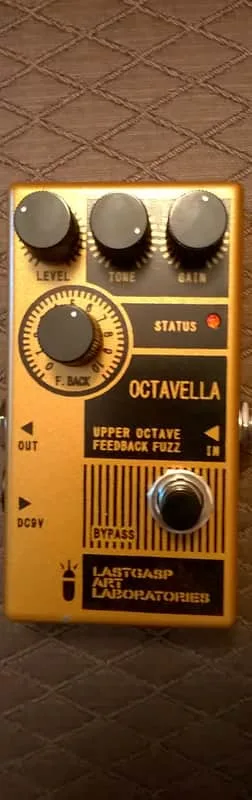
On the Tycobrahe side, madbeanpedals' Retrograde24 is documented as based on the Tycobrahe Octavia22, and PedalPCB's Ottava Octave Fuzz is presented as a comparison to the Lastgasp Octavella27. On the Roger Mayer side, the original transformerless circuit has circulated as a stripboard layout: the Guitar FX Layouts blog published a 21 by 15 stripboard vero layout of the transformerless Roger Mayer Octavia in February 2014, noting it fits a 1590B enclosure. General Guitar Gadgets cites the Octavia as an example of a PNP transistor circuit in its power supply documentation, a reminder that the original polarity arrangement is the opposite of what most modern pedalboards expect, and that PNP builds need attention to how they are powered28.
For builders, the choice between the two approaches is the same one players face with commercial pedals. The transformer-based Tycobrahe layout needs the right transformer, which Tru-Fi identifies as central to getting the sound right9. The transformerless Roger Mayer design avoids that hard-to-source part but reproduces a different, later point in the circuit's development.
Pedals on this page
News
Questions
What octave pedal did Hendrix use on Purple Haze?
He used the original Octavia designed for him by Roger Mayer in early 1967. The solo of Purple Haze, recorded February 3, 1967, was the first time the Octavia sound was heard on record. Jimi Hendrix and a few others called the boxes Octavio, but Roger Mayer always called them Octavia.
Who designed the Octavia?
Roger Mayer, a British engineer who had been working with Jimi Hendrix on his guitar sound. He designed the first Octavia in early 1967 and continued developing it through several versions, including the wedge shaped units and the transformerless Rocket Octavia.
What is the difference between the Roger Mayer and Tycobrahe Octavia?
Roger Mayer's originals evolved through germanium and silicon transistor designs, ending in the transformerless Rocket version. The Tycobrahe Octavia was a copy of a 1969 variation of the circuit built for 24 volt operation, which Roger Mayer describes as not designed to work optimally at 9 volts. Most modern clones follow the Tycobrahe copy.
Does the Octavia work better before or after a fuzz?
According to Roger Mayer, a fuzz unit in front of the Octavia produces an upper octave double. A clean tone from the guitar with the tone control rolled off instead produces ring modulated overtones. So the Octavia is designed to sit after a fuzz in the chain, not before it.
Is Roger Mayer still making the Octavia?
Yes. Roger Mayer reissued the last version Jimi used in the Rocket casting in the early 1980s and has continued producing the pedal since. The current range includes the Octavia TC, the Octavia Classic with an added tone control section, and the Vision Octavia.
Did Stevie Ray Vaughan use an Octavia?
Yes. Stevie Ray Vaughan used the Tycobrahe Octavia, the 1970s copy of Roger Mayer's circuit. Voodoo Lab describes the Tycobrahe model as the one used by Stevie Ray Vaughan and one of the most desired pedals by vintage collectors, which is why its Proctavia replica targets that specific version.
Sources (28)
- Guitar Effects Pedals by Roger Mayer, roger-mayer.co.uk, 1968-01-30
- Guitar Effects Pedals by Roger Mayer, Roger Mayer (roger-mayer.co.uk)
- Guitar Effects Pedals by Roger Mayer, Roger Mayer (roger-mayer.co.uk)
- The Best Octavia Fuzz Pedals In 2023: Clones And Evolutions, Delicious Audio, 2023-03-09
- Octavia by Roger Mayer, RockBoard PedalPedia, 2026
- Classic Gear: Roger Mayer's Octavia Pedal, GuitarPlayer (www.guitarplayer.com), 2021-11-02
- Guitar Effects Pedals by Roger Mayer, Roger Mayer (roger-mayer.co.uk)
- Hot News, Roger Mayer (roger-mayer.co.uk)
- NEW Compact Octavia Guitar Pedal in smaller and modern enclosure, tru-fi.com
- Octavia Fuzz Guitar Pedal, tru-fi.com
- Proctavia, Voodoo Lab, 2026-10-14
- Proctavia FAQ, Voodoo Lab, 2026-07-24
- [HOW TO FIND THE FUZZ YOU NEED
- Vahlbruch Octavia Fuzz Octaver pedal, MagTraB switching, made in Germany, Vahlbruch FX, 2023
- Octavus - Tychobrahe Octavia Variant - Tiny and Ferocious - Function f(x), Function f(x), 2026-09-30
- Octahive, Beetronics
- The OLD TIMER, ThorpyFX
- OCTONE ™, Pedal Pawn
- Pedal Pawn unveils the Octone, an octave fuzz inspired by the “spooky magic” of a vintage Octavia, Guitar World, 2022-08-02
- SLOB | BLAMMO! Electronics, BLAMMO! Electronics
- Bloup Octavia Fuzz Tribute, GUP Tech (guptech.ca)
- Retrograde24.pdf, madbeanpedals.com, 2024-11-21
- Kingmaker Fuzz, Source Audio
- KEMPER Distortion Effects, Kemper GmbH
- Octavio | DIY Guitar Effects Pedal Kits, Jed's Peds (jedspeds.co.uk)
- Guitar FX Layouts: Roger Mayer Octavia, tagboardeffects.blogspot.com (Guitar FX Layouts)
- Ottava Octave Fuzz, PedalPCB.com
- How to Add a 9V Power Jack to a Guitar Pedal, generalguitargadgets.com, 2014-05-22