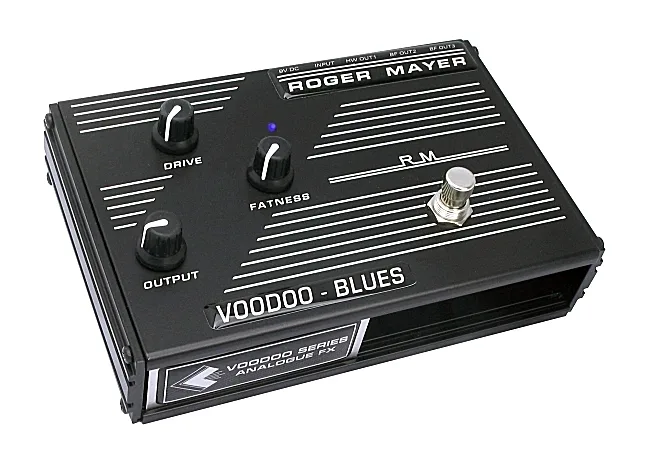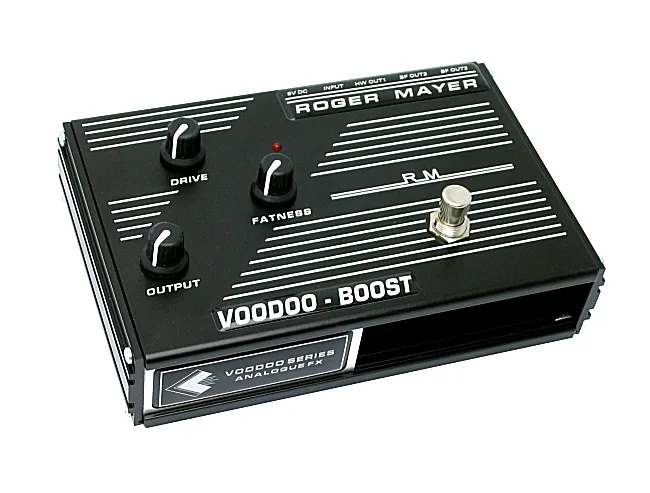


The Roger Mayer Voodoo Boost is an analog clean boost pedal, described by its maker as a 20dB clean boost with fatness control and the latest in the Voodoo Series of analog guitar effects1. It does more than raise volume: Roger Mayer states it controls not only volume boost but also has a fatness control and a gain/distortion control, so it can push an amp's input or shape the tone of the boost itself1.
The controls and outputs
At its core the pedal is a volume boost: a touch of the footswitch engages what Roger Mayer calls a significant distortion free volume boost to the amplifier's input1. Around that, the fatness control sets the tone required when the boost is used, and the maker says a wide range of amplifier tones can be emulated with ease, from Screaming Tweed Twang to Classic British 4 x12 tones, with no overriding nasal tonal quality1.
The output arrangement is unusual for a boost pedal and worth understanding before you wire it up1:
- Dual direct drive buffered outputs: capable of driving very long leads without any loss, which Roger Mayer describes as reducing output lead length to zero1
- Traditional hard wire output/bypass: provided as well, to enable comparison between using a buffered output in your patch and a straight wire1
- Buffer disconnection: the buffered outputs are disconnected when the hard wire output is used1
That makes the pedal a candidate for the end of a board even if you normally avoid buffers; players who prefer no buffering at all can simply use the hard wire output. For more on where a buffer belongs in a chain, see Buffer Pedals, and for other pedals in this family, see Roger Mayer Voodoo-Blues, which adds a Tone control along with Gain and Output knobs for fine tuning the blues tone without adding more distortion3.
Placement in the signal chain
Roger Mayer designed the Voodoo Boost to be used last in the effects chain, just before the amplifier1. That placement matters: the boost is meant to hit the amp's input directly, which is how the pedal delivers its range of amplifier tones, and the buffered outputs are there to carry that signal down long cable runs without loss1. If you are comparing boost designs, the Boost Pedals page covers the wider type, and the gain/distortion control also overlaps with what Overdrive Pedals and Distortion Pedals do.
Power and battery life
The Voodoo Boost runs on 9 volt DC, with a regulated output recommended, and draws 50mA or more1. Power access is through a standard DC power jack with a 2.1mm center pin, situated next to the jack sockets, and it uses the standard negative center pin connection protocol used by many leading manufacturers; an external AC adapter is not supplied1.
The pedal is housed in a standard style enclosure with a rapid change 9V battery compartment, and Roger Mayer specifies 150 hours or more using a premium grade alkaline 9 Volt type1. With a 50mA or higher current draw, a daisy chain supply shared with several pedals may not be adequate; a regulated supply rated for the draw is the safer choice1.
Videos
Roger Mayer
Tom
james ryan
Questions
Where does the Roger Mayer Voodoo Boost go in the signal chain?
Roger Mayer designed the Voodoo Boost to be used last in the effects chain, just before the amplifier. That placement lets the boost drive the amp's input directly, which is where the pedal's range of amplifier-style tones, from tweed twang to classic British 4x12 tones, is meant to come through. Its dual buffered outputs can also drive very long cable runs without loss, so it works well as the final pedal before a long lead to the amp.
Does the Voodoo Boost run on a battery?
Yes. The pedal is housed in a standard style enclosure with a rapid change 9V battery compartment, and Roger Mayer specifies 150 hours or more of battery life using a premium grade alkaline 9 Volt type. It can also run from an external 9 volt DC adapter with a regulated output recommended, using the standard negative centre pin connection protocol.
What does the fatness control do?
The fatness control sets the tone required when the boost is engaged. Roger Mayer describes the pedal as covering a wide range of amplifier tones, from Screaming Tweed Twang to Classic British 4 x12 tones, without an overriding nasal tonal quality. Alongside fatness there is also a gain/distortion control, so the pedal shapes more than just volume.
Is the Voodoo Boost analog?
Yes. Roger Mayer describes the Voodoo Boost as the latest in the Voodoo Series of analogue guitar effects. The pedal is analogue throughout, with a footswitch-engaged distortion free volume boost, a fatness control and a gain/distortion control.
What power supply does the Voodoo Boost use?
The Voodoo Boost takes 9 volt DC power, with a regulated output recommended, through a standard DC power jack with a 2.1mm centre pin situated next to the jack sockets. It uses the standard negative centre pin connection protocol used by many leading manufacturers, and draws 50mA or more. An external AC adapter is not supplied.
Sources (3)
- Guitar Effects Pedals by Roger Mayer, Roger Mayer (roger-mayer.co.uk)
- VooDoo Bass by Roger Mayer, RockBoard (rockboard.de PedalPedia), 2026
- What Might Hendrix's Pedalboard Look Like If He Were Alive Today? Roger Mayer Reveals His Thoughts and Talks New Jimi-Inspired Effects Pedals, GuitarPlayer (www.guitarplayer.com), 2022-04-01