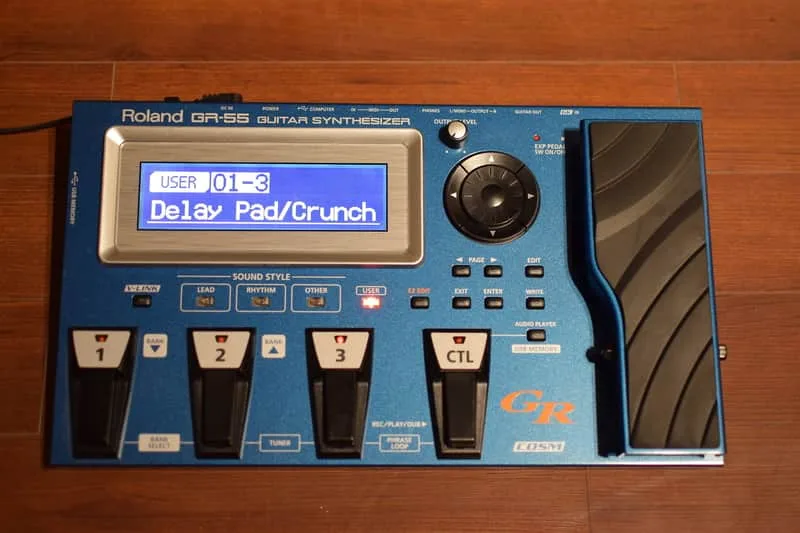


The Roland GR-55 is a guitar synthesizer with modeling and effects, released in 20111. It sits in a long line of Roland and Boss guitar synths, and it fuses elements from both the GR and VG series into one unit, delivering the sounds of virtual guitars, basses and amps plus synth voices2. Roland describes the GR-55 as far and away the fastest tracking guitar synth ever, and MusicRadar's reviewer Trevor Curwen wrote that this is borne out when playing2.
It is not a pedal you plug a normal guitar straight into. The GR-55 connects via the industry-standard 13-pin cable to Roland's GK-3 divided pickup hardware, which is what makes the pitch detection work2. There are two GR-55 versions, one with and one without a pickup, to cater for players who already have a guitar sporting one2.
What it does to your sound
A patch on the GR-55 can blend four voices at once. The Edit button's first page, 'Tone', shows you the elements the patch is made up from: the PCM1 and PCM2 synth engines, the COSM engine and the normal pickup, with mixing, sound selection and parameter tweaking available for each2. COSM is Roland's modeling approach, and on the GR-55 it covers guitar and amp simulation for conventional guitar tones as well as altered tunings2. Boss's own history article says newly developed pitch-detection technology made it the fastest and most accurate guitar synthesizer1.
"A practical blend of synthesis and modelling in an easy-to-use package that will greatly expand your sonic options."
The controls
Foot control comes from four switches and a pedal treadle, alongside a larger rotary wheel and four-way cursor set-up2.
| Control | What it does |
|---|---|
| First three footswitches | Select patches, which are stored in banks of three, letting you change sound instantly on stage2 |
| First two footswitches (held together) | Enter bank select mode: switch one scrolls up through banks, switch two scrolls down2 |
| Control switch | Switches something on and off per patch, such as pitching the synth sound up an octave, turning on a delay effect or layering a 12-string with a six-string emulated acoustic2 |
| Treadle | Assignable to parameters, typically volume, wah or Whammy-style octave pitch shifts2 |
| EZ Edit button | Gives a simple four-sided grid instantly for tonal and ambient tweaks via the four-way cursor, plus Patch Level adjusted by the rotary wheel2 |
| Edit button | Brings up editable pages, starting with 'Tone', which shows the patch elements and their mixing and parameters2 |
Patches
Patches are categorised as Lead, Rhythm, Other or User, with 30 banks each for the first three categories and 99 User banks2. Since banks hold three patches, that gives 90 patches in each of the preset categories and 297 User patch slots, a plain sum of the bank counts2.
Guitar, bass and MIDI
The GR-55's default mode is for use with guitars, but if you want to use it with a bass you can switch modes in a menu2. Beyond its own sounds, MIDI data can be outputted from the GR-55, giving you access to any synth or sampler connected to it2. The separate 'Guitar Out' output carries the guitar signal, with or without the COSM sound, so the synth sounds and your normal guitar tone can go to different amps2.
Build and computer support
MusicRadar's reviewer found the GR-55 has a metal construction that should withstand the rigours of stage use very well2. On the computer side, Roland's support pages list GR-55 drivers for Windows 8 / 8.1 (64-bit and 32-bit Edition), Windows 7 (64-bit and 32-bit Edition), Windows Vista (32-bit and 64-bit Edition), and OS X 10.9, 10.10 and 10.113.
The listed drivers cover Windows Vista through 8.1 and OS X 10.9 through 10.113. Players on newer computer systems have no driver listed for those versions on Roland's GR-55 support page.
What reviewers said
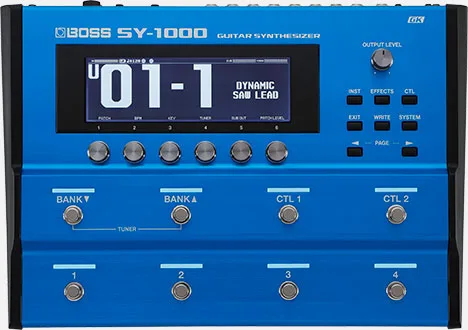
MusicRadar's review lists ease of use, the ability to blend four voices, COSM guitar and amp simulation for conventional guitar tones, and altered tunings among its reasons to buy2. The same review's verdict calls it a practical blend of synthesis and modeling in an easy-to-use package2. For players who want a newer take on the same idea, Boss has since moved further into this territory with guitar synth and modeling processors, and the synth pedals and multi-effects pedals pages cover the wider field.
Videos
Andertons Music Co
Full Compass
Guitarist
Questions
Does the Roland GR-55 need a special pickup?
Yes. The GR-55 connects via the industry-standard 13-pin cable to Roland's GK-3 divided pickup hardware, which reads each string separately so the unit can detect pitch. There are two GR-55 versions, one with and one without a pickup, so players who already have a guitar fitted with a divided pickup can buy the unit alone.
Can the Roland GR-55 be used with a bass?
Yes. The GR-55's default mode is for use with guitars, but if you want to use it with a bass you can switch modes in a menu. The unit also delivers the sounds of virtual basses alongside virtual guitars and amps, so bass players have dedicated material to work with.
How many patches does the Roland GR-55 have?
Patches are categorised as Lead, Rhythm, Other or User, with 30 banks each for the first three categories and 99 User banks. Since patches are stored in banks of three, that works out to 90 patches each in Lead, Rhythm and Other, plus 297 User patch slots.
Can the Roland GR-55 send MIDI to other synths?
Yes. MIDI data can be outputted from the GR-55, giving you access to any synth or sampler connected to it. The divided pickup's pitch detection effectively turns your guitar into a controller for external MIDI gear as well as for the GR-55's own engines.
Does the Roland GR-55 have a separate guitar output?
Yes. The guitar signal, with or without the COSM sound applied, is sent to a separate 'Guitar Out' output on the GR-55, so you can use a different amp for the guitar signal than the one handling the synth sounds.
Sources (3)
- Strings and Synths: A History of Roland and BOSS Guitar Synthesizers, articles.boss.info (BOSS Articles), 2021-04-08
- Roland GR-55 review, MusicRadar, 2011-03-30
- Roland - Support - GR-55 - Updates & Drivers, Roland