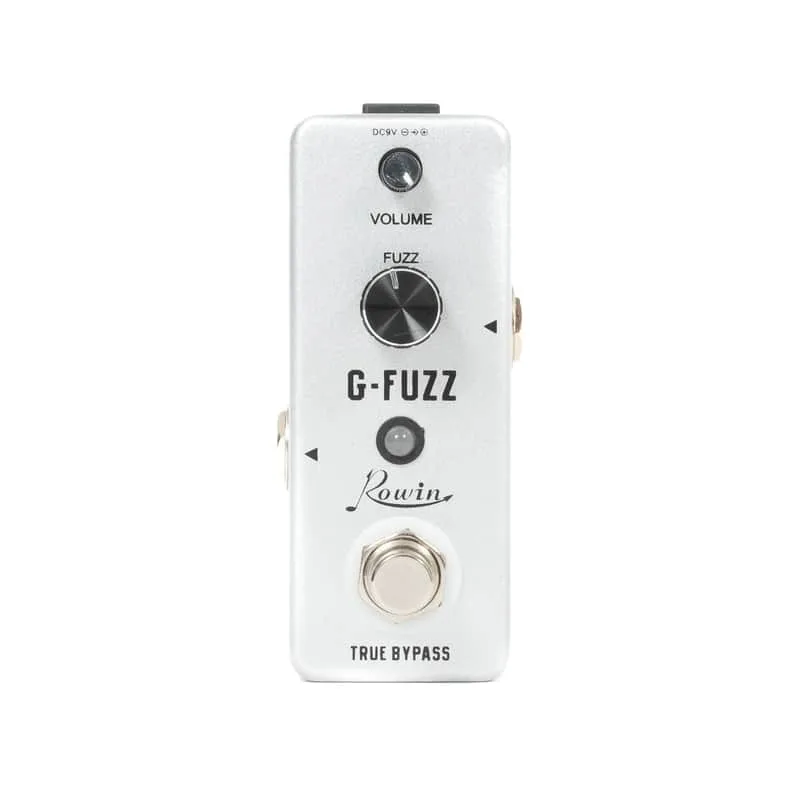


The Rowin G-Fuzz is a compact fuzz pedal from Rowin, model number LEF-322. Rowin says it delivers "a smooth, vintage fuzz sound" and that the circuit uses a vintage germanium transistor, the type of component associated with the warm, rounded fuzz tones of 1960s pedals rather than the harsher edge of silicon-based designs1.
It sits at the budget end of the fuzz market, listed at $39.99, and its selling point is size: Rowin calls it "very small and exquisite," and at 95mm deep it occupies a fraction of the board space of a standard-size fuzz1.
What it is and what it does
Fuzz is the most aggressive member of the gain family that also includes overdrive and distortion. Instead of clipping the signal softly, a fuzz circuit squares off the guitar's waveform hard, producing a thick, saturated tone. Germanium transistors, the kind Rowin says the G-Fuzz uses, were the original fuzz component and are known for a smoother, more compressed character than the silicon transistors that replaced them in many later pedals1.
Rowin's own description of the sound is brief:
"a smooth, vintage fuzz sound"
The company does not publish a control list for the pedal, so exactly how you shape that sound, and how many knobs the pedal carries, is not something its product page sets out.
Power and connections
The G-Fuzz runs on a 9V DC supply with a negative center plug, the standard arrangement for effect pedals, and draws only 5mA1. That current draw is low enough that the pedal can share a daisy chain or a multi-output supply with the rest of a board without putting real demand on it.
| Specification | Value |
|---|---|
| Power | DC 9V, negative center1 |
| Current draw | 5mA1 |
| Input | 1/4" monaural jack, 10k Ohms impedance1 |
| Output | 1/4" monaural jack, 1k Ohms impedance1 |
| Bypass | True bypass1 |
The pedal is true bypass, so when it is off, the guitar signal passes through untouched1.
Rowin lists no battery option for the G-Fuzz, only DC power, so it needs a power supply or a powered board to run.
Size and build
The enclosure is a metal shell measuring 95mm deep, 45mm wide and 53mm high, weighing 278g with its box1. For comparison, that footprint is roughly half the depth of a typical standard-size pedal, which is the practical case for it: players with crowded boards can slot it in where a full-size fuzz would not fit.
Where it sits in Rowin's fuzz range
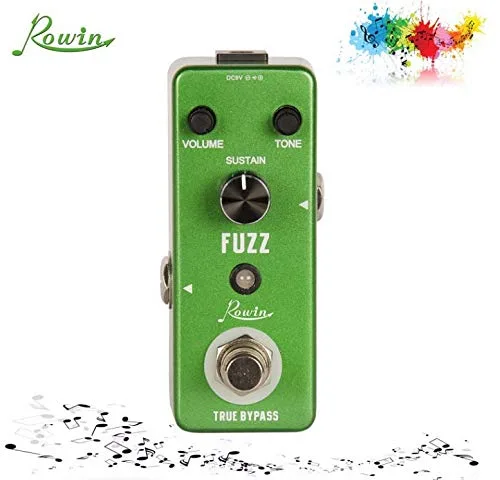
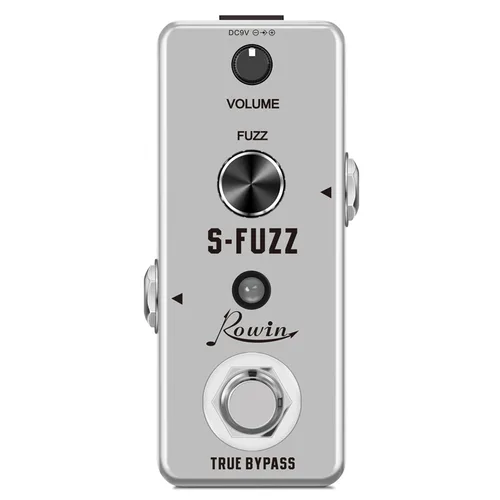
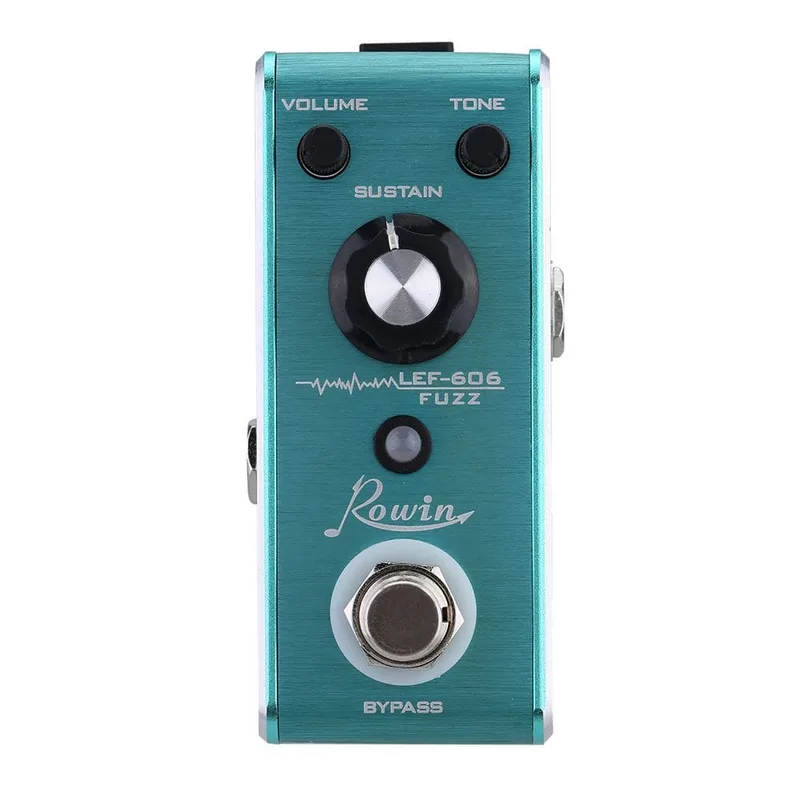
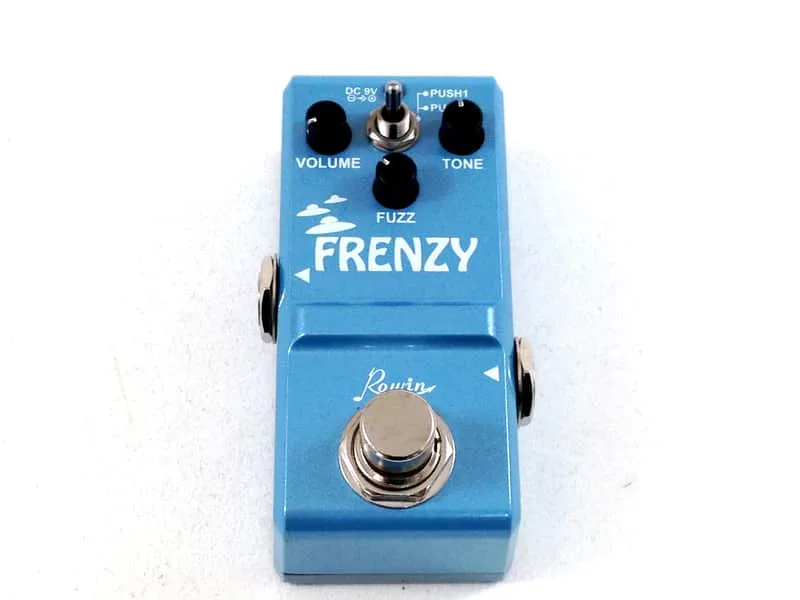
Rowin makes several fuzz pedals alongside this one, including the Rowin Fuzz, the Rowin S-FUZZ, and the Rowin LEF-606 Fuzz. The G-Fuzz is the germanium option in that lineup, where the others use different circuit approaches to the same effect1.
There is also a closely related pedal sold under the Tomsline name, the G-Fuzz, described as a vintage germanium fuzz with true bypass, powered by a 9V DC adapter that is not included2. Players comparing listings may encounter both names.
Videos
DutchGuitarDude
Shari Pedals
philtc
Questions
Is the Rowin G-Fuzz true bypass?
Yes. Rowin lists the G-Fuzz as true bypass, so when the pedal is switched off the signal passes through without active circuitry in the path. That matters on a pedalboard, since a true bypass fuzz leaves your clean tone alone when disengaged.
Does the Rowin G-Fuzz use germanium transistors?
Yes. Rowin's product page for the G-Fuzz states that it uses a vintage germanium transistor. Germanium fuzz circuits are associated with the smoother, warmer vintage fuzz sounds of the 1960s, and Rowin describes the pedal's sound as smooth and vintage.
What power supply does the Rowin G-Fuzz need?
It runs on a 9V DC supply with a negative center, drawing only 5mA. That low current draw means it shares a daisy chain or isolated supply easily with other pedals. Rowin lists no battery option for this model.
How big is the Rowin G-Fuzz?
The enclosure measures 95mm deep by 45mm wide by 53mm high, and it weighs 278g with its box. Rowin describes it as very small and exquisite, so it takes up little room on a pedalboard.
Sources (2)
- ROWIN-G-FUZZ, Rowin
- Tomsline Model AGF-3 G-Fuzz, Vintage Germanium Fuzz Pedal with true bypass, Butler Music LLC