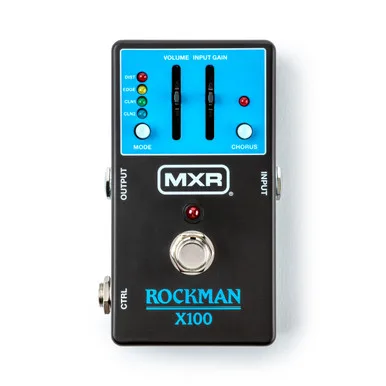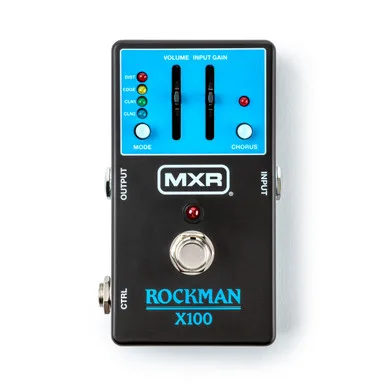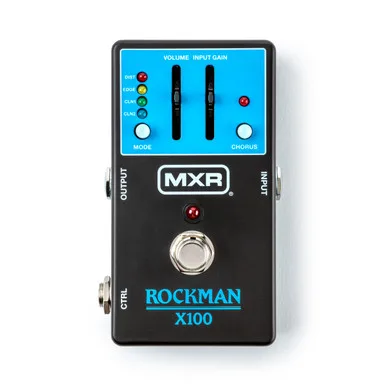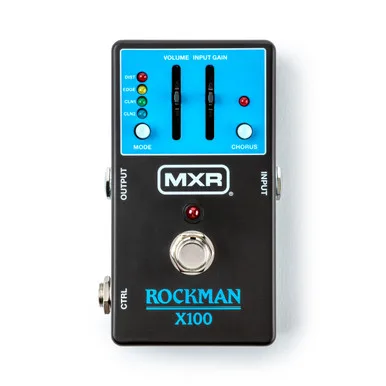


The Rockman X100 is a headphone amplifier with built-in effects, designed so a guitarist could plug straight in, put on headphones, and hear a finished arena-rock guitar tone with no amp in the room. Tom Scholz, guitarist and founder of the hard rock band Boston, designed and released it through his electronics company, Scholz Research & Development (SR&D). Jim Dunlop describes it as a headphone amp "with recording console connectivity and several tone tweaking features and built-in effects," which made it as much a recording tool as a practice unit1.
A key part of the original X100's sound was a complex compression circuit that kept the signal clear whether clean or dirty, along with four presets and an MN3007 bucket brigade chip for chorus1. Delicious Audio calls it "a headphone amplifier that encapsulated the soaring, chorus-drenched guitar tones of 1980s arena rock"2.
Tom Scholz and the Rockman line
Tom Scholz was not just a rock guitarist lending his name to a product. MusicRadar notes that in 1982 he "designed and released the Rockman X100 headphone amp" himself, via Scholz Research & Development4. Guitar.com's reviewer puts it plainly:
"Designed by Tom 'Boston' Scholz, yep, the fella who wrote More Than A Feeling"5
The X100 sat within a wider Rockman line from SR&D. Rockman.fr's independent review records the sequence: the original Rockman launched in 1982 as the first commercial amp simulator, the Ultralight followed in 1983, and the hard-clipping X100 and the stereo Bass Rockman both appeared in 19846. That 1984 date is why some sources place the X100 there, while Dunlop, MusicRadar, Delicious Audio and Premier Guitar date the X100's unveiling to 19821425.
The X100's distinctive compressed sound, with its integral analog chorus, soon found its way onto various recordings in the 1980s4. Gearnews reports that original X100 headphone amps "were used by bands, including Def Leppard, to get that much-loved '80s guitar tone," on the stadium rock album Hysteria7. Guitar World lists Joe Satriani, Phil Collen and Boston among the players associated with the revolutionary headphone amp8.
What the X100 does to your sound
The unit combines several effects a player would otherwise build a pedalboard around: compression, distortion and chorus. The compression circuit was a key component of the sound, keeping the signal clear whether clean or dirty1. Gearnews characterizes the X100's reputation as "crystal-clear cleans, soaring harmonics, nuanced modulation, and gritty crunch," with the chorus built on a Bucket Brigade MN3007 chip7.
The chorus deserves special mention, because it is integral rather than an add-on. On the MXR pedal revival, MusicRadar's reviewer Trevor Curwen notes the output, mono as shipped, "can be switched internally to stereo, which gives you really spacious chorus"4.
From the 1982 original to the MXR pedal
In 1982, Tom Scholz of Boston fame unveiled the Rockman X100, a headphone amplifier24. MXR later revived the design as the MXR Rockman X100 Analog Tone Processor, described by Premier Guitar as a "pedal-sized revival of Tom Scholz's 1982 Rockman X100"63. Guitar World describes MXR's approach: "MXR has reimagined the unit as a standalone all-analog pedal"9.
The pedal keeps the original's building blocks: the same complex compression circuit, the four presets, and the same classic MN3007 bucket brigade chip found in the original headphone amp for chorusing1.
Controls
| Control | What it does |
|---|---|
| Volume slider | Sets the level going to your amplifier1 |
| Input Gain | Sets the input level1 |
| Mode switch | Selects between the amp presets4 |
| Chorus switch | Adds the chorus effect10 |
| Internal mono/stereo switch | Switches the output from mono as shipped to stereo4 |
| Bypass footswitch | Bypasses the pedal4 |
The manual also covers both mono and stereo modes, plus optional external mode switching10. Guitar.com's reviewer found the chorus "can be set to full stereo lushness by flicking an internal switch and plugging in a TRS cable"5.
How reviewers suggest using it
MusicRadar reviewed the Rockman X100 alongside other Tom Scholz designs4, and MXR's manual for its reissue covers setup options for the pedal10. The X100 itself was designed by Tom Scholz, founder of Boston, and released in 1982 through his electronics company Scholz Research & Development4.
The original SR&D X100 is a 1980s unit, and Rockman.fr documents several hardware revisions among collectors: the REV8 is stamped Rockman on the front and X100 on the back, while an X100 without a power supply TRS mini-jack can be a REV9 or REV10, and with a TRS mini-jack it is a REV1064.
Videos
MisterShred
jimdunlopusa
Rich Bischoff
Questions
Who designed the Rockman X100?
Tom Scholz, guitarist and founder of the hard rock band Boston, designed and released the Rockman X100 through his own electronics company, Scholz Research & Development (SR&D). He created it as a headphone amplifier so he could practice and record with his signature tone without an amp.
What records was the Rockman X100 used on?
The original X100 headphone amps were used by Def Leppard, including on the 1980s stadium rock album Hysteria, to get their '80s guitar tone. Players associated with the Rockman sound also include Joe Satriani, Phil Collen and Boston themselves.
Is the Rockman X100 still made?
The original SR&D unit is a 1980s product. The design lives on in the MXR Rockman X100 Analog Tone Processor, a pedal MXR launched at NAMM in January 2025 for $229, which revives the original's sonic character in stompbox form.
Does the Rockman X100 have a chorus effect?
Yes. Chorus is built in, and it is a big part of the Rockman sound. Both the original and the MXR pedal use an MN3007 bucket brigade chip for the chorus, and on the pedal the chorus can run in full stereo via an internal switch and a TRS cable.
What is the MXR Rockman X100 pedal?
It is an all-analog pedal MXR released in January 2025 that revives the sonic character of Tom Scholz's original headphone amp in stompbox form. It offers the original's four presets, compression, distortion and MN3007 chorus, with mono and stereo modes and optional external mode switching.
Can you plug a Rockman X100 into a mixing console?
Yes. Console connectivity was part of the original X100's design, and MusicRadar's reviewer found the MXR pedal works best for DI recording, offering flavors and textures entirely its own. For a subtler high-end response, MXR suggests running the pedal into an amp FX loop return or a full-range, flat-response speaker system.
Sources (10)
- MXR® ROCKMAN® X100™ ANALOG TONE PROCESSOR, Jim Dunlop (jimdunlop.com), 1982
- MXR Rockman X100 Stereo Preamp, Delicious Audio, 2025-10-07
- Rockman X100 Preamp Pedal, Premier Guitar, 2025-01-23
- “Perfect for anyone seeking that specific '80s arena-rock vibe”: MXR Rockman X100 pedal review, MusicRadar, 2025-03-21
- MXR Rockman X100 review, Guitar.com, 2025-01-24
- Rockman.fr, Rockman.fr, 2008
- MXR Unleashes The Rockman X100, gearnews.com, 2025-01-23
- MXR revives the Rockman amp as a pedal, Guitar World, 2025-01-23
- MXR Rockman X100 Analog Tone Processor Pedal review, Guitar World, 2025-03-24
- MX100.pdf, Jim Dunlop, 2025
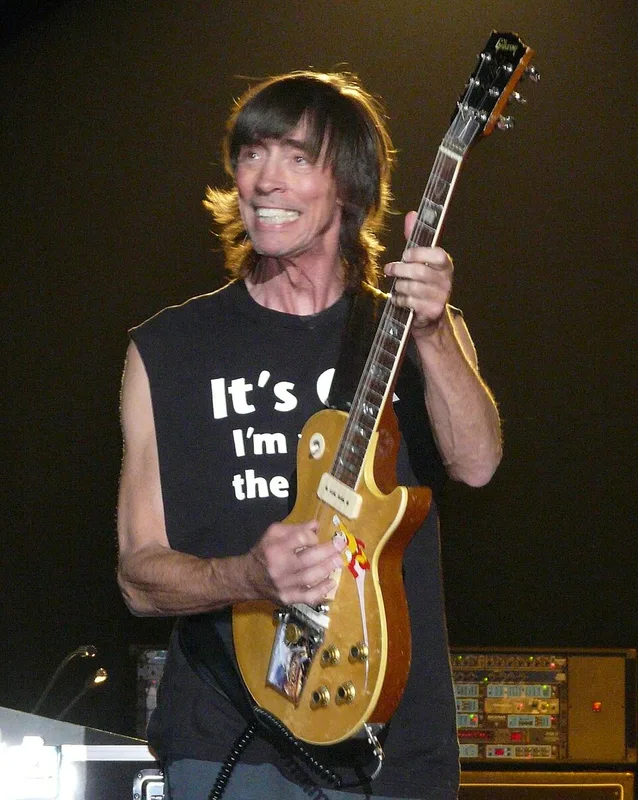 Tom Scholz