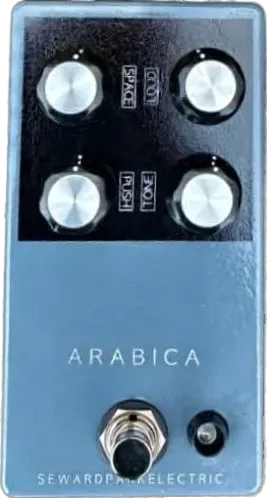

The Seward Park Electric Arabica- Harmonic Percolation is an analog distortion pedal built on the classic harmonic percolator circuit. RockBoard's PedalPedia describes it as a fuzz-adjacent pedal that can be hairy, brittle, clear, and everything in-between, and says it can do the "paper tear" sound these pedals are known for1. It sits in the distortion territory between overdrive and fuzz, where the percolator circuit has always lived.
Where the circuit comes from
RockBoard's PedalPedia says it took the classic harmonic percolator circuit and enhanced it with additional controls while maintaining the character of the original, with the design influenced by the Albini modifications1. The added Tone control is a case in point: RockBoard's PedalPedia says it gives the pedal EQ ability the original pedal generally lacks1.
The controls: Tone, Space, Push and Loud
| Control | What it does |
|---|---|
| Tone | Voiced from clear and brittle to low and warm; EQ ability the original pedal generally lacks1 |
| Space | A pseudo presence control, adding more "air" clockwise; can enhance octaves under the right conditions1 |
| Push | Adjusts the drive hitting the silicon transistors and diodes for a range of clipping sounds1 |
| Loud | Overall pedal volume1 |
Push is the gain control in practice: it sets how hard the silicon transistors and diodes are driven, which is where the pedal's range of clipping sounds comes from1. Space works on the other end of the signal, and the maker notes its octave-enhancing behavior is conditional rather than an always-on octave effect like a dedicated octave pedal.
"it's a great sounding fuzz-adjacent pedal that can be hairy, brittle, clear, and everything in-between"
Power
The Arabica runs on 9V DC, center negative, the standard polarity used by most pedals1.
9V DC center negative is the common pedal standard, so a regular isolated supply works. The maker's page gives no current draw figure, so check your supply's headroom against the pedal's needs when planning a board.
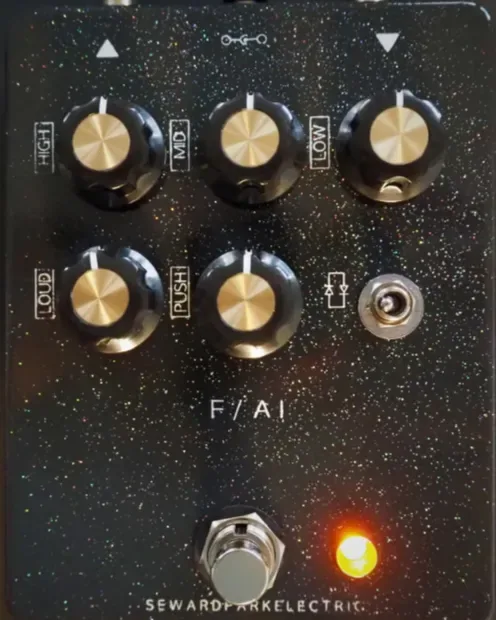
Seward Park Electric also makes the F/AI- Distortion Box, a separate take on distortion in the maker's range.
Videos
Boring Gear Reviews
Questions
What is a harmonic percolator pedal?
A harmonic percolator is a distortion circuit known for a hairy, brittle, fuzz-adjacent character, including a distinctive 'paper tear' sound. The Arabica takes that classic circuit and enhances it with additional controls while keeping the original character, and it is influenced by the Albini modifications to the design.
What is the paper tear sound?
The paper tear sound is the quality these pedals are known for, a brittle, torn, fuzzy distortion character. Seward Park Electric says the Arabica can also do that paper tear sound, within a range the maker describes as hairy, brittle, clear, and everything in-between.
Is the Arabica Harmonic Percolation analog?
Yes. The circuit type is analog, built around silicon transistors and diodes for clipping.
What power supply does the Arabica Harmonic Percolation need?
It runs on 9V DC with a center negative plug, the standard pedal supply. Use an isolated supply rather than a daisy chain with high-draw digital pedals for the quietest operation.
What does the Space knob do on the Arabica?
Space is described by the maker as a pseudo presence control that adds a bit more air as turned clockwise. Under the right conditions it is also capable of enhancing octaves.
Sources (1)
- Arabica- Harmonic Percolation by Seward Park Electric, RockBoard PedalPedia, 2026