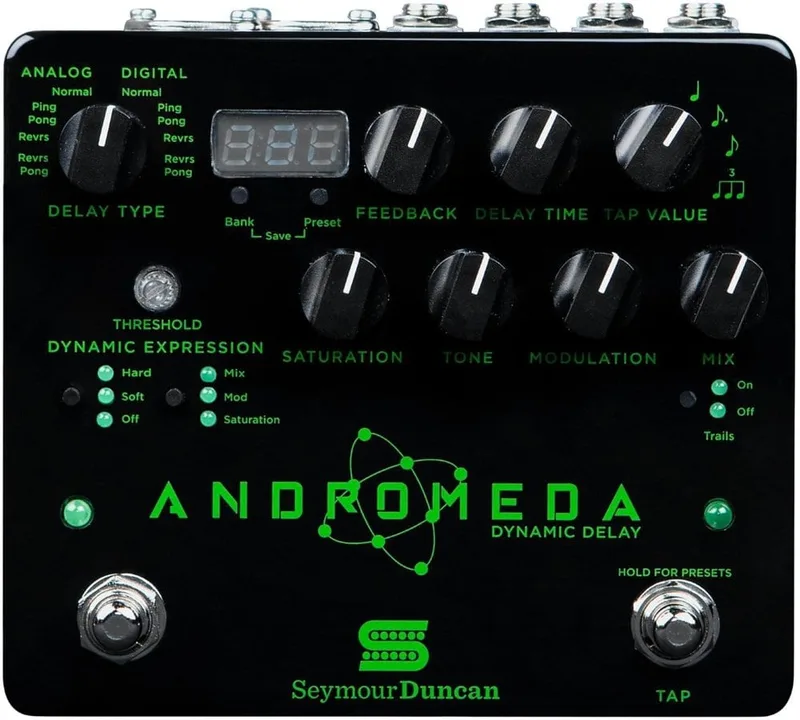


The Seymour Duncan Andromeda, announced in May 2017 as the Andromeda Dynamic Delay, is a digital delay pedal that responds to how hard you play. Its headline feature, Dynamic Expression, lets your picking strength control the mix, modulation or saturation of the repeats, so the effect can duck under quiet playing and open up when you dig in1. Beyond that it is a fully featured programmable delay: delay times up to 5 seconds, tap tempo with subdivisions, 128 presets, MIDI control and stereo inputs and outputs, all in what Pedal of the Day called "a very pedalboard-friendly enclosure"21.
Seymour Duncan positioned it as a performance tool rather than a straight echo box. Gearnews described the company's framing: "Seymour Duncan refers to the Andromeda as a dynamic delay with a lot of emphasis on how it being a performance tool in its own right"3.
A digital delay that ducks under your playing
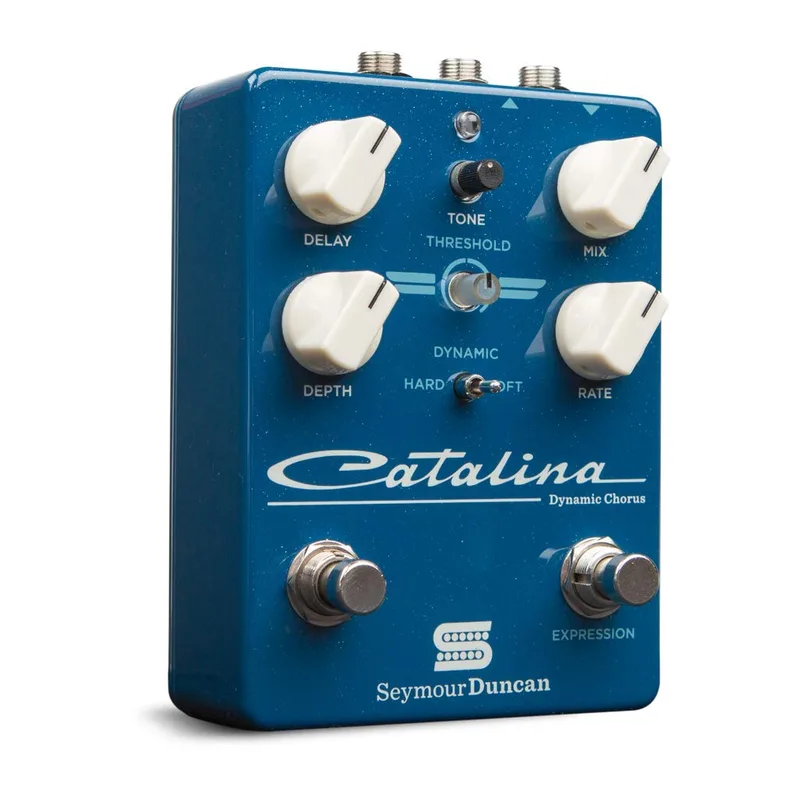
The Andromeda's core idea is Dynamic Expression, the same technology Seymour Duncan used on its Catalina Dynamic Chorus. You pick a parameter, Mix, Modulation or Saturation, and your picking strength varies that parameter in real time: play softly and the effect sits back, play harder and it intensifies1. Pedal of the Day described the result as "wide variations in tonal output and texture"2.
Setting it up is a three-step process2:
- Choose the Dynamic Expression level: Hard, Soft, or none at all.
- Choose the parameter it applies to: Mix, Modulation or Saturation.
- Set the intensity with the Threshold control, which is LED-infused so you can see where the response sits.
The delay engine itself covers both analog and digital territory. The pedal offers digital and analog-simulated versions of four delay types: normal, ping pong, reverse and reverse pong1. In the launch announcement, Seymour Duncan explained the reasoning: "So we provided both analog and digital delay palettes with a lot of tone-shaping functionality that can easily tweaked and shaped to taste"1. Pedal of the Day's reviewer found the pedal delivered "warm, clean and crystal clear delay tones (unless you want to make them dirty, which is easy, too)"2.
Controls
| Control | What it does |
|---|---|
| Delay Time | Sets delay time up to 5 seconds2 |
| Feedback | Adjusts the number of repeats2 |
| Tone | Darkens or brightens the repeats2 |
| Modulation | Adds chorus/vibrato to the repeats2 |
| Saturation | Adds grit to the repeats2 |
| Threshold | Sets the intensity of Dynamic Expression2 |
| Tap Value | Helps you quickly sync echo repeats to the song1 |
The Modulation knob adds chorus or vibrato to the repeats, while the Saturation control adds grit, which is how you push the pedal from clean echoes toward dirtier, tape-flavored repeats2.
Presets, MIDI and stereo connections
The Andromeda is built as much for the programmable pedalboard as for the plug-and-play player. It stores 128 presets, arranged in Presets and Banks that you reach by holding down the Tap switch2. It can also be controlled via MIDI, with MIDI In and Thru connections for hooking up to a computer or DAW12.
The stereo connections open up the ping pong and reverse pong types, which bounce repeats between the left and right outputs1. Pedal of the Day summed up the connectivity: "Connect to your computer or DAW via the MIDI In and Thru connections, run a sweet stereo setup from the Stereo Input and Outputs"2.
A Trails switch decides what happens when you bypass the pedal: the repeats can cut off immediately, or trail off naturally. Pedal of the Day put it more colorfully, noting "there's even a Trails switch that allows the repeats to smoothly fade into oblivion once the Andromeda is bypassed"21.
Tap tempo
Tap tempo is handled by a dedicated footswitch, with four subdivisions available: quarter, eighth, dotted eighth and triplet12. MusicRadar noted that "Tap tempo is also onboard, with four available subdivisions, while sounds can be saved in 128 presets"5. The Tap switch does double duty: a tap sets the tempo, and holding it down takes you into the Presets and Banks2.
Where it came from and what reviewers said
Seymour Duncan announced the Andromeda Dynamic Delay on May 10, 2017, at $399, made in the USA1. MusicRadar followed the next day with the UK price of £4295. Delicious Audio later described it as having "brought a new dimension to delay in 2017", calling it "a fully programmable digital workhorse packed with eight types of delay, echo and repeats"4. A demo video by Pro Guitar Shop showcased the pedal around the same time6.
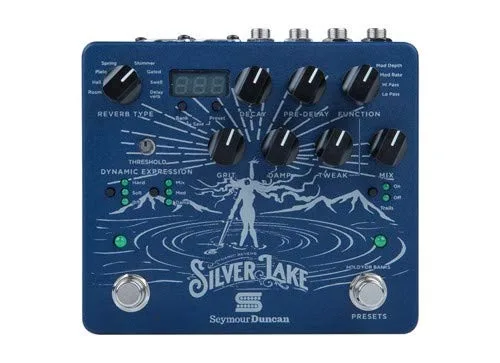
The Dynamic Expression concept carried forward into other Seymour Duncan pedals, including the Silver Lake Dynamic Reverb4.
Reviewer reactions were largely positive but not uncritical. Pedal of the Day praised the layout: "The simple layout and ease-of-use make it great for veteran players and beginners alike, and there's no shortage of exploration for either once you plug this guy into your favorite amp"2. Gearnews' writer raised a practical concern about the control panel: "It looks very busy and the pedal is also quite dark with green text, so I would probably find it a bit awkward to use on a dark stage, so would need to brush up on all those controls before I was confident using it in a band situation"3.
"The simple layout and ease-of-use make it great for veteran players and beginners alike, and there's no shortage of exploration for either once you plug this guy into your favorite amp."
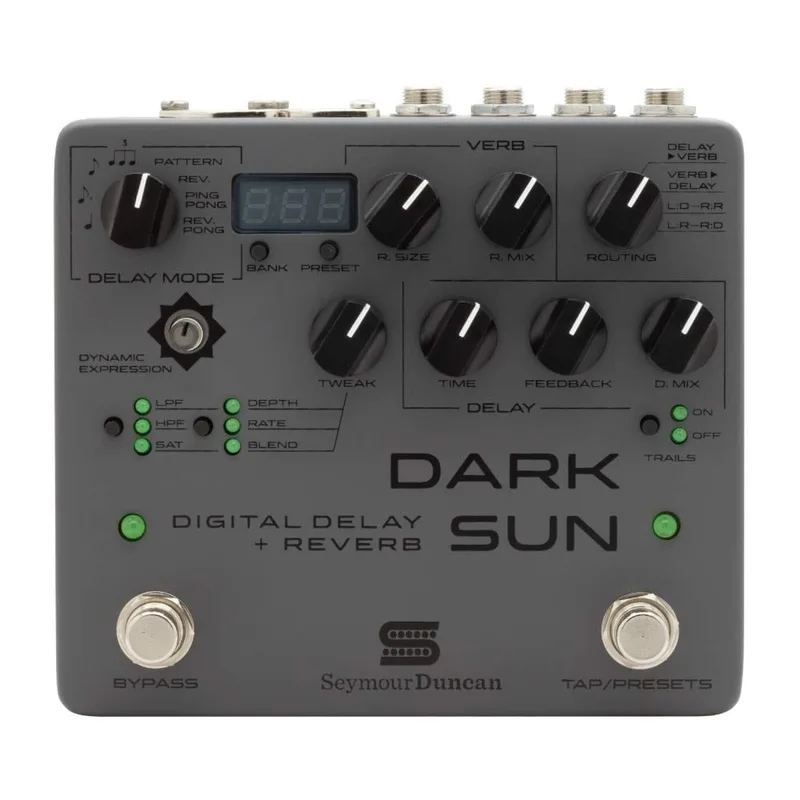
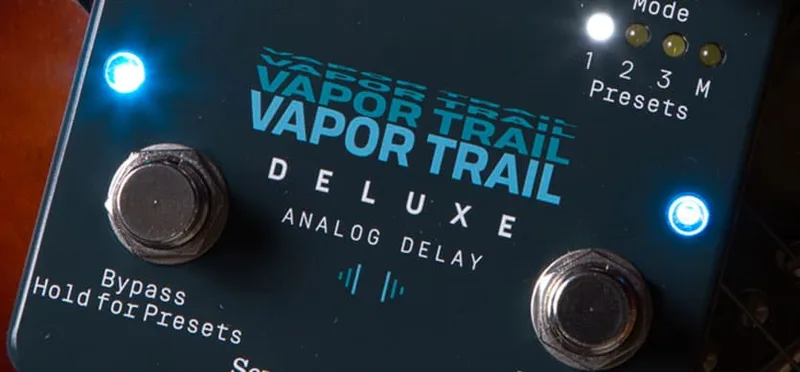
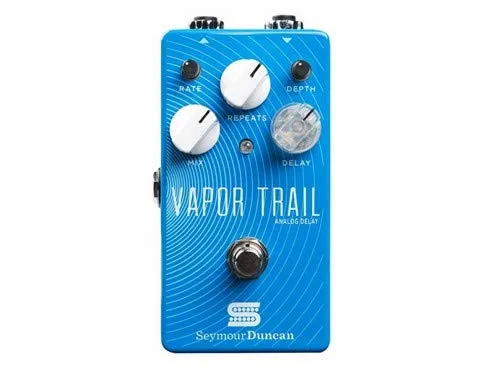
Within Seymour Duncan's delay line, the Andromeda sits at the programmable, feature-heavy end. The company later released the Dark Sun delay and reverb with Mark Holcomb of Periphery, and the Vapor Trail Deluxe, an analog Bucket Brigade delay with digital control. Where the Vapor Trail line keeps an analog signal path, the Andromeda is fully digital7.
Videos
ProGuitarShopDemos
Sweetwater
Sweetwater
Questions
What is the maximum delay time on the Seymour Duncan Andromeda?
The Delay Time knob sets delay times up to 5 seconds. You can also sync repeats to the song with the Tap Tempo footswitch and the Tap Value control, using quarter, eighth, dotted eighth or triplet subdivisions.
Does the Andromeda have tap tempo?
Yes. An onboard Tap Tempo footswitch sets the tempo, and holding it down accesses the Presets and Banks. Four subdivisions are available: quarter, eighth, dotted eighth and triplet, and a Tap Value control helps you sync echo repeats to the song.
Do the Andromeda's repeats trail off when bypassed?
That is your choice. A Trails switch lets the repeats smoothly fade once the pedal is bypassed, or you can set them to cut off immediately when you hit the Bypass switch.
Is the Seymour Duncan Andromeda stereo?
Yes. The Andromeda has stereo inputs and outputs, so you can run a full stereo delay setup, including the ping pong and reverse pong delay types that bounce repeats between the outputs.
How much did the Seymour Duncan Andromeda cost?
At launch in May 2017 the Andromeda sold for $399 in the US, listed as £429 in the UK. It was made in the USA.
What is Dynamic Expression on the Andromeda?
Dynamic Expression, first seen on Seymour Duncan's Catalina Dynamic Chorus, lets your picking strength control an effect parameter in real time. On the Andromeda you apply it to Mix, Modulation or Saturation, choose a Hard, Soft or off level, and set the intensity with the Threshold control.
Sources (7)
- Seymour Duncan Releases the Andromeda Dynamic Delay, Premier Guitar, 2017-05-10
- Seymour Duncan Andromeda Dynamic Digital Delay, Pedal of the Day, 2018-01-02
- NAMM 2017: Seymour Duncan Andromeda delay, gearnews.com, 2017-01-20
- Inside Seymour Duncan’s "Dynamic Expression" Pedals; The Silver Lake Reverb, Delicious Audio, 2018-04-09
- Seymour Duncan releases Andromeda dynamic digital delay pedal, MusicRadar, 2017-05-11
- Seymour Duncan Andromeda Dynamic Delay, Delicious Audio, 2017-05-02
- Seymour Duncan Andromeda Dynamic Digital Delay, Pedal of the Day, 2017-12-31