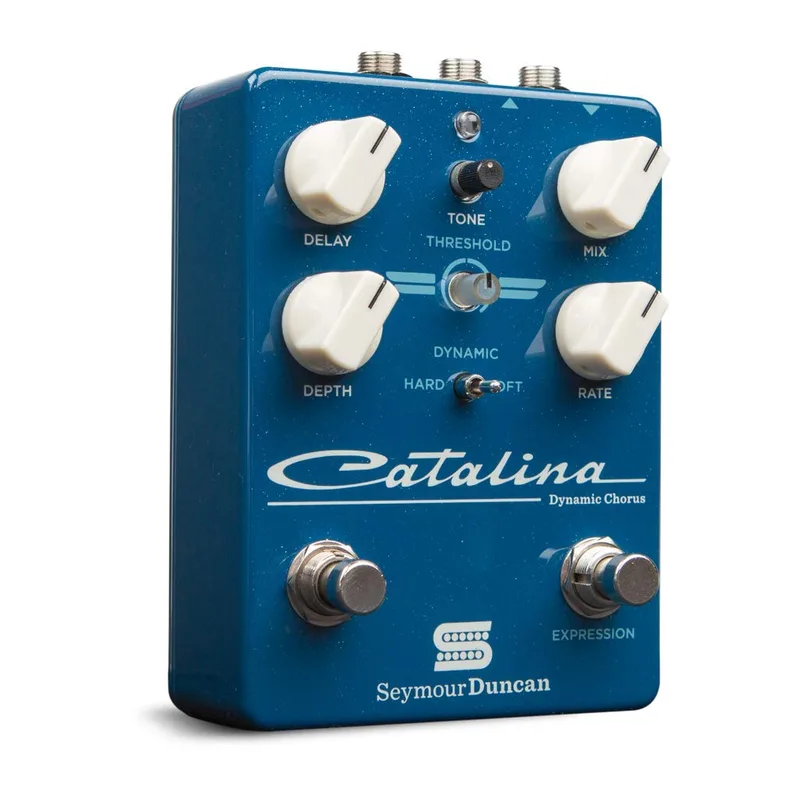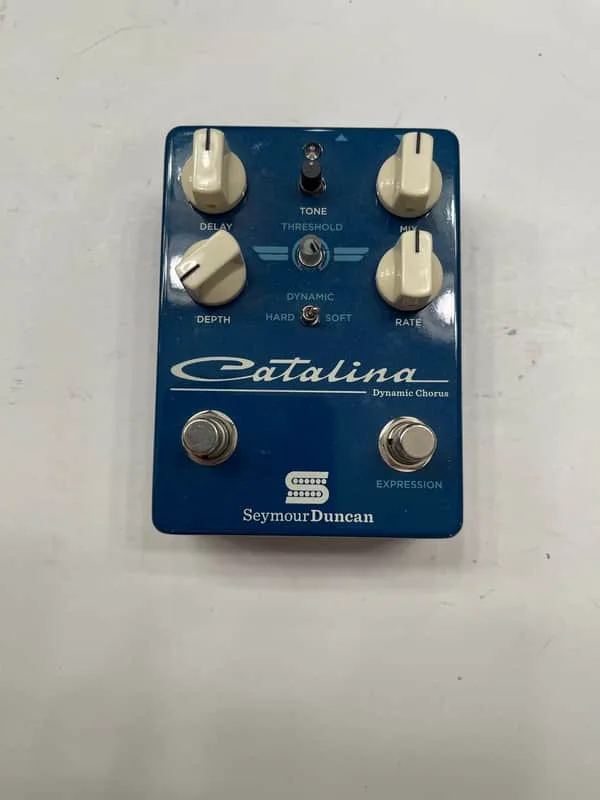


The Seymour Duncan Catalina Dynamic Chorus is a stereo chorus pedal built around analog Bucket-Brigade Device (BBD) circuitry, announced at NAMM in January 2016. Its distinguishing feature is Dynamic Expression, a mode that lets your picking intensity drive the depth of the chorus, so the effect swells and eases with the way you play rather than sitting at one fixed setting1.
The first pedal with Dynamic Expression
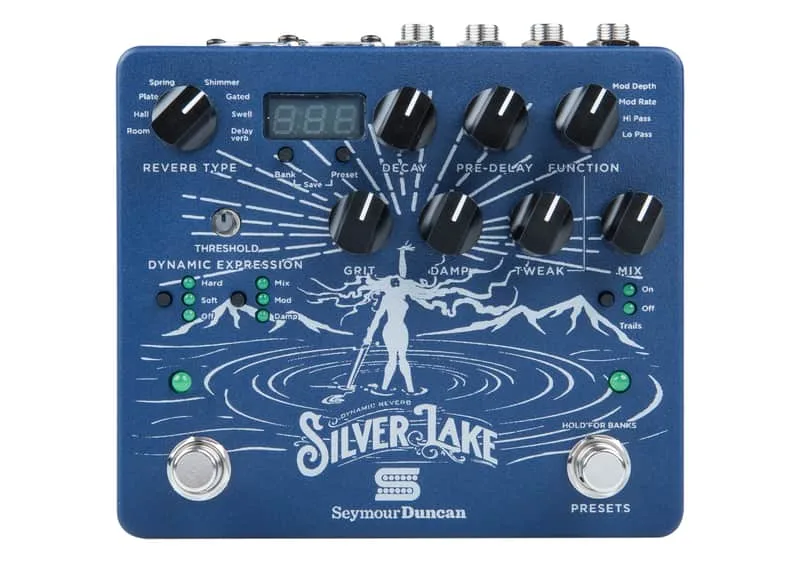
Dynamic Expression was introduced on the Catalina Dynamic Chorus in 2016, and the Catalina was the first pedal to carry it. In a later interview with Delicious Audio, Seymour Duncan's Kevin Harvey described the platform as "a stereo modulation pedal (like the Catalina Dynamic Chorus)," with Dynamic Expression first appearing there before spreading to other designs such as the Silver Lake reverb2.
The idea is simple from a player's standpoint: instead of bending down to adjust depth, you let your hands do it. Guitar Interactive's Jonathan Graham wrote that the pedal includes "a uniquely innovative Dynamic Expression mode that allows you to control the depth" of the effect with your playing, calling it, alongside "a beautiful sounding chorus pedal," a way to give players control "from subtle to bold, and everything in-between"1.
Controls and modes
The Catalina's control set is compact: four knobs, a Dynamic switch, and the footswitch3.
| Control | What it does |
|---|---|
| Mix | Blends the wet signal, from silent to unity to a +3dB boost for the wet signal3 |
| Rate | Sets the speed of the chorus3 |
| Depth | Sets the amount of chorus; the Dynamic switch lets your playing interact with it3 |
| Delay | Sets the delay time of the chorus voice3 |
| Threshold | Dials in the sensitivity of the Dynamic feature1 |
| Dynamic switch | Hard or Soft mode, shaping how playing intensity affects depth3 |
The Dynamic switch is the heart of the pedal. In Hard mode, the chorus depth increases as you play with more intensity. Flip it to Soft mode and you receive more effect as you play lighter. The Threshold control sets how sensitive that response is, so the pedal can be tuned to a light-fingered style or a heavy attack3.
Circuit, bypass and stereo routing
The Catalina is an analog design. Seymour Duncan's release material states that "It employs analog Bucket-Brigade Devices (BBDs) supported by modern low-noise analog electronics," the same bucket-brigade approach used in classic chorus designs1. The footswitch is true bypass, "for the most pure signal when the pedal is not in use"1.
The mono input and stereo outputs make it straightforward to run the pedal into two amps or a stereo effects chain, with the chorus voice spread across the two outputs3.
The Catalina was revealed at NAMM 2016 with a US street price of $229 reported at the time32. It sits alongside Seymour Duncan's later Dynamic Expression designs, such as the Silver Lake reverb2.
What reviewers said
Premier Guitar's review was positive on both sound and the headline feature. The reviewer's pros list read: "Great tones. Expression mode is awesome and works very well with other effects."4
Videos
ProGuitarShopDemos
Premier Guitar
Premier Guitar
Questions
What does Dynamic Expression do on the Catalina?
Dynamic Expression lets your playing intensity control the depth of the chorus. A Threshold control sets how sensitive the feature is, so the pedal responds to how hard or soft you pick. In Hard mode the chorus depth increases as you play with more intensity, while in Soft mode you get more effect as you play lighter.
What is the difference between Hard and Soft mode on the Catalina?
The Dynamic switch has two settings. Hard mode signals the chorus depth to increase as you play with more intensity. Flip it to Soft mode and you receive more effect as you play lighter. The Threshold control dials in the sensitivity of the Dynamic feature either way.
Is the Seymour Duncan Catalina analog?
Yes. The Catalina employs analog Bucket-Brigade Devices (BBDs) supported by modern low-noise analog electronics, according to Seymour Duncan's press material at release.
Does the Catalina have stereo outputs?
Yes. The Catalina has a mono input and stereo outputs, which lets you spread the chorus across two amplifiers or a stereo rig.
Is the Catalina true bypass?
Yes. The footswitch is true bypass, which Seymour Duncan says keeps the purest signal when the pedal is not in use.
Where is the Catalina made?
Like all of Seymour Duncan's pedals, the Catalina Dynamic Chorus is designed and assembled at the company's Santa Barbara, California factory.
Sources (4)
- Seymour Duncan Releases The Catalina DynamicChorus Effects Pedal, Guitar Interactive Magazine, 2016-01-18
- Inside Seymour Duncan’s "Dynamic Expression" Pedals; The Silver Lake Reverb, Delicious Audio, 2018-04-09
- NAMM 2016: Seymour Duncan's Catalina dynamic chorus pedal revealed, MusicRadar, 2016-01-21
- Seymour Duncan Catalina Dynamic Chorus Review, Premier Guitar, 2016-09-16