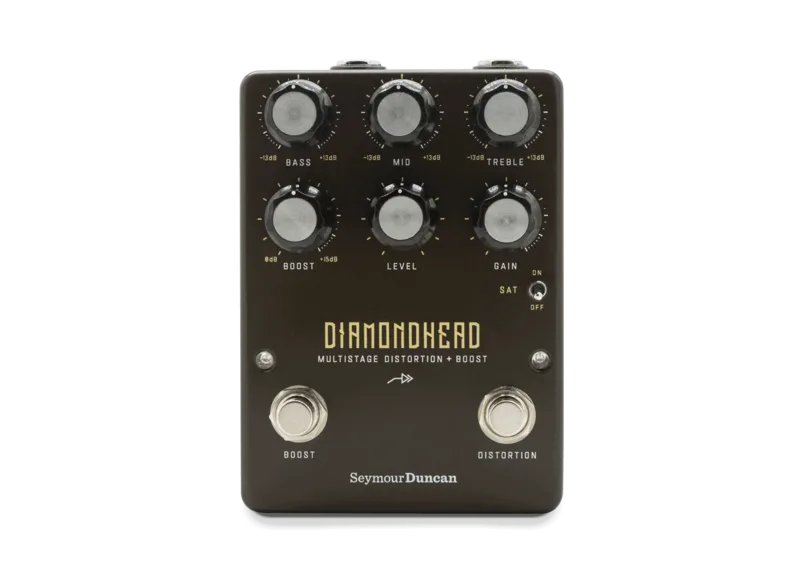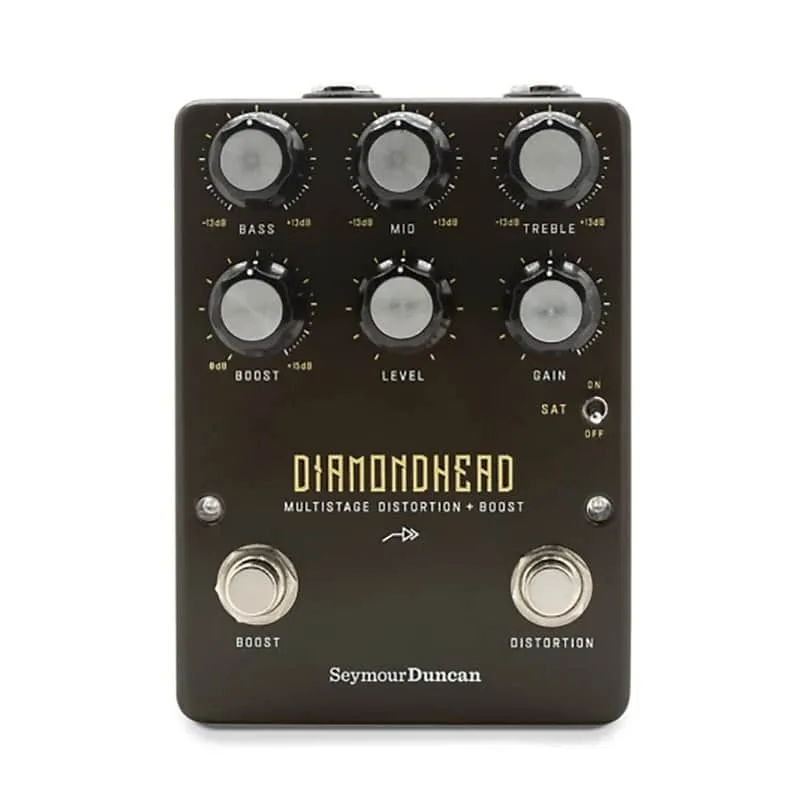


The Seymour Duncan Diamondhead Multistage Distortion + Boost is a distortion pedal with a separate, footswitchable boost section, designed to capture the tone and feel of a hot-rodded tube amp being pushed by a drive unit, what the maker describes as "the guitar sound that defined classic '70s and '80s metal and hard rock"1. Its SAT (saturation) switch is based on Seymour Duncan's TS-style 805 Overdrive pedal1.
The pedal is billed as giving you the feel of a cranked all-tube amplifier that is then hit hard with an added boost2. Guitar Pedal X's reviewer, Stefan Karlsson, described it as a "Great authentic high fidelity sounding Marshall style distortion" whose profile "leans modern and searing," covering both Plexi and JCM800 tones3.
A Marshall-style distortion with a separate boost
The Diamondhead is a multistage distortion pedal with a distinct '80s drive flavor2. It is designed to be run into an already crunchy amp for full-on rock tones, and its design also suits use as an extra channel for a clean amp2. Seymour Duncan recommends using the boost with a slightly dirty amp as the first gain stage, then adding the drive section for higher overdrive sounds1.
The boost section offers 0 to 15 dB of available gain and operates independently of the drive circuit1, so the two halves of the pedal can be used separately or stacked. Guitar Pedal X's Karlsson found the combination convincing, writing that the Diamondhead "joins the top tier selection of Marshall style pedals" overall3.
"The Diamondhead is expansive - while also being relatively easy on the dial in. A great extended coverage Marshall style"
At gearnews.com, Jef highlighted the EQ and boost as the pedal's strengths: "For me, the extensive EQ section and the added boost section of this drive pedal make it one to watch out for," especially for classic '80s heavier drive tones2.
The controls: three-band EQ, SAT switch and two footswitches
The control layout is split across two rows. On top sit the three-band EQ knobs, bass, mid and treble; below them are the boost, level and gain knobs1. The EQ sits immediately after the gain control in the circuit, to help shape your sound and drive tones2.
| Control | What it does |
|---|---|
| Gain | Sets the amount of distortion3 |
| Bass, Mid, Treble | Three-band active EQ, each ±13dB, placed after the gain control32 |
| Level | Sets the output volume3 |
| Boost | Sets the boost level, 0 to 15 dB31 |
| SAT switch | Adds a 24 dB pre-gain boost, tightens low end1 |
| Boost footswitch | Engages the boost section31 |
| Distortion footswitch | Engages the drive section3 |
The boost section is activated by its own dedicated bottom-left footswitch1, and the drive section has its own distortion footswitch3.
The SAT switch
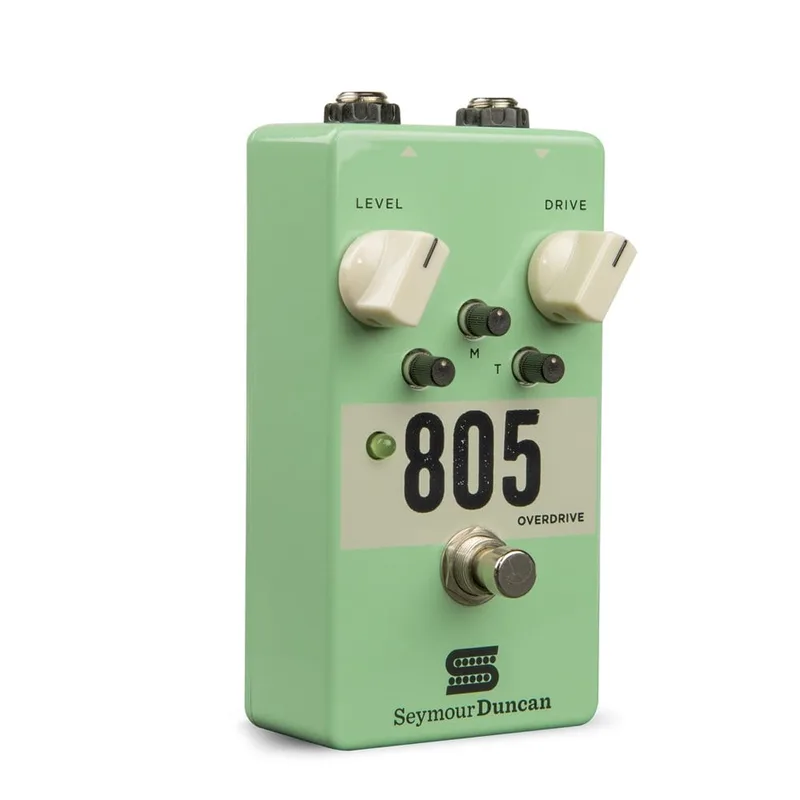
The SAT (saturation) switch adds a 24 dB pre-gain boost that tightens up the low end for a more aggressive and defined attack1. With the lows and highs rolled off, it allows the midrange to cut through1. The circuit is based on Seymour Duncan's TS-style 805 Overdrive pedal1, which gearnews.com describes as SD's in-house 805 Overdrive2.
Where it sits in the Seymour Duncan pedal line
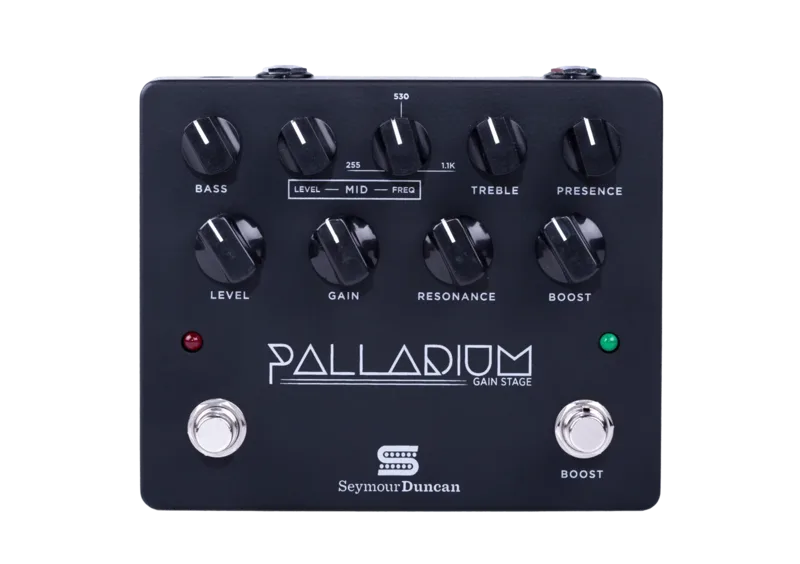
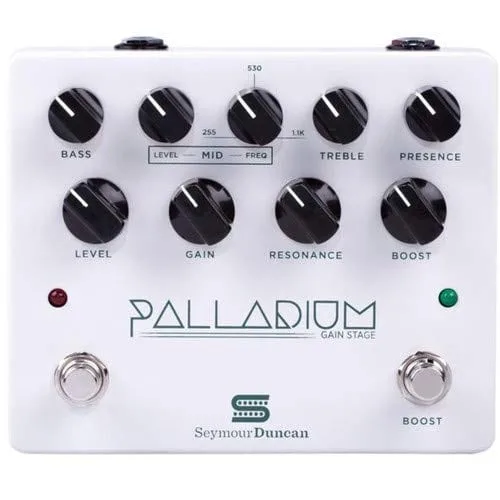
Seymour Duncan's pedal range has included drive pedals such as the Palladium Gain Stage. The Diamondhead arrived as a multistage distortion with a separate boost aimed at classic '70s and '80s metal and hard rock tones1, and its SAT switch ties it to the company's own 805 Overdrive1.
Videos
Sweetwater
Seymour Duncan
Seymour Duncan
News
Questions
Can the boost be used without the distortion on?
Yes. The boost section, with 0 to 15 dB of available gain, operates independently of the drive circuit, and it has its own dedicated bottom-left footswitch. Seymour Duncan recommends using the boost with a slightly dirty amp as the first gain stage, then adding the drive section for higher overdrive sounds.
What does the SAT switch on the Diamondhead do?
The SAT (saturation) switch adds a 24 dB pre-gain boost that tightens up the low end for a more aggressive and defined attack. With the lows and highs rolled off, it lets the midrange cut through. The circuit is based on Seymour Duncan's TS-style 805 Overdrive pedal.
Does the Diamondhead sound like a Plexi or a JCM800?
Reviewers describe it as an authentic, high-fidelity Marshall-style distortion whose profile leans modern and searing, covering both Plexi and JCM800 tones. Guitar Pedal X's reviewer placed it in the top tier of Marshall-style pedals, calling it expansive and relatively easy to dial in.
How much does the Seymour Duncan Diamondhead cost?
The Diamondhead launched at $229 in the United States in November 2019. Guitar Pedal X listed it at $229 in 2026, and also noted a price of £229 on the Seymour Duncan webstore at the same time.
Sources (3)
- Seymour Duncan shoots for hot-rodded hard-rock and metal tones with the Diamondhead Multistage Distortion + Boost pedal, Guitar World, 2019-11-14
- Seymour Duncan's new Diamondhead multistage distortion pedal takes us back to the 80s, gearnews.com, 2019-11-14
- Guitar Pedal X, Guitar Pedal X, 2026-01-23