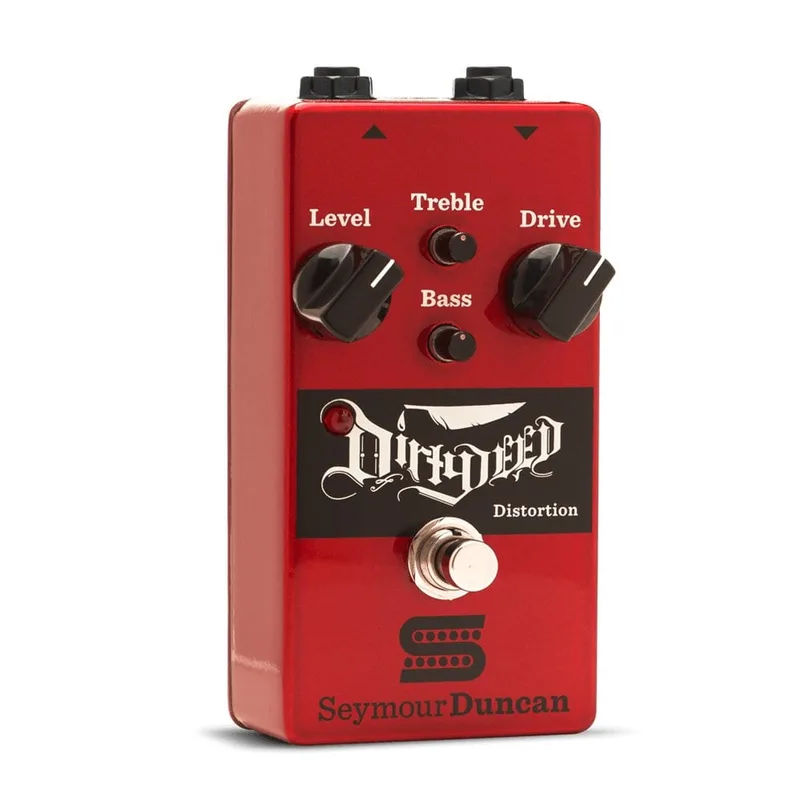


The Seymour Duncan Dirty Deed is a compact distortion pedal from Seymour Duncan, the pickup maker's entry on the filthier side of the effect. Announced on November 6, 2013 after several years of development, it is an all-analog, 100% true bypass pedal built around a pair of MOSFET transistors, designed to capture the character and responsiveness of a classic overdriven tube amplifier1.
Where many distortion pedals lean toward modern metal, the Dirty Deed sits on the classic-rock side of the effect. Premier Guitar's announcement described it as combining elements of distortion, fuzz and overdrive in a single wide-range pedal, with MOSFETs chosen to evoke the tube-like harmonics and lush sustain of a dangerously pushed amplifier1. MusicRadar's reviewer, Mike Astley-Brown, placed it the same way: "The DDD falls on the classic-rock side of distortion, with a presence and mid kick aimed at the stage"2.
Classic-rock distortion from a pair of MOSFETs
The heart of the Dirty Deed is its clipping stage: a pair of cross-connected MOSFET transistors. Guitar World's reviewer, Chris Gill, described the circuit as using "a pair of cross-connected MOSFETs to produce a rich, thick and dynamic overdrive"7. MOSFETs are a type of transistor whose soft, tube-like clipping behavior has made them popular in amp-in-a-box style circuits, and here they are intended to give the pedal the harmonics and sustain of an amplifier being pushed hard rather than the harder clipping of a diode-to-ground design18.
The result, according to MusicRadar, is full-bodied gain at any drive level, with a dynamic response similar to a cranked amp2. Vintage Guitar's news piece framed the same design goal from the maker's side: the MOSFET pair is designed to emulate the tube-like harmonics and sustain of a pushed amplifier8.
The pedal also departs from Seymour Duncan's earlier pedal boxes. Delicious Audio noted that the Dirty Deed "deviates away from the design of previous SD pedals with a re-worked housing and a tightly condensed face," moving to a standard-size enclosure with level and drive knobs on either side and treble and bass mini switches in the middle4. MusicRadar places it in the company's compact range2.
The controls
The Dirty Deed keeps its control set simple: Gain, Level, Treble and Bass. The gain knob is the wide-range one. Premier Guitar's announcement put it this way: "With a turn of the gain knob you can go from the sparkling overdrive of your favorite classic rock songs to a rich, powerful hard rock distortion"1. Guitar Interactive repeated the same range, from sparkling overdrive to hard rock distortion with amp-like saturation9.
| Control | What it does |
|---|---|
| Gain | Sets the amount of gain, from sparkling overdrive to hard rock distortion19 |
| Level | Sets the output volume4 |
| Treble | Active treble control, up to 12dB boost or cut18 |
| Bass | Active bass control, up to 12dB boost or cut18 |
The treble and bass controls are an active EQ rather than passive cut-only tone shaping, offering up to 12dB of boost or cut on each band18. MusicRadar found this matters in practice: the active EQ "helps to maintain the distortion's clarity," with up to 12dB of cut or boost available2.
Seymour Duncan describes the Dirty Deed's Treble, Bass, Gain and Level controls as highly responsive, letting you dial in your ideal sound whether the pedal is your sole source of grit or extra dirt stacked onto an already-overdriven amp59.
Power: 9V to 18V DC
The Dirty Deed runs on standard 9V to 18V DC power supplies1. Guitar World's review described the layout plainly: "You've got an input, an output, and 'the jack' that accommodates both nine- and 18-volt power supplies"7.
The voltage choice changes the character. At 18V, the Dirty Deed enhances overall saturation and compression, giving a fuller, more pushed feel than the standard 9V supply189. For a player who finds 9V distortion pedals thin at high gain, the higher headroom is the practical difference between the two settings.
The Dirty Deed accepts 9V to 18V DC, so it works on a standard pedalboard supply, but running it at 18V changes the sound: more saturation and compression overall1.
What reviewers said
MusicRadar reviewed the Dirty Deed as part of Seymour Duncan's compact FX range and came away impressed2:
"We've tried plenty of distortion pedals over the years, but the DDD ranks among our favourites"2
Mike Astley-Brown, MusicRadar2
The same review noted that the active treble and bass EQ helps the distortion keep its clarity, with up to 12dB of cut or boost on each band2.
Where it came from and where it was made
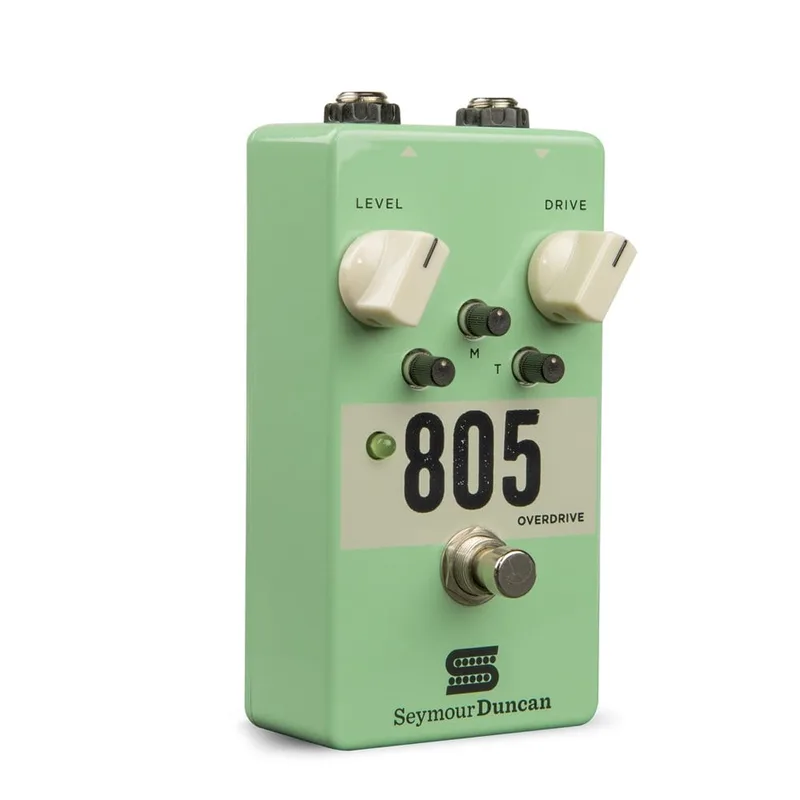
Seymour Duncan announced the Dirty Deed on November 6, 2013, describing it as the product of several years of development before its public release1. The pedal is designed and assembled at the Seymour Duncan factory in Santa Barbara, California6, the same facility where the company assembles its other pedals, including the 805 Overdrive10.
Delicious Audio highlighted a video demo of the pedal courtesy of Jack Thammarat4.
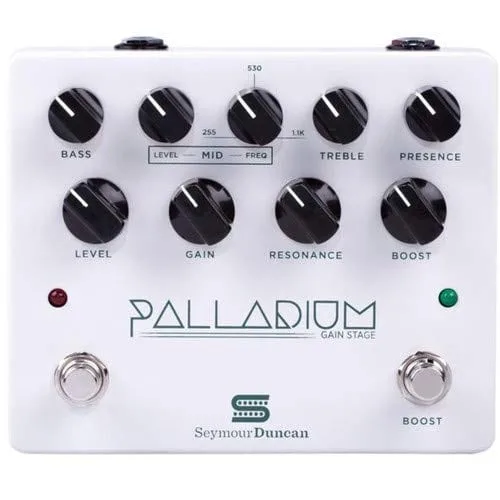
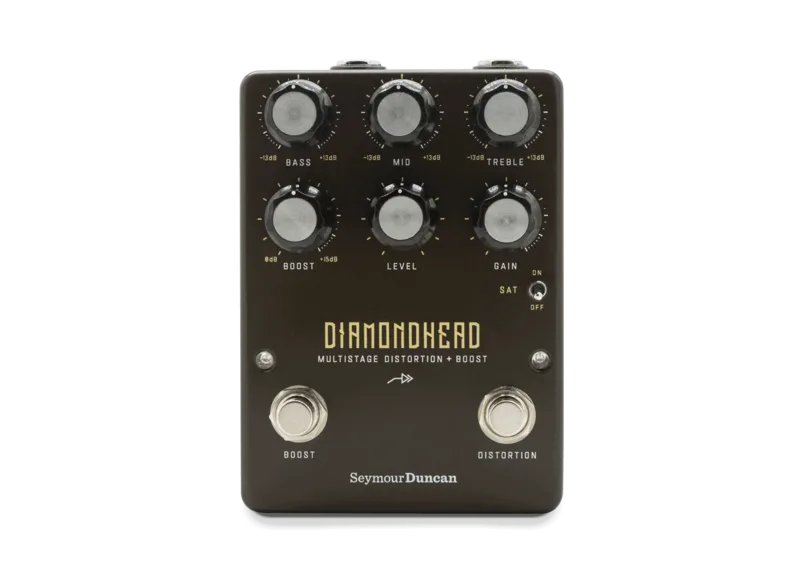
Within Seymour Duncan's distortion lineup, the Dirty Deed sits alongside later designs like the Palladium Gain Stage and the Diamondhead Multistage Distortion + Boost, which take the company's gain offerings in higher-gain and multistage directions.
Videos
Guitar World
ProGuitarShopDemos
Premier Guitar
Questions
What does the Dirty Deed sound like at 18 volts?
At 18V the Dirty Deed enhances overall saturation and compression, giving the distortion a fuller, more pushed feel than it has on a standard 9V supply. Seymour Duncan describes the effect as more saturation and compression across the whole pedal.
Is the Seymour Duncan Dirty Deed true bypass?
Yes. The Dirty Deed is a 100% true bypass pedal, so with the effect switched off your signal passes through without coloring it. Vintage Guitar also describes it as an all-analog, true-bypass pedal.
Is the Dirty Deed analog?
Yes, the Dirty Deed is an all-analog distortion pedal. Its clipping comes from a pair of MOSFET transistors designed to emulate the tube-like harmonics and sustain of a pushed amplifier.
Where is the Seymour Duncan Dirty Deed made?
The Dirty Deed is designed and assembled at the Seymour Duncan factory in Santa Barbara, California. It was announced on November 6, 2013 after several years of development.
Sources (10)
- Seymour Duncan Launches Dirty Deed Distortion Pedal, Premier Guitar, 2013-11-06
- Seymour Duncan Dirty Deed Distortion review, MusicRadar, 2014-09-02
- Seymour Duncan Chris Letchford, Seymour Duncan, 2024-12-20
- New Pedals: Seymour Duncan's Dirty Deed Distortion, Delicious Audio, 2014-06-11
- Video: Seymour Duncan Shares New Dirty Deed Distortion Pedal Demo, Guitar World, 2013-12-30
- Seymour Duncan launches Dirty Deed pedal, MusicRadar, 2013-11-06
- Review: Seymour Duncan Dirty Deed Distortion Pedal, Guitar World, 2014-03-03
- Seymour Duncan Releases Dirty Deed Distortion Pedal, Vintage Guitar magazine, 2013-11-05
- Seymour Duncan Releases 'Dirty Deed' Distortion Pedal, Guitar Interactive Magazine, 2013-11-06
- Seymour Duncan Introduces 805 Overdrive Pedal -Demo Video, Guitar World, 2014-07-02
 Chris Letchford