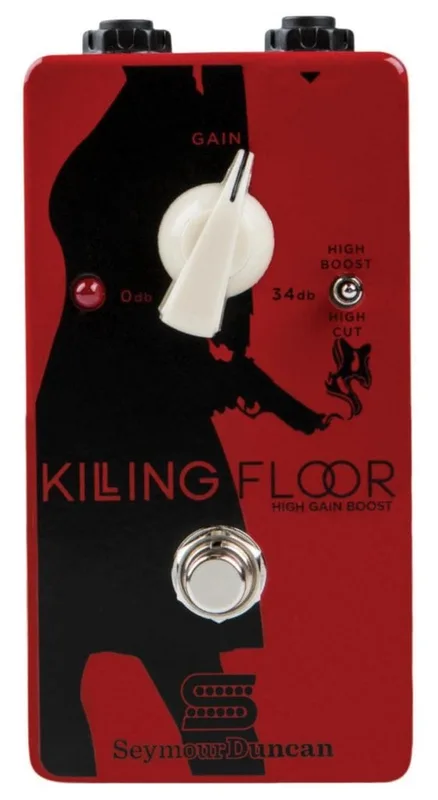


The Seymour Duncan Killing Floor is a high-gain boost pedal that combines a volume boost and what Seymour Duncan calls a musical, amp-like overdrive in one box1. It was announced on 28 June 2016 as the Killing Floor High Gain Boost1, and it sits in the Seymour Duncan effects line alongside pedals like the Pickup Booster.
The idea is simple: one Gain knob that goes from a subtle level lift all the way to a full, fat overdriven lead, with up to 34 dB of additional gain on tap1. Seymour Duncan's own pitch for it covers the classic boost jobs: raising your overall output for solos, pushing an amp further into overdrive, or building what the announcement calls "an unmistakable, undeniable bluesy feel"1. Guitar World's reviewer put the same point in plainer terms, noting that its 34 dB of boost "will push any amp into overdrive"2.
Controls
The control set is deliberately minimal: one knob and one switch.
| Control | What it does |
|---|---|
| Gain | A single knob giving up to 34 dB of additional gain, from subtle boost through brash chords to a full, fat overdriven lead1 |
| Voicing | A three-way toggle that sculpts the high end: boost at 10K, cut at 4.8K, or flat1 |
The Voicing switch is where the Killing Floor lets you match the pedal to your guitar. Seymour Duncan suggests using it to take the bite out of overly bright single coils, put more sting into a dark humbucker, or add what the announcement describes as "crystal clear, boutique-style airiness to your tone"1. In practice that means a bright guitar can be tamed with the 4.8K cut, a dark one can be opened up with the 10K boost, and the flat setting leaves the top end alone.
Sound and circuit
Inside, the Killing Floor uses a hybrid JFET/op-amp circuit that Seymour Duncan describes as "optimised for low-order harmonics", which the guitar.com review took to mean it should stay pure and fizz-free3. The same review passes on Seymour Duncan's warning that some overdrive comes from within the pedal itself, not just from the front end of the amp it is pushing3. So it is not a purely clean boost: turned up, it produces its own overdrive character.
On the question of transparency, the guitar.com review found in favor of the pedal. Reviewer Richard Purvis reported that the boost "comes without any obvious colouration except for a subtle pepping up of the top end"3. That slight top-end lift is worth knowing about if you want a boost that changes nothing at all, but it lines up with the Voicing switch's flat option if you would rather shape that region yourself.
"it comes without any obvious colouration except for a subtle pepping up of the top end."
Power, build and size
The Killing Floor runs on a 9V battery or a mains supply, with the supply not included3. Its simple circuit draws only 3.7 mA of current3, which is low enough that battery use is a realistic option rather than an emergency fallback. Build-wise, the guitar.com review describes it as "a fairly standard compact stomper, with true bypass and a battery compartment whose plastic cover is easy to open"3. At 130 x 66 x 54 mm it takes up a typical single-pedal footprint on a board3, and it is made in the USA13.
The mains power supply is not included with the pedal, so plan on a 9V battery or your own supply3.
Where it came from and what reviewers said
Seymour Duncan announced the Killing Floor High Gain Boost on 28 June 20161, and by early 2017 Guitar World was describing it as "one of Duncan's latest offerings"2. The company positions it as both a volume boost and an amp-like overdrive in one1, which separates it from a straightforward clean boost like the Pickup Booster: where a clean boost aims to raise level without changing character, the Killing Floor is built to overdrive on its own when the Gain knob is pushed1.
Published reviewers covered it from two angles. Guitar World's take centered on the headline number, noting the 34 dB of boost that will push any amp into overdrive, at a street price of $1592. Guitar.com's Richard Purvis focused on how the pedal behaves, finding the boost largely color-free apart from that subtle top-end lift, and calling attention to the scale of the gain on offer: "there's another clue by the top end of the dial: 34dB, which is rather a lot"3.
Videos
ProGuitarShopDemos
Guitar World
Sweetwater
Questions
Is the Seymour Duncan Killing Floor true bypass?
Yes. Seymour Duncan's announcement lists it as True Bypass1, and the guitar.com review confirms it3.
Can the Killing Floor run on a 9V battery?
Yes. It is powered by a 9V battery or a mains supply, with the supply not supplied3, and its 3.7 mA current draw is low3.
Does the Killing Floor color the guitar's tone?
The guitar.com review found it comes without any obvious coloration except a subtle pepping up of the top end3, though Seymour Duncan warns to expect some overdrive from within the pedal itself at high settings3.
How much gain does the Seymour Duncan Killing Floor add?
Up to 34 dB from the single Gain knob, ranging from subtle boost to a full, fat overdriven lead13.
What does the Voicing switch do on the Killing Floor?
It is a three-way toggle offering a high-end boost at 10K, a cut at 4.8K, or a flat setting1, useful for taming bright single coils or adding sting to a dark humbucker1.
Sources (3)
- Meet the New Killing Floor High Gain Boost Pedal, Guitar Interactive Magazine, 2016-06-28
- Review: Seymour Duncan Killing Floor High Gain Boost, Guitar World, 2017-02-08
- Seymour Duncan Palladium & Killing Floor Review, guitar.com, 2017-04-19