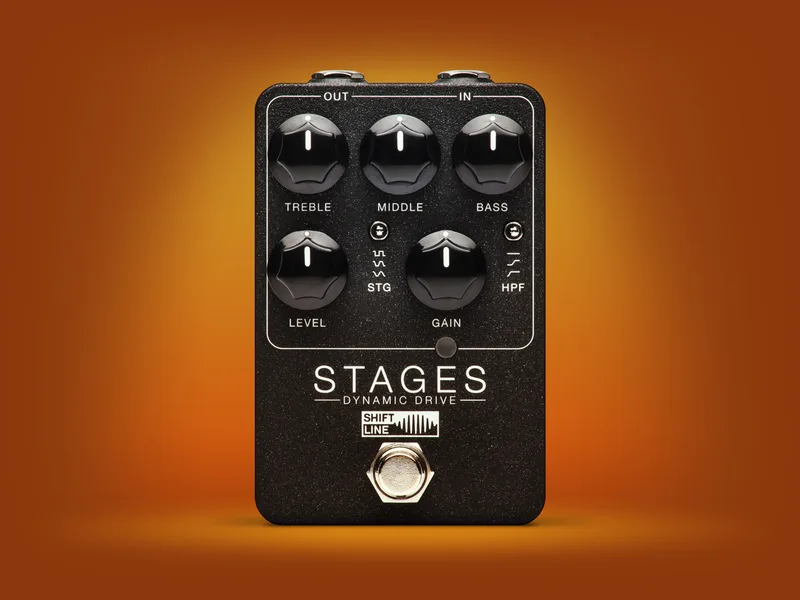


The Shift Line Stages is a fully analog overdrive pedal built around a bipolar power supply: it takes a standard 9V or 12V DC input and converts it internally to ±18V, a voltage level Shift Line describes as "studio gear level" and credits with the pedal's dynamic response1. The core of the pedal is a three-position STG switch that selects how many gain stages are active, which lets one box cover everything from a light, dynamic drive to a heavily saturated, filtered distortion.
The maker's product page offers a Notify Me option for the pedal1.
What it is and what it does
Shift Line describes the Stages as "an overdrive with an excellent dynamic range and deep tone-shaping capabilities"1. The signal path is fully analog, and the enclosure is a compact, lightweight aluminum box with top-mounted jacks designed to save pedalboard space1. The single footswitch turns the effect on and off, with a white LED indicating when the pedal is engaged1.
What sets the Stages apart from most compact overdrives is its internal power arrangement. Instead of running the audio circuit at the 9V a typical pedal supply delivers, it generates a bipolar ±18V rail, which Shift Line says gives the best dynamic response1. The trade-off is current draw: 180mA at 9V is well above what a simple battery could supply, and the pedal has no battery slot at all1.
The controls
The front panel pairs three knobs with two three-position switches, giving the player control over both the amount of drive and the frequency balance feeding it1.
| Control | What it does |
|---|---|
| GAIN | Controls the amplification of the input signal and the amount of harmonic distortion in it1 |
| BASS | A focused "bell" at the 80Hz mark with a 13dB range1 |
| MIDDLE | A mild "bell" in the 600 to 800Hz range, affecting both the mids and the gain texture1 |
| TREBLE | A mild "shelf" set at 10kHz with an 11dB range1 |
| STG switch | Selects the number of gain stages; Shift Line calls it the control with the biggest impact on the sound, determining the pedal's overall sonic character and its response to the incoming signal1 |
| HPF switch | Selects the amount of low cut applied to the signal1 |
| FOOTSWITCH | Turns the effect on or off; the LED glows white when engaged1 |
The STG switch: three gain-stage configurations
The STG switch is the heart of the pedal, and each position changes both the circuit topology and the filtering around it1.
- UP: The maximum number of gain stages. The highly saturated signal is colored by filtering1.
- MIDDLE: One fewer gain stage and a different filter character. The sound is more "open", while the harmonics sit differently1.
- DOWN: The smallest number of gain stages, giving the least amount of harmonic distortion and the most prominent dynamic response1.
In practice, DOWN behaves closest to a clean-boost or light-drive territory, while UP pushes toward saturated distortion sounds, with MIDDLE splitting the difference in character1.
The HPF switch: three low-cut settings
The HPF switch shapes the low end before the drive circuit, which affects how tight the sound feels and where the harmonics land1.
- UP: Minimal low cut; the pedal's frequency range is 25 to 16000Hz1.
- MIDDLE: The largest amount of low cut. A mild filter set at 400Hz boosts harmonics in the mid and high frequencies, which Shift Line says works great for mid- and/or top-boost applications1.
- DOWN: A moderate amount of low cut.
Power and connections
The Stages runs on an external supply only, with no battery option1.
- Voltage: 9V DC or 12V DC, internally converted to ±18V bipolar voltage1
- Current draw: 180mA at 9V DC, 140mA at 12V DC1
- Connector: 2.1/5.5mm barrel, negative tip1
- Input: 6.3mm mono unbalanced jack, 500kOhm input resistance, a high-resistance input for a mono signal source1
- Output: 6.3mm mono unbalanced jack, 100Ohm output resistance1
The 180mA draw at 9V is higher than many compact analog pedals, so it needs a power supply or isolated output rated for it rather than a battery or a low-current daisy chain1.
Warranty and service
Shift Line covers the Stages with a 3-year warranty on electronics from the date of purchase, and a 1-year warranty on parts subject to load, meaning potentiometers, buttons, switches and jacks1. Warranty and post-warranty repairs are only conducted at the maker's service center in Saint Petersburg, Russia1. The maker can be reached at sales@shift-line.com for worldwide shipping questions and info@shift-line.com for warranty policy questions1.
Videos
Shift Line
Shift Line
intheblues
Questions
Is the Shift Line Stages true bypass?
Yes. Shift Line states that the pedal uses true bypass, so when it is switched off the signal passes through without processing. A white LED on the footswitch glows when the effect is engaged.
Can the Shift Line Stages run on a battery?
No. The pedal has no battery slot, so it needs an external power supply. It accepts 9V DC at 180mA or 12V DC at 140mA through a 2.1/5.5mm center-negative barrel connector, which it converts internally to bipolar ±18V.
Where is the Shift Line Stages repaired under warranty?
Warranty and post-warranty repairs are only conducted at Shift Line's service center in Saint Petersburg, Russia. The warranty covers electronics for 3 years from purchase and parts subject to load, such as potentiometers, buttons, switches and jacks, for 1 year.
Is the Shift Line Stages still in production?
The maker has not stated that it is discontinued, so it may return to availability.
Sources (1)
- Shift Line Stages, Shift Line, 2026