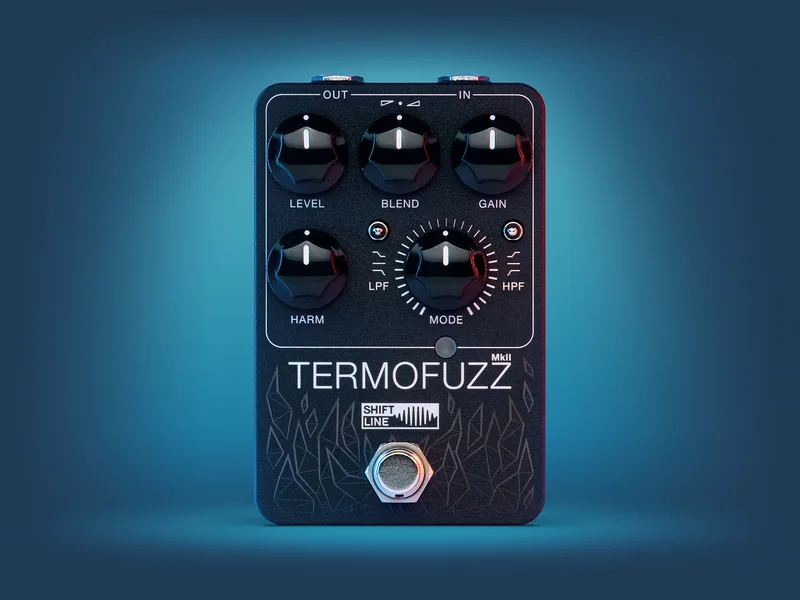


The Shift Line Termofuzz is an all-analog fuzz pedal that aims to be several fuzzes in one box. Shift Line describes its sound palette as ranging from break-up crunch to super hi-gain fuzz tones, octafuzz, gated fuzz and self-oscillation, and calls it "50 years of fuzz in one pedal"1. The original Termofuzz was the most popular fuzz/drive pedal in the Shift Line lineup, and it has since been replaced by the Termofuzz MkII, an updated version with added blend and filter controls2.
The MkII is a universal fuzz/drive pedal that Shift Line says "easily goes from traditional fuzz tones to wildly experimental" territory2. Guitar Pedal X's Stefan Karlsson, reviewing the MkII in June 2025, called the line one of his favorite versatile multi-fuzzes:
"The original was legendary - and this new one sounds like more of the same - with a few more controls - to get even more"3
"possibly in some ways even the most expansively versatile single fuzz I own - as it touches on all manner of classic and" otherworldly fuzz voicings3
The original Termofuzz is discontinued1. The MkII is the current version, but Shift Line's product page lists it as out of stock, with a Notify Me option available2.
One fuzz, many voices: from crunch to octafuzz and glitch
The core idea of the Termofuzz, in both versions, is that one pedal covers fuzz territory that usually takes a whole board. The original's Mode knob has no fixed positions: it changes the sound smoothly, from low gain to super high gain, passing through up and down octaves, arpeggios and gate effects1. Pedal of the Day's Mike B, reviewing the original in 2015, counted ten different fuzz modes and wrote that "The sounds from these modes basically cover every fuzz sound you could think of, from straightforward rock fuzz to the g"litchy, random, noise-generating end of the spectrum5.
The MkII formalizes that range into named starter settings: Overdrive, Distortion, Fuzz 1, Fuzz 2, OctaFuzz, OctaDist, Octaver and Glitch2. It also carries an analog octave up and down effect that can be blended in with any drive setting, plus a bipolar wet/dry mix for proper signal phase processing2.
For a player, that means the Termofuzz can sit in for an overdrive or distortion pedal at one end of its range and reach octave and pitch effects and gated, glitchy noise at the other, all from the same analog circuit521.
The controls on the Termofuzz MkII
The MkII keeps the spirit of the original's control set but reorganizes it. The original had Level, Dirt, Gain, a Harmonics switch and a Mode knob3; the MkII moves to Level, Gain, Mode, and LPF and HPF filter switches.
| Control | What it does |
|---|---|
| LEVEL | Controls the output signal's volume; Shift Line recommends setting LEVEL and GAIN to neutral positions initially2 |
| GAIN | Controls the gain applied to the incoming signal, setting the amount of harmonic distortion; range runs from "almost clean" to "completely unrecognizable" depending on the MODE position2 |
| MODE | Moves between the pedal's modes, from Overdrive through the fuzz, octave and Glitch settings2 |
| LPF switch | UP: steep high-frequency cut, low frequencies accentuated in the distorted signal. DOWN: medium high-frequency cut, works great for classic tones2 |
| HPF switch | UP: steep low-frequency cut, low frequencies get a minimum amount of distortion. MIDDLE: no low-frequency cut, the entire frequency spectrum is processed and distorted2 |
| FOOTSWITCH | Turns the effect on or off; when engaged the LED glows white2 |
The two filter switches are the practical difference from the original's Harmonics switch, which set the amount of high-frequency harmonics and had no effect when the Mode knob was turned fully clockwise or counterclockwise1. On the original, the Dirt knob was the route to self-oscillation, random octaves, 8-bit sounds and noises1, territory the MkII's Glitch setting now covers.
Power and connections
The MkII runs on a 2.1/5.5 mm power jack, negative tip, accepting 9 to 12V DC at 85mA2. Shift Line states plainly that the pedal cannot be battery-powered and should be run from a regulated power supply only2. The original was more flexible: it took a 9V regulated center-negative adapter or a 9V battery, drawing 25mA1.
The MkII's 85mA draw and regulated-PSU-only requirement mean it is not a candidate for a battery, and players using daisy-chain supplies should account for the current draw.
Connections are simple: a 6.3 mm mono unbalanced input with 1 MOhm impedance, described by the maker as a high-impedance input jack for mono signal sources, and a 6.3 mm mono unbalanced output with 100 Ohm output impedance2. Both jacks are top-mounted in a compact aluminum enclosure designed to save pedalboard space2.
Where it came from and what reviewers said
Shift Line states that warranty and post-warranty repairs for the Termofuzz are only conducted at its service center in Saint Petersburg, Russia2. A review of the original found the Level control's overall output volume ample, with room to spare5. The original's street price was listed at $1654.
The MkII is an analog fuzz/drive effect that Shift Line describes as having a broad sonic palette, ranging from classic sounds to avant-garde2. It adds a bipolar wet/dry mix for proper signal phase processing2, and it comes in a compact aluminum enclosure with top-mounted jacks to save pedalboard space2. The original's street price was listed at $1654.
Videos
ProGuitarShopDemos
Shift Line
Shift Line
Questions
Does the Termofuzz MkII take a battery?
No. Shift Line states the MkII cannot be battery-powered and should be run from a regulated power supply only. It uses a 2.1/5.5 mm center-negative jack accepting 9 to 12V DC at 85mA. The original Termofuzz, by contrast, did support a 9V battery.
Is the Shift Line Termofuzz true bypass?
Yes. The original Termofuzz used clickless relay true bypass, and the MkII also uses true bypass in its circuit. When the MkII's footswitch is engaged, its LED glows white to show the effect is on.
Is the original Termofuzz discontinued?
Yes. Shift Line's product page for the original Termofuzz marks it as discontinued. The MkII replaces it in the lineup, though as of the maker's 2026 page the MkII itself is listed as out of stock, with a Notify Me option available.
Where is the Shift Line Termofuzz made?
Each pedal is hand-built in Saint Petersburg, Russia, according to Guitar World's review of the original. Shift Line also states that warranty and post-warranty repairs are only conducted at its service center in Saint Petersburg.
What does the HPF switch on the Termofuzz MkII do?
It sets how the low end is handled. In the UP position it applies a steep low-frequency cut so bass frequencies get a minimum amount of distortion. In the MIDDLE position there is no low-frequency cut, so the entire frequency spectrum is processed and distorted.
Sources (5)
- Shift Line Termofuzz, Shift Line, 2026
- Termofuzz MkII, Shift Line, 2026
- Guitar Pedal X, Guitar Pedal X, 2025-06-13
- Gear Review: Shift Line Termofuzz Fuzz Pedal, Guitar World, 2015-03-17
- Shift Line Termofuzz, Pedal of the Day, 2015-05-05