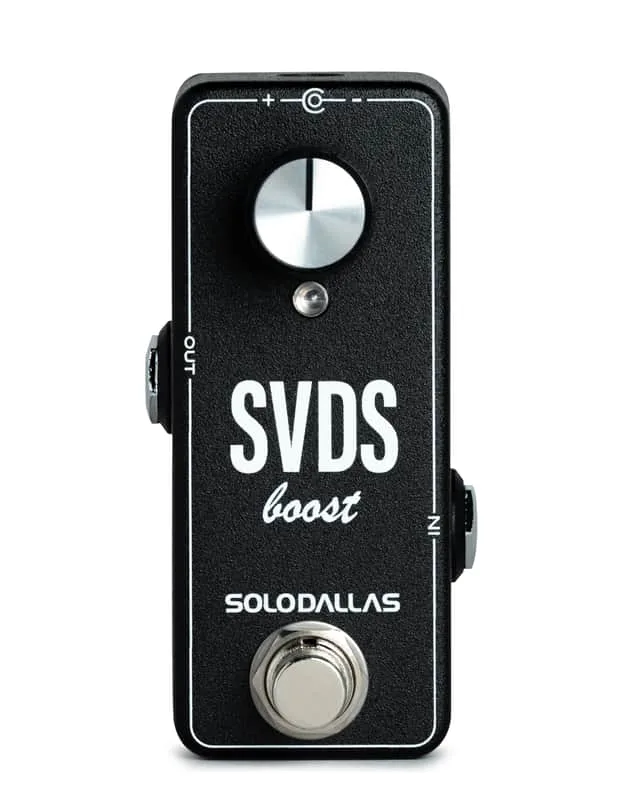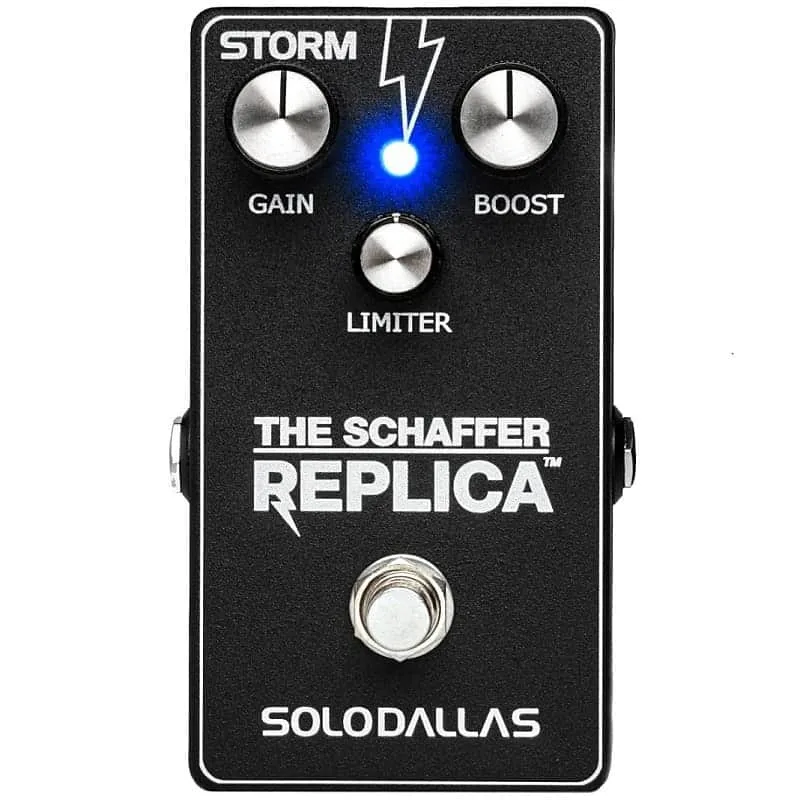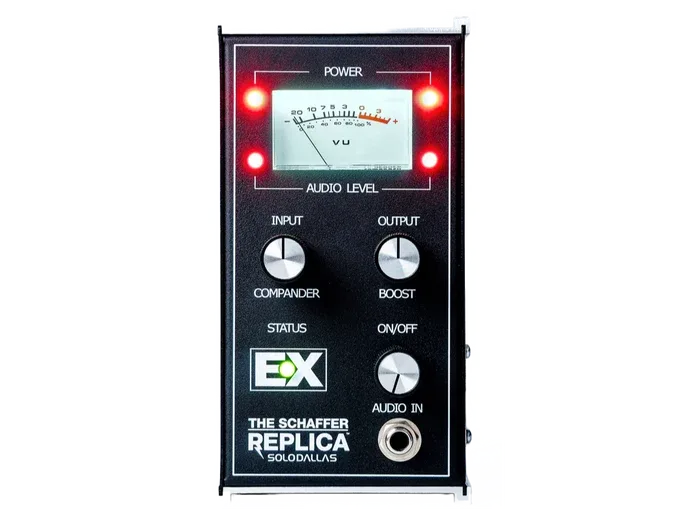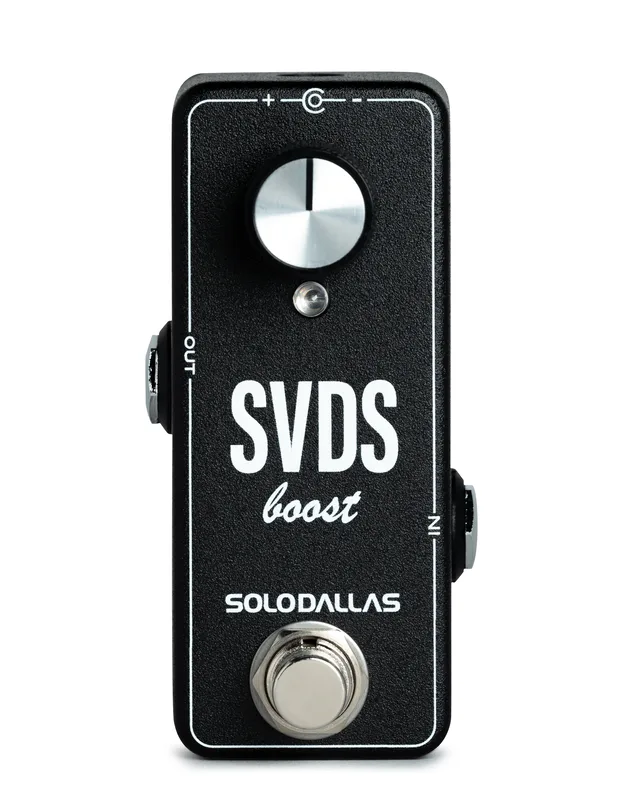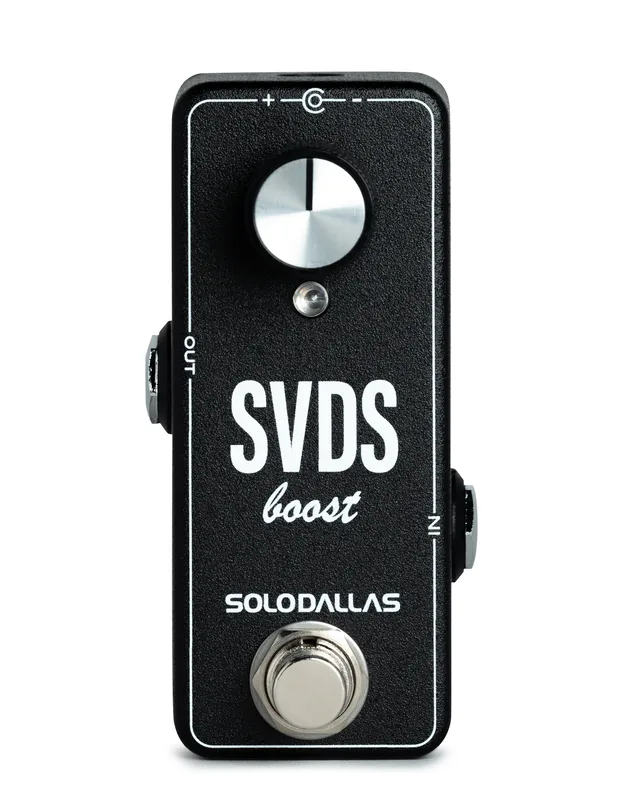


The Schaffer-Vega Diversity System signal boost replica is a pedal from Solo Dallas, sold through solodallas.com, that recreates the boost stage of the 1975 Schaffer-Vega Diversity System, a wireless guitar system whose audio circuitry became prized in its own right. Premier Guitar's Tom Butwin describes it as a pedal that "recreates the legendary 1975 signal boost from the Schaffer-Vega Diversity System, which provided up to 30 dB of boost."1
What it does
The original Schaffer-Vega Diversity System was a wireless unit with a 1/4" Monitor Out. That output was driven by an op-amp stage, and guitarists were "accidentally" using this opamp to boost their signal, according to SoloDallas's product page.3 What began as a side effect of the wireless design became the point: as the GuitarPCB manual puts it, "Originally designed as a wireless system, its audio circuitry became valued for its ability to push amplifiers harder."4
The coloration is what sets it apart from a straightforward clean boost. Premier Guitar's Tom Butwin writes, "Unlike typical clean boosts, it enhances vintage coloration and harmonics."1 A maker manual for a circuit of this type describes the coloration as "more transparency," plus "slight compression (out of the compounder function) and the additional gain boost."2 In practice that means the pedal lifts the signal into the front of an amp while adding a mild compression and a vintage-flavored character, rather than only raising the volume.
"The audio circuit of the SVDS caused subtle improvements to the tone of an instrument that caught the attention of some of the greatest guitarists, bassists, and studio engineers of the 70s and 80s."
Where it came from
The Schaffer-Vega Diversity System dates to 1975. SoloDallas's history page records that "Schaffer ceased production of [the SVDS] in 1982 due to stricter FCC regulations," so the original wireless unit has long been out of production.6 The boost stage inside it, however, kept its reputation, and Solo Dallas builds its replicas around that circuit. The company describes the replica line as capturing what the original's audio circuit did to an instrument's tone.5
The original Schaffer-Vega Diversity System was discontinued in 1982 because of stricter FCC regulations. What Solo Dallas sells is a replica of its boost circuit, not the wireless unit itself.6
As a boost pedal
Among boost pedals, this one sits on the colored side of the fence. Premier Guitar's buying guide lists it alongside clean boosts but notes the difference: it adds vintage coloration and harmonics where a typical clean boost leaves the tone alone.1 Butwin also notes that it is "Built with high-quality components, it's designed for both studio and stage reliability."1
For a player, the appeal is pushing an amplifier harder without changing pedals: the up to 30 dB of lift from the original design, plus the slight compander compression and added gain, drive the amp's input stage in the way the 1975 wireless unit did when players left it switched on.12
Videos
Pete Thorn
Pete Thorn
Premier Guitar
Questions
What was the Schaffer-Vega Diversity System?
It was a wireless system first sold in 1975, built around an op-amp stage that was originally intended to power a 1/4-inch Monitor Out. Players found that the same circuitry pushed amplifiers harder and added subtle improvements to their tone, and it became valued as much for that boost as for its wireless function. Schaffer ceased production in 1982 due to stricter FCC regulations.
How is this replica different from a clean boost?
Premier Guitar's Tom Butwin notes that unlike typical clean boosts, it enhances vintage coloration and harmonics. The original system's sound is described as more transparency, slight compression from its compander function, and an additional gain boost, so it shapes the signal as it lifts it rather than only raising its level.
Sources (6)
- 7 Boost Pedals for Rich Tube Harmonics, Premier Guitar (www.premierguitar.com), 2025-03-25
- gerateblatt_2020_black-box_klein.pdf, treblebooster.net, 2020
- SVDS Boost, SoloDallas LLC
- 2026-NostalgiTone-Tower-Power.pdf, GuitarPCB, 2026-10
- THE SOLO-X, SoloDallas LLC
- History of The Schaffer Replica Circuit, SoloDallas LLC