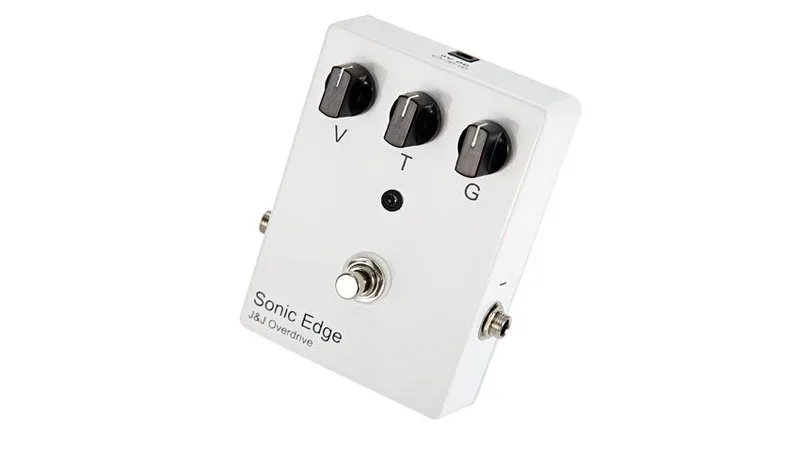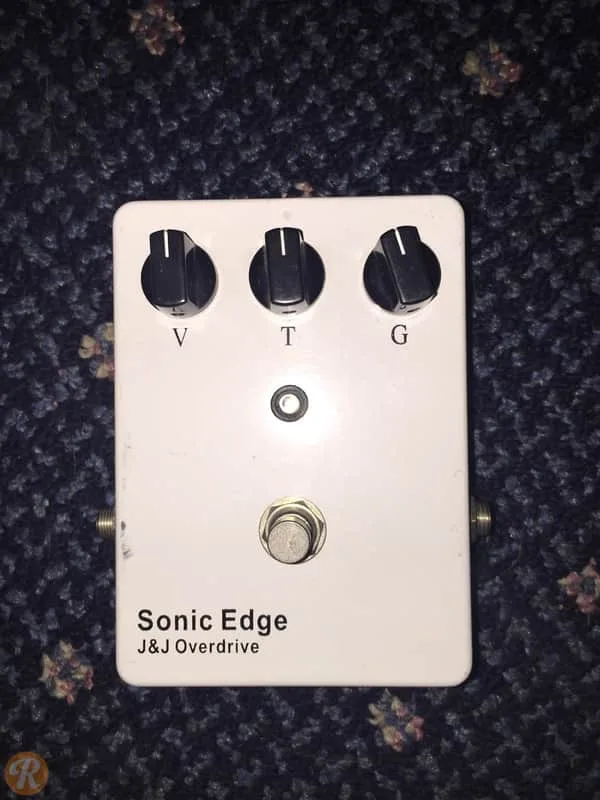


The Sonic Edge J&J Overdrive is a no-frills analog overdrive pedal built by Sonic Edge, the pedal brand of Sacramento-based Fargen amps1. It was the company's first effects pedal: Ben Fargen announced the J&J Overdrive in March 2010 as a vintage overdrive pedal, with preorders taken and delivery expected that June2. Vintage Guitar later reviewed it in early 2013 as Fargen's first entry into effects3.
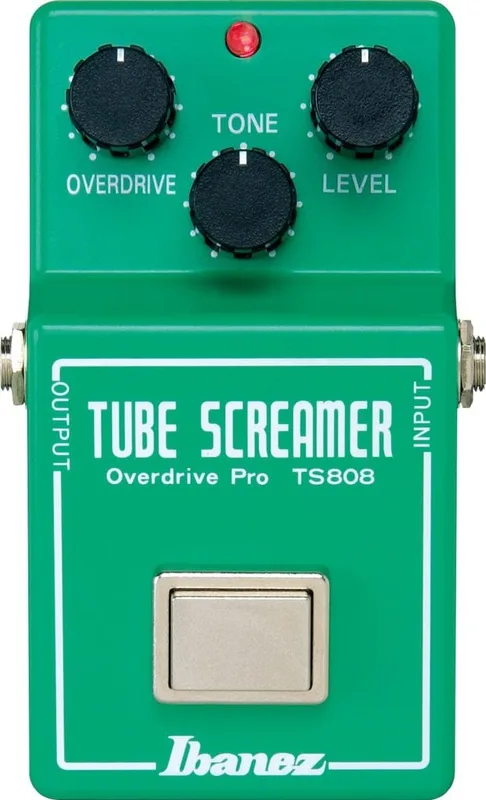
What the pedal does for a player is cover a wide gain range. MusicRadar's review describes it as going "from clean boost up to a decent Tube Screamer-style drive"1, so one box can serve as a level lift for a clean amp or as a midrange-forward drive in front of a non-master amp. Fargen himself described the design goal in Tube Screamer terms at launch, calling it "the heart and soul of a tube screamer"2.
From clean boost to Tube Screamer-style drive
The J&J's gain range is its main selling point. At the low end it works as a clean boost, pushing an amp harder without adding much character of its own; turned up, it reaches what MusicRadar calls "a decent Tube Screamer-style drive"1, meaning a midrange-focused overdrive in the family of the classic Ibanez design rather than an open, flat-edged distortion.
Vintage Guitar's review of the Fargen version found the voicing consistent across that range: "no matter the settings, the J&J Overdrive gives a healthy midrange and bass boost"3. That mid and low emphasis is part of why the pedal suits non-master amps, where the pedal and the amp's own push work together rather than the pedal doing all the clipping.
MusicRadar's verdict sums up where the pedal fits:
"The J&J's transparent tone and excellent touch sensitivity make it a perfect partner for any non-master amp when a bit more drive is needed"1
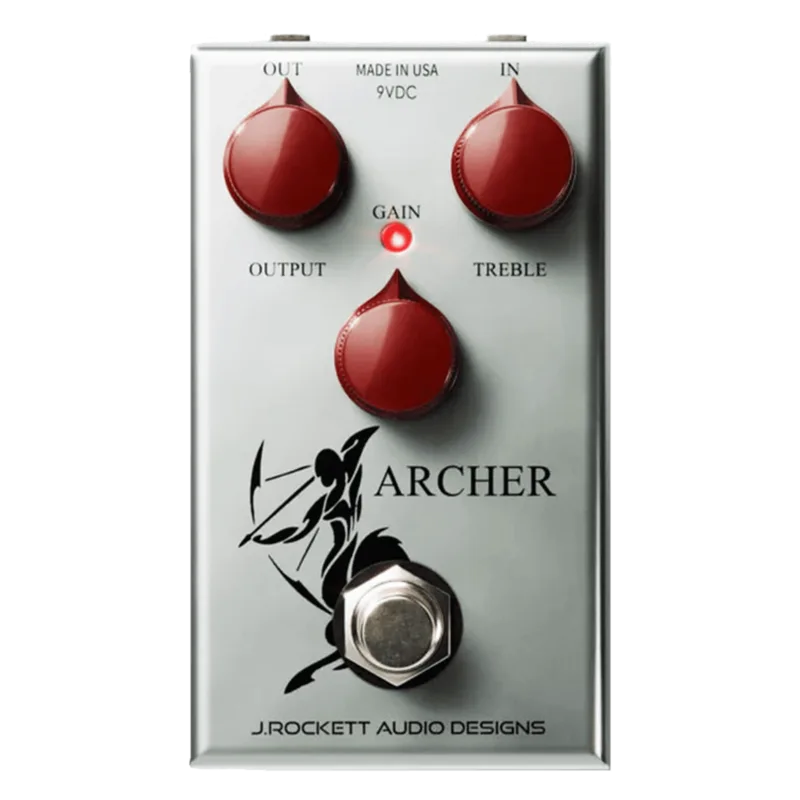
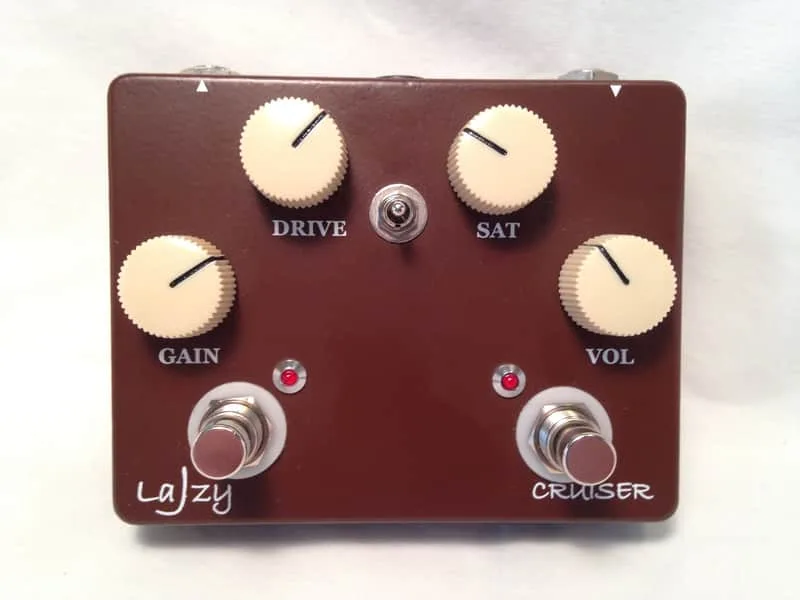
For players comparing it against other boost-plus-overdrive pedals, the J&J sits alongside designs like the J. Rockett Audio Designs Archer, a booster and overdrive in one box4, and the Lazy J Cruiser Deuce, an overdrive and booster5. The J&J takes a simpler route: one circuit, three knobs, and a gain control that spans both jobs.
The controls
The control set is minimal: three knobs for volume, tone and gain, plus a blue status LED, and a true bypass in/out switch1. Vintage Guitar's review of the Fargen version lists the same three controls: Volume, Tone, and Gain3.
| Control | What it does |
|---|---|
| Volume | Sets the output level, from a subtle lift to a full clean boost1 |
| Tone | Shapes the treble content of the driven signal1 |
| Gain | Sets the amount of drive, from clean boost up to Tube Screamer-style overdrive1 |
Because the pedal is true bypass, the dry signal passes through untouched when the pedal is off1.
Inside the circuit
The J&J is a pure analog pedal1. Its drive comes from a pair of JFET transistors on a small single-sided PCB, complemented with film capacitors and carbon comp resistors1. JFETs are transistor types often chosen for overdrive circuits because they clip in a way players often describe as more tube-like than op-amp-based designs; the J&J uses them instead of the op-amp arrangement found in many Tube Screamer-style pedals.
Vintage Guitar's review of the earlier Fargen version describes the same approach: "a JFET-based pedal with carbon-comp resistors and metal-film caps throughout its signal path"3. The two reviews differ slightly on the capacitor types (film capacitors versus metal-film caps), but both agree on the JFET circuit and the carbon-comp resistors.
Power and practical details
Power comes from a PP3 battery or a standard DC socket1. Vintage Guitar's review of the Fargen version gives the supply requirement as a center-pin-negative 9-volt DC power supply, and confirms battery operation3. The pedal sits in a cast-alloy box with a non-slip rubber pad underneath1.
The DC supply is center-pin-negative3, the opposite of some pedal brands. Check the polarity of your power supply before plugging in.
Videos
Premier Guitar
Fargen Amplification
TheToneShack
Questions
Is the Sonic Edge J&J Overdrive true bypass?
Yes. MusicRadar's review notes a true bypass in/out switch, and Vintage Guitar's earlier review of the Fargen Sonic Edge J&J Overdrive likewise describes true-bypass switching, so the pedal's dry signal passes through untouched when it is switched off.
Does the Sonic Edge J&J Overdrive run on a battery?
Yes. Power comes from a PP3 battery or a standard DC socket, according to MusicRadar's review. Vintage Guitar's review of the earlier Fargen version also confirms battery operation alongside a center-pin-negative 9-volt DC power supply.
Is the Sonic Edge J&J Overdrive analog?
Yes. MusicRadar describes the J&J as a pure analogue pedal. Its circuit uses a pair of JFET transistors on a small single-sided PCB, complemented with film capacitors and carbon comp resistors rather than digital processing.
Who makes the Sonic Edge J&J Overdrive?
Sonic Edge, which MusicRadar identifies as the pedal brand of Sacramento-based Fargen amps. The J&J Overdrive was Fargen's first effects pedal, announced in March 2010 under the Sonic Edge name.
What is the Fargen Sonic Edge J&J Overdrive?
It is the same pedal in its original form. Fargen began building effects pedals in 2013 with the Sonic Edge J&J Overdrive as the first entry, a JFET-based overdrive with carbon-comp resistors and metal-film caps in its signal path.
Does the J&J Overdrive use JFET transistors or op amps?
JFET transistors. MusicRadar's review describes a pair of JFET transistors on a small single-sided PCB, and Vintage Guitar's review of the Fargen version calls it a JFET-based pedal, so there are no op amps in the drive circuit.
Sources (5)
- Sonic Edge J&J Overdrive review, MusicRadar, 2013-06-25
- Ben Fargen Launches Sonic Edge With J&J Overdrive, Premier Guitar, 2010-03-19
- Fargen Olde 800 MKII, Sonic Edge J&J Overdrive, Vintage Guitar magazine, 2016-05-09
- Archer by J. Rockett Audio Designs, RockBoard PedalPedia, 2026
- Cruiser Deuce by Lazy J, RockBoard PedalPedia, 2026