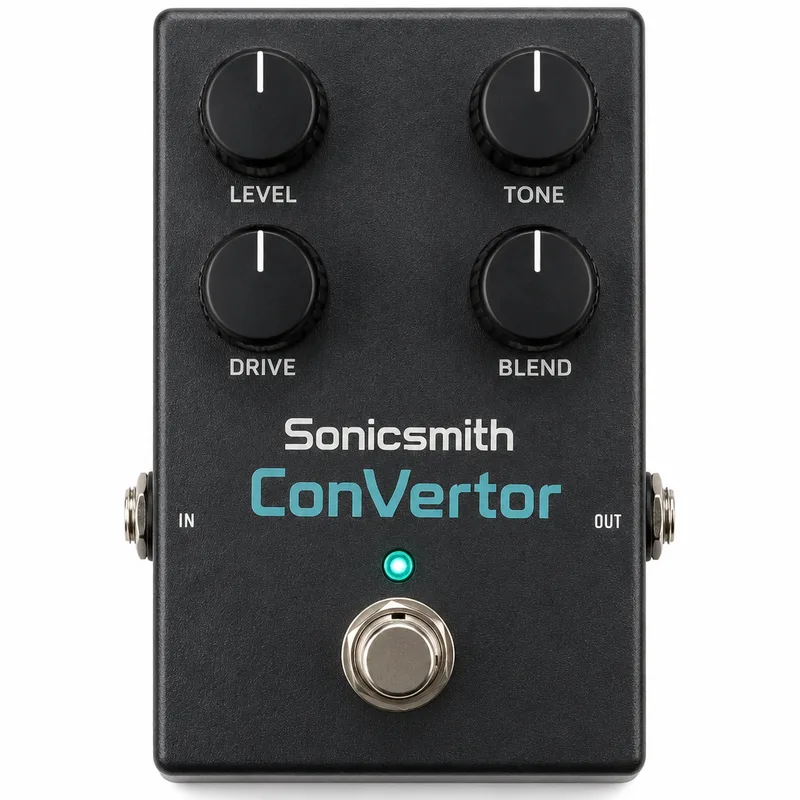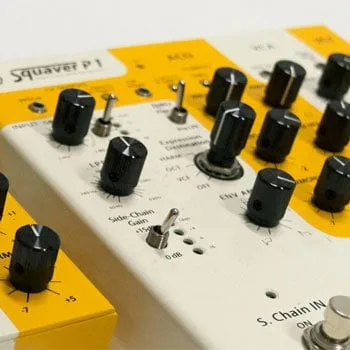


The Sonicsmith Squaver P1+ is a semi-modular synthesizer built in large stompbox format, with three footswitches, that converts the notes from a guitar or bass into analog synth tones. It is part of a pair of Sonicsmith pedals, alongside the Sonicsmith ConVertor, both built on the company's Audio Controlled Oscillator technology, which can convert any analog audio into analog square and sawtooth waves and CV signals1. For a player, that means your instrument's signal drives a real analog synth engine rather than a modeled one, and the patch points on top let you route audio and control signals in and out of the synth, which MusicRadar's reviewer counted as a plus: "Plenty of patch points for routing audio and control signals in and out of the synth"2.
How it converts your playing
The heart of the pedal is the Audio Controlled Oscillator technology. As Christopher Scapelliti put it in Delicious Audio's coverage of the Sonicsmith range: "Both synths have a new technology called Audio Controlled Oscillator that can convert any analog audio into analog square, sawtooth waves"1. In practice, the incoming instrument signal passes through an auto-filter whose job is to help the circuit detect frequency, not to shape the sound you hear. It can be switched between 2-pole (12dB/octave) and 4-pole (24dB/octave) modes, with the 2-pole setting intended to give a faster transient response2.
Tracking is the question every guitar synth has to answer, and MusicRadar's reviewer found the P1+ capable: notes were detected across the full fret range quickly, with the input auto-filter setting only having a moderate effect on the result with electric guitar2.
Controls, jacks and filters
The P1+ carries a full filter section of its own, on top of the conversion engine2:
- VCF section: variable cutoff and resonance, switchable between low, high and band-pass modes, with a selectable slope of 12 or 24dB/octave2
- Filter routing: the filter can process both the dry input and the synth section, or the synth alone, with continuous mixing between the two2
- Expression input: an expression pedal can be plugged in to control the Harmony, Octave or filter cutoff2
- Audio input: 1/4" jack on the back panel, passing through a high-pass filter and on to an adjustable gain section2
- Thru output: unbuffered and pre-gain, for daisy-chaining effects or parallel recording of un-processed audio, switchable to access the output of the auto-filter section instead2
The Thru output is unbuffered and taken before the gain stage, so it delivers your raw input signal. If you want the auto-filter's output sent down that path instead, it has to be switched over2.
Getting a clean signal into it
Because the pedal follows whatever dynamics you feed it, what goes in matters. The manual suggests placing a compressor between the source signal and the P1+ input to get more controllable dynamics, advice MusicRadar's reviewer passes along2. The adjustable gain section behind the input jack gives you a second stage of level control once the compressor has evened things out2.
Where it sits among guitar synths
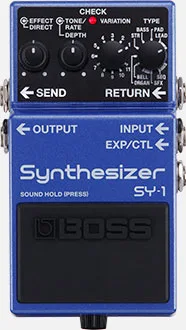
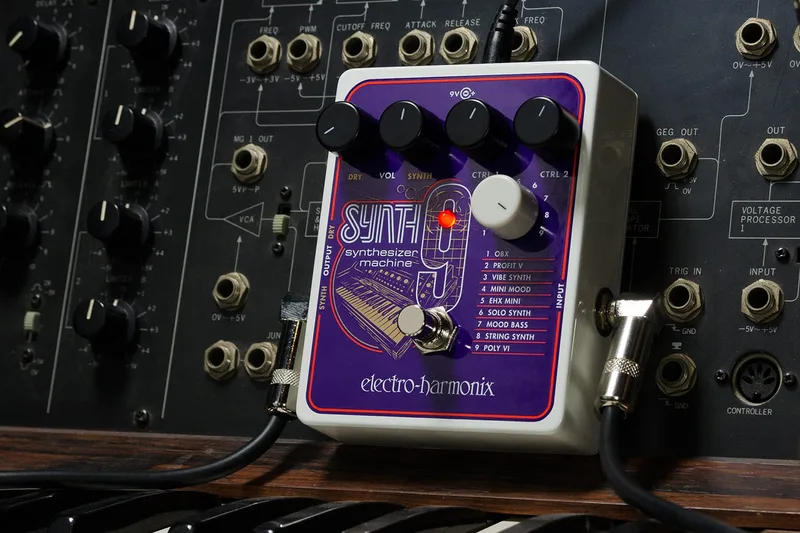
Most pedals in the synth category, from the BOSS SY-1 to the Electro-Harmonix Synth9, are preset-based digital or modeled engines. The Squaver P1+ takes a different approach: a semi-modular analog design with patch points for external control signals, closer in spirit to a modular synth row than to a preset pedal, and built on the same Audio Controlled Oscillator idea as its sibling, the Sonicsmith ConVertor1.
Videos
Nate Navarro
Zachary Rizer
Sound On Sound magazine
Questions
Does the Sonicsmith Squaver P1+ work with bass?
The Squaver P1+ is built around converting any analog audio source into synth tones, and the input stage includes a high-pass filter and an adjustable gain section ahead of the pitch detection. MusicRadar's reviewer found notes were detected across the full fret range quickly with electric guitar, and the manual's advice on placing a compressor before the input to even out dynamics applies to any source, bass included.
Can I connect an expression pedal to the Squaver P1+?
Yes. According to MusicRadar's review, an expression pedal can be plugged in to control the Harmony, Octave or filter cutoff, which lets you sweep those parameters in real time while playing.
What is the Thru output on the Squaver P1+ for?
The Thru output is an unbuffered, pre-gain feed of your input signal. MusicRadar notes it is provided for daisy-chaining effects or for parallel recording of un-processed audio, and it can be switched to access the output of the auto-filter section instead.
Does the Squaver P1+ track notes across the whole fretboard?
MusicRadar's reviewer found that notes were detected across the full fret range quickly, and that the input auto-filter setting had only a moderate effect on the result when tracking electric guitar.
Should I put a compressor before the Squaver P1+?
The Squaver P1+ manual suggests placing a compressor between the source signal and the P1+ input to get more controllable dynamics, which makes sense for a converter that follows what you play. MusicRadar's reviewer passes this advice along in their review.
Sources (2)
- Sonicsmith, Delicious Audio, 2017-06-13
- Sonicsmith Squaver P1+ & Convertor+ review, MusicRadar, 2018-09-19