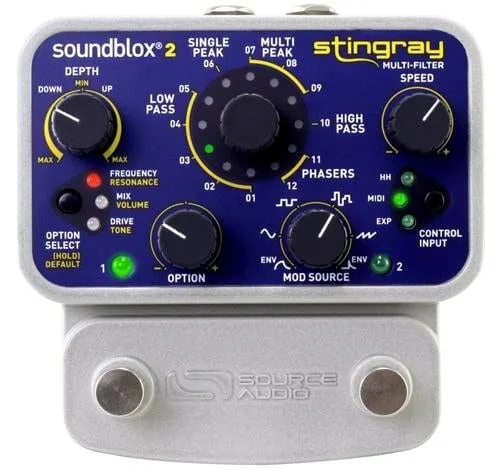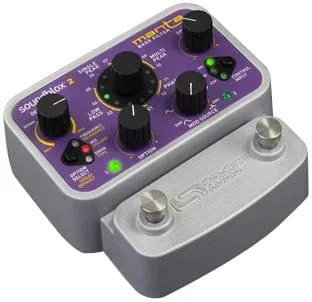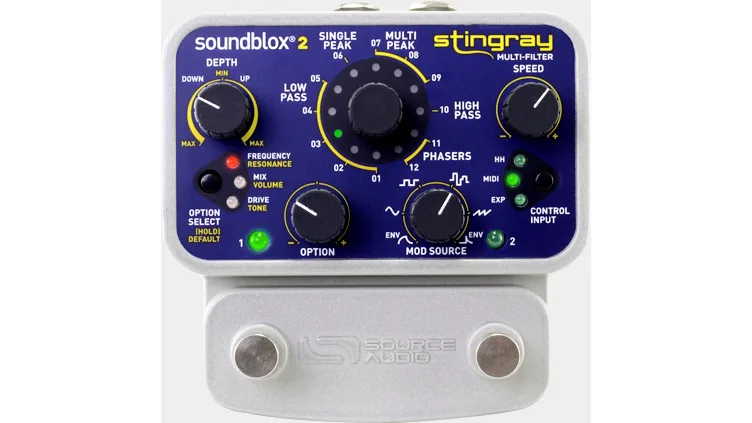


The Source Audio Soundblox 2 Stingray is a digital multi-filter pedal, announced by Source Audio on 22 October 2014 as an expansion of its Soundblox 2 range1. Where a single filter pedal gives you one envelope or wah voice, the Stingray puts 12 filter types in one box: Low Pass, High Pass, Band Pass, Single Peak, Multi-Peak, and Notch filters, with four modes of modulation to drive them1. MusicRadar described it at launch as forging "a distinct new path in filter modulation"1.
Under the hood it is a DSP design rather than an analog filter circuit. Source Audio's own specification for the pedal lists its proprietary 56-bit Digital Signal Processor, the SA601, and 24-bit converters1. A Drive function adds dirt in front of the filter, generating everything from overdrive to fuzz1.
Twelve filters and a Drive control
The 12 filter types cover the main shapes a player reaches for. Low Pass filters roll off highs above a moving cutoff, High Pass thins out the lows, Band Pass isolates a band of frequencies, Single and Multi-Peak boost one or more narrow regions, and Notch cuts a narrow region out1. Switching between them is how the Stingray moves from a vocal wah-like sweep to a thin, honking synth voice.
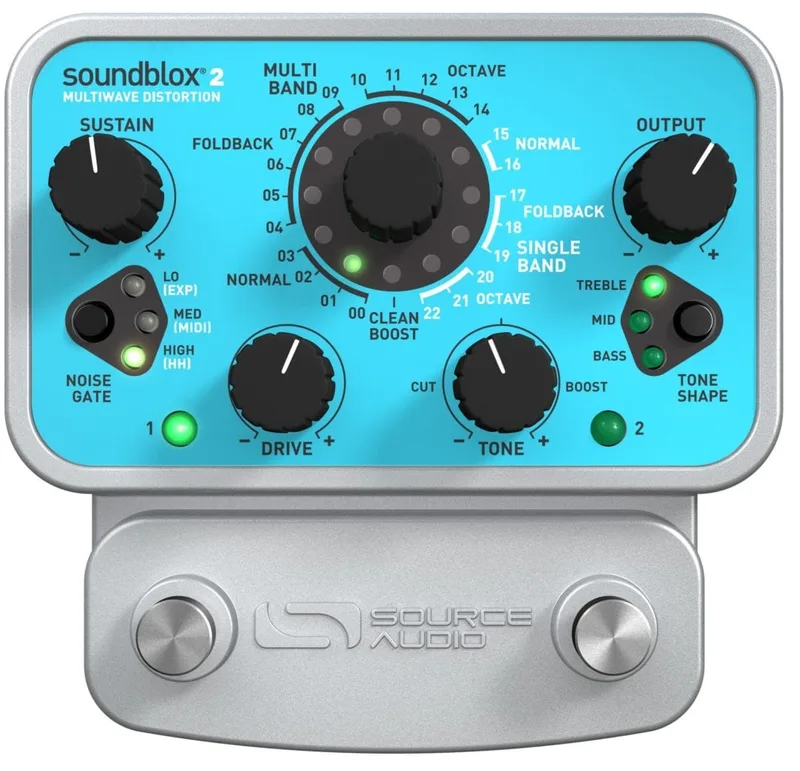
The Drive function is the other half of the sound. Source Audio positions it as a tonal control that can be used to generate everything from subtle overdrive through to fuzz1, so the filter has something to bite on. Players who want that grit as a separate, switchable stage can look at the Soundblox 2 Multiwave pedals, which carry Source Audio's distortion algorithms instead.
Ways to modulate the filter
A filter is only as useful as what moves it, and the Stingray offers four modulation sources1:
- Envelope follower: the filter responds to your picking dynamics, opening up as you play harder.
- Tap Tempo LFO: an oscillator sweeps the filter on a tempo you tap in, with a choice of sine, square, random sample-and-hold, or sawtooth waveforms, and the LFO modulation can be synced using tap tempo1.
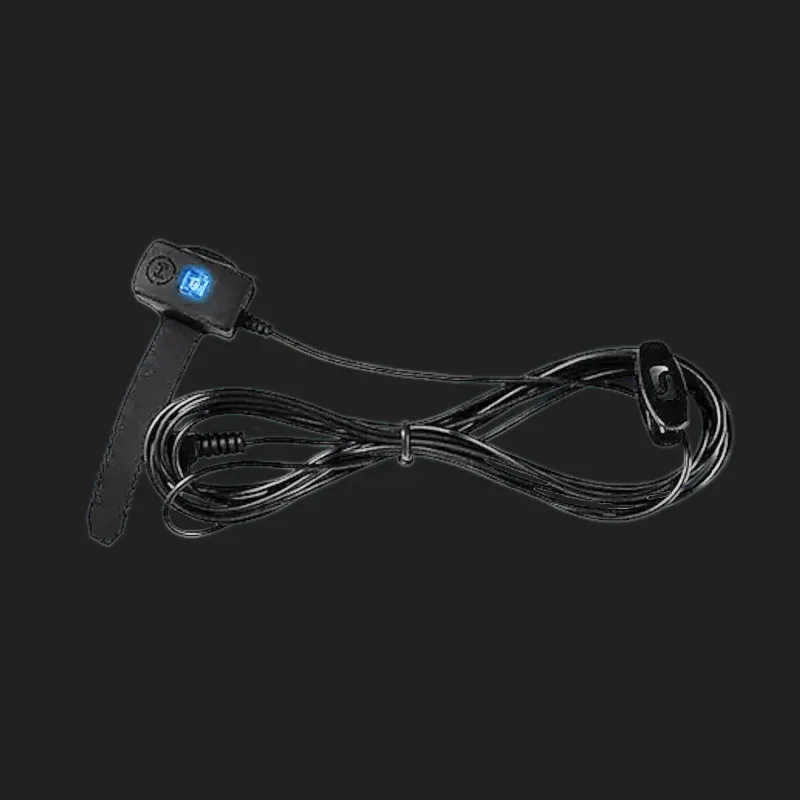
- Hot Hand: Source Audio's motion sensor, which drives the filter from your hand movement.
- Dual Expression Pedal: Source Audio's expression pedal, for conventional foot control.
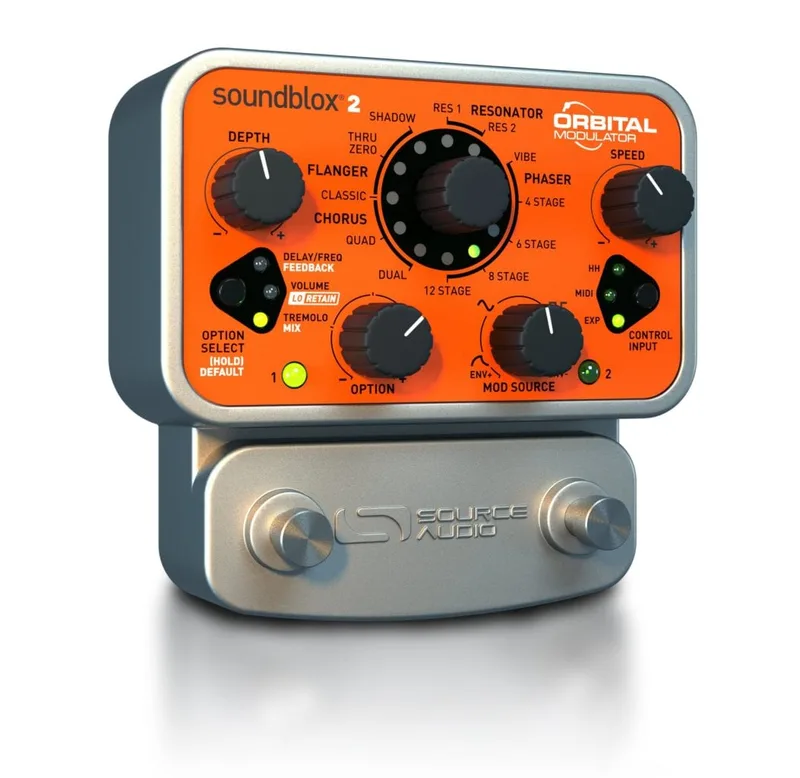
The same multi-function input idea runs through the whole Soundblox 2 line: every pedal in the series has a multi-function input that supports MIDI, an expression pedal, or Hot Hand control2. On the sibling Orbital Modulator, that jack also allows MIDI access to presets and parameters3.
For a sense of how these modulation sources behave in practice, the Premier Guitar review of the related Soundblox 2 Manta Bass Filter is instructive. Its mod-source control can alter the attack and decay of the envelope follower or transform the LFO wave shape from a smooth sine to a jagged sawtooth, and the reviewer noted that "the modulation characteristics blend as you move between settings, so you can tailor in-between tones to taste"4.
Presets, MIDI and the Soundblox HUB
On its own, the Stingray holds two programmable user presets, each called up by its own dedicated footswitch1. That matches the standard Soundblox 2 format, which Source Audio described at the 2012 launch as rack-mount power in a pedalboard-friendly cast aluminum housing with two user presets2.
For bigger rigs, the Soundblox HUB adds MIDI. Connected through the HUB, the Stingray gains MIDI access to control parameters and to save up to 128 user presets1. The HUB became the MIDI route for the whole line: Source Audio's OFD microModeler pedals, and the rest of the Soundblox 2 series, gained MIDI compatibility when the MIDI Control HUB arrived in early 20145.
Power and bypass
The Stingray runs on a 9V DC power supply, and one is included in the box1. The Soundblox 2 line's power standard is 9V DC, center negative6, so it fits a typical pedalboard power supply.
Bypass is Source Audio's Universal Bypass: you select either analog buffered or relay-based True Bypass1. That choice matters on a large board. True bypass keeps the pedal out of the signal path entirely when off, while buffered bypass keeps a buffer in line, which can preserve high end over long cable runs. Every Soundblox 2 pedal offers the same selectable bypass2.
Where the Stingray sits in the Soundblox 2 line
Source Audio introduced the Soundblox 2 format at NAMM in January 2012 with three new products, all sharing precision 56-bit signal processing, the multi-function input, Universal Bypass, and two user presets2. The series housings are compact cast aluminum with a 4" x 4" footprint7, and the Stingray follows that form: a compact, rugged, cast aluminum housing measuring 4.5 by 4.5 by 2.25 inches including knobs1.
The Stingray is a multi-filter pedal from Source Audio, featuring 12 different Low Pass, High Pass, Band Pass, Single Peak, Multi-Peak, and Notch filters1.
Videos
ProGuitarShopDemos
ProGuitarShopDemos
sourceaudioeffects
Questions
Does the Stingray come with a power supply?
Yes. The Stingray ships with a 9V DC power supply included, so it is ready to run out of the box without a separate purchase.
Can I control the Stingray with an expression pedal?
Yes. The Stingray's multi-function jacks accept the Source Audio Dual Expression Pedal and Hot Hand motion sensors, giving you real-time control over the modulation or any knob parameter while you play.
Can the Stingray be used with a bass?
The Stingray is a filter pedal in the Soundblox 2 line, which Source Audio built for both guitar and bass players. Players wanting a filter voiced specifically for bass can also look at the Soundblox 2 Manta Bass Filter, which carries over the Stingray's 12 filter effects.
How many presets can the Stingray store?
On the pedal itself, two programmable user presets, each reachable from its own dedicated footswitch. Connected to the Soundblox HUB over MIDI, the Stingray can save up to 128 user presets.
What is the Hot Hand on the Stingray?
Hot Hand is Source Audio's motion sensor, worn on the hand, that plugs into the Stingray's multi-function jack. Moving your hand drives the filter, giving you wah-like control without touching a knob or expression pedal.
Sources (7)
- Source Audio releases Soundblox 2 Stingray multi-filter pedal, MusicRadar, 2014-10-22
- NAMM 2012: Source Audio to release Soundblox 2 line of guitar, bass effects, MusicRadar, 2012-01-15
- Source Audio's New Soundblox 2 and Pro Poly-Mod Filter, Premier Guitar, 2013-01-22
- Source Audio Manta Bass Filter Review, Premier Guitar, 2014-07-15
- The Soundblox 2OFD Micromodelers from Source Audio Now Available, Guitar Interactive Magazine, 2013-10-03
- Soundblox 2 Orbital Modulator by Source Audio, RockBoard (rockboard.de), 2026
- Source Audio Unveils Soundblox 2 Series at NAMM, No Treble, 2012-01-28