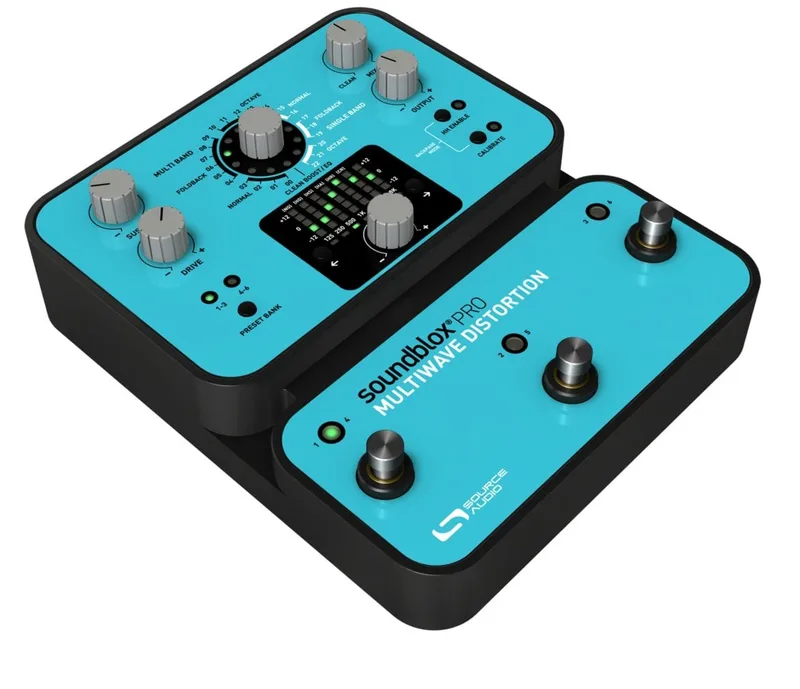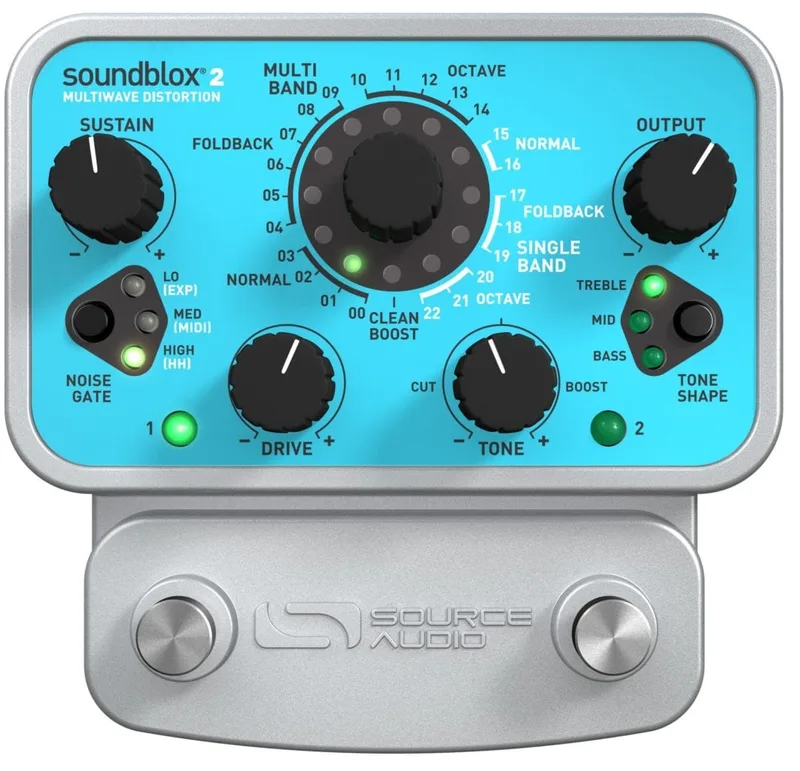


The Source Audio Soundblox 2 Multiwave Distortion is a digital distortion pedal that packs 23 distortion algorithms into a compact cast-aluminum stompbox, from tube drive to octave fuzz and, as Performer Mag's reviewer Chris Devine put it, "pretty much everything in between"1. What sets it apart from a conventional distortion box is its multiband processing: it splits your signal into frequency bands, distorts them separately, and recombines them, which keeps chords articulate under gain that would turn to mush through an ordinary pedal2.
Source Audio's Soundblox Multiwave Distortion pedal offers Multi Band and Single Band distortion setting banks, divided between Normal, Foldback and Octave modes2. Performer Mag's reviewer found it solved the problem of complex chords turning to mush under distortion, writing "I pulled off a complex G7b13+9 chord through distortion with unbelievable clarity"2.
What multiband distortion is
The core idea behind every Multiwave pedal is multiband processing, a technique that breaks the signal into multiple bands and distorts them individually. Premier Guitar's review of the original Soundblox Multiwave Distortion explains the topology: it "divides the guitar signal input into multiple frequency bands, distorts the bands separately, and then recombines the signal"2. The result, in the reviewer's words, is "a distorted guitar tone with an incredible amount of clarity between the notes"2.
The practical payoff showed up in the same review. Where complex chords normally collapse into mush under distortion, the reviewer found the Multiwave solved that problem, pulling off "a complex G7b13+9 chord through distortion with unbelievable clarity"2. Delicious Audio's reviewers noted that this kind of multiband distortion "would only be available in the digital domain," which is why the pedal is a DSP design rather than an analog circuit5.
The Effect knob organizes the 23 algorithms into Multi Band and Single Band banks, each divided between Normal, Foldback and Octave settings1. The single-band modes process the tone like a standard distortion or fuzz box, while the multi-band modes split the signal into ten frequencies and distort them individually before recombining them6.
The controls
Performer Mag found the control set simple: Drive, Voice, Tone, and Output1. The Tone control is a 3-band design1, and the pedal also carries a Tone Shape function that "allows more customization of the tones at the touch of button"1.
| Control | What it does |
|---|---|
| Drive | Sets the amount of distortion1 |
| Voice | Acts more like a "warmth" control, nuanced but effective in small doses, especially for vintage tones1 |
| Tone | 3-band tone control1 |
| Output | Sets the level1 |
| Effect | Selects among the 23 algorithms in Multi Band and Single Band banks1 |
The Voice control drew particular attention from Performer Mag's reviewer, who wrote that it "acts more like a 'warmth' control, which is very nuanced, but can make a big difference in small doses, especially dialing in more vintage tones"1. A 3-level noise gate is easily activated and, in the reviewer's testing, "keeps things from getting unruly" at high gain13.
Presets, morphing and MIDI
The Soundblox 2 Multiwave stores two user presets, each recalled from one of its two footswitches1. The more distinctive feature is preset morphing, which No Treble's coverage of the Soundblox 2 line lists as specific to the Multiwave units4. Performer Mag's Chris Devine explained how it works with an expression pedal:
"This allows the user to pan between a two different modes of the player's choosing to get a unique blend of the two at the same time!"
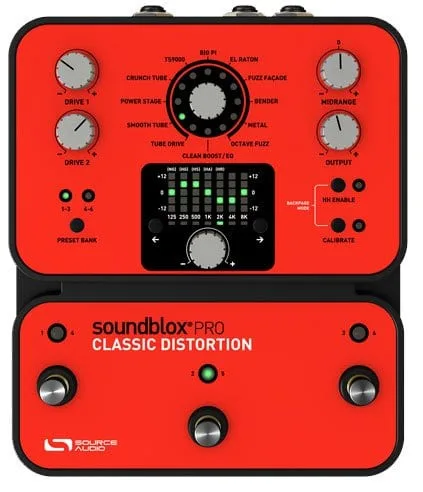
The multi-function input accepts MIDI, an expression pedal, or Source Audio's Hot Hand motion sensor ring4. The pedal is MIDI capable, running on what Performer Mag called state-of-the-art DSP1. The Pro-series Multiwave pedals took this further: the Soundblox Pro Multiwave Distortion and its bass sibling carry a MIDI input allowing external access to presets and parameters, with the Pro Multiwave Bass Distortion adding six user presets on three footswitches and an expression pedal input that can morph between presets78. You can read more about that version on the Soundblox Pro Multiwave Distortion page.
What reviewers said
Performer Mag's review of the Soundblox 2 Multiwave Distortion, priced at $169, listed its pros as "Good selection of distortions, flexible controls"1. On specific modes, the reviewer found the pedal "nails the models it's using as a basis," writing that "the smoother Tube Drive really re-creates the sound of an overdriven amp, and the El Raton nails the sound of an old Rat pedal while the noise gate keeps things from getting unruly"3.
The original Soundblox Multiwave Distortion, at a $159.99 MSRP, drew a detailed Premier Guitar review. The reviewer praised its clarity on complex chords2 and noted its active analog bypass, "fully routed around the DSP and guarantees no signal loss"2. The pedal was housed in a sleek turquoise enclosure with a 4"x7" footprint, which the reviewer found "a little larger than the average stompbox"2. MusicRadar's 2012 NAMM coverage described the Multiwave Distortions as "award-winning," available in both guitar and bass models9.
The bass side of the family has its own review record. Premier Guitar's review of the Soundblox 2 Multiwave Bass Distortion, tested with a Fano Alt de Facto PX4 bass and a Verellen Meatsmoke tube amp, found the single-band modes gave a vintage-rock grind while the foldback modes held "some of the pedal's fiercest, nastiest fuzz tones"6. The multi-band modes "possessed wider, more 3-D qualities that greatly helped the overdriven tones' low end and midrange even after piling on ridiculous amounts of gain"6. The verdict: "Tons of range. Great response. Multi-band modes are just the ticket for keeping even the wildest distortions tight and crisp," with the caveat that "extreme settings on the octave and foldback modes can be overwhelming"6. The earlier Soundblox Multiwave Bass Distortion earned an overall rating of 3.6 and a WIHO Award from MusicPlayers.com10.
Versions and editions
The Multiwave family spans several generations:
| Version | Key differences |
|---|---|
| Soundblox Multiwave Distortion | Original, 21 effects, SA601 56-bit DSP, active analog bypass, $159.99 MSRP112 |
| Soundblox Pro Multiwave Distortion | MIDI-enabled, 23 effect types, expression pedal input for morphing between presets127 |
| Soundblox 2 Multiwave Distortion | 23 algorithms, Universal Bypass, user presets recalled via two footswitches, morphing, $169 (2014)1 |
| Soundblox 2 Multiwave Bass Distortion | Same 23 distortions adapted to bass, clean and mix knobs, Hot Hand and Dual Expression integration46 |
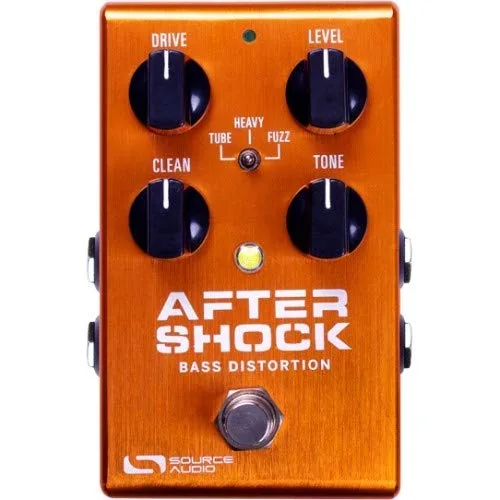
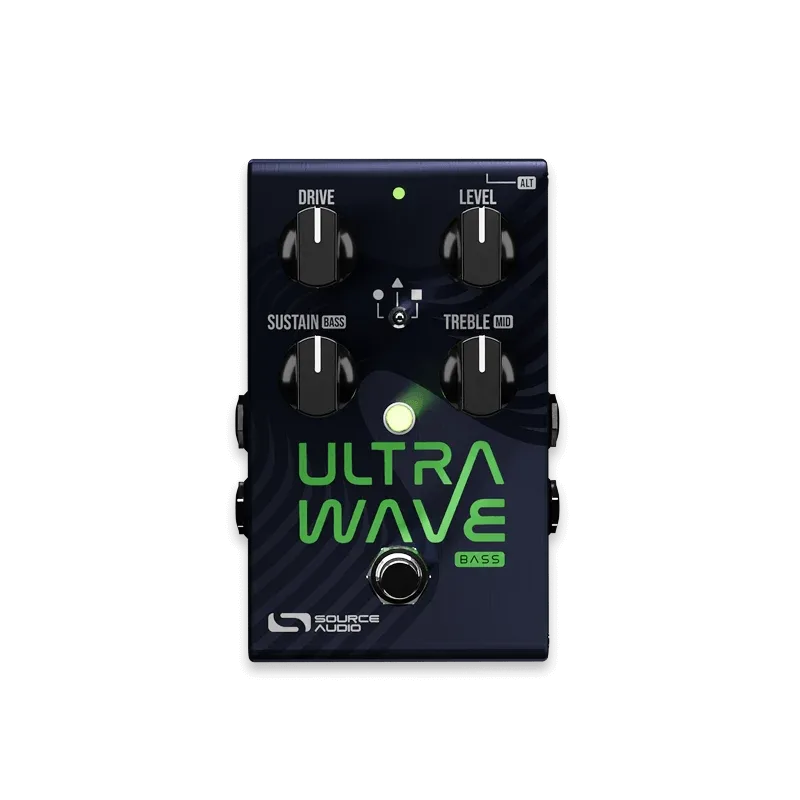
The Soundblox 2 Multiwave Bass Distortion was a repackaging of the earlier Soundblox Multiwave Bass Distortion into the Soundblox 2 line, in what Premier Guitar called "a much smaller and more affordable unit, while still retaining all the versatility and unique tonality of its predecessor"6. That earlier bass pedal itself grew out of the Pro version: No Treble reported the Soundblox Multiwave Bass Distortion was available without the Pro's programming abilities8. The bass line later continued in Source Audio's One Series with the AfterShock Bass Distortion, and the multiband concept carried forward into the Ultrawave Multiband Processor.
The published power and connection details cover the bass models rather than the guitar Soundblox 2 Multiwave: the Soundblox Multiwave Bass Distortion runs on a 9V, 110mA power supply, with Guitar In and Guitar Out 1/4" jacks and a Hot Hand sensor connection on the rear panel10.
Videos
sourceaudioeffects
Leon Todd
Gearfacts
Questions
How many distortion types does the Soundblox 2 Multiwave Distortion have?
It carries 23 varieties of distortion algorithms, organized into Multi Band and Single Band banks divided between Normal, Foldback and Octave settings12. Performer Mag described the range as running from tube drive to an octave fuzz with "pretty much everything in between," and listed the good selection of distortions among the pedal's pros1.
Is the Multiwave Distortion true bypass or buffered?
Both. The Soundblox 2 line uses Universal Bypass, selectable as either buffered or true bypass1. The original Soundblox Multiwave Distortion instead used an active analog bypass fully routed around the DSP, which Source Audio said guarantees no signal loss2.
What is multiband distortion?
Multiband distortion divides the input signal into multiple frequency bands, ten in the Multiwave's multi-band modes, distorts each band separately, and then recombines them26. Because the bands are distorted individually, the result is a distorted tone with an unusual amount of clarity between the notes, even on complex chords2.
Can I use an expression pedal with the Soundblox 2 Multiwave?
Yes. The Soundblox 2 series has a multi-function input that accepts an expression pedal, MIDI, or Source Audio's Hot Hand motion sensor4. On Multiwave units the expression pedal can drive preset morphing, panning between two modes of your choosing to blend them at the same time41.
Does the Multiwave Distortion work on bass?
There is a dedicated bass version, the Soundblox 2 Multiwave Bass Distortion, with the same 23 distortions adapted to the bass frequency range, clean and mix knobs, and a 56-bit digital processor46. Premier Guitar's reviewer called it an excellent tool for adding grind and grit to bass tone with enough sonic options to carve a place in a rock or metal band's mix6.
Is the Source Audio Multiwave Distortion analog or digital?
It is digital. The Soundblox 2 line runs 56-bit signal processing4, and the original Soundblox Multiwave Distortion used the SA601 56-bit Digital Signal Processor with 24-bit A/D and D/A converters, with an analog bypass path around the DSP2.
Sources (12)
- Source Audio SoundBlox 2 Multiwave Distortion Pedal Review, Performer Mag, 2014-11-20
- Review: Source Audio Soundblox Multiwave Distortion, Premier Guitar, 2008-08-06
- Source Audio SoundBlox 2 Multiwave Distortion Pedal Review, Performer Mag, 2014-12-03
- Source Audio Unveils Soundblox 2 Series at NAMM, No Treble, 2012-01-28
- Review: Audio Source Multiwave Bass Distortion, Delicious Audio, 2012-07-22
- Soundblox 2 Multiwave Bass Distortion Pedal Review, Premier Guitar, 2012-09-05
- Source Audio Unveils Soundblox Pro Pedals at NAMM 2010, Premier Guitar, 2010-01-06
- Gear Watch: Soundblox Pro Multiwave Bass Distortion Pedal, No Treble, 2010-01-12
- NAMM 2012: Source Audio to release Soundblox 2 line of guitar, bass effects, MusicRadar, 2012-01-15
- Source Audio Soundblox Multiwave Bass Distortion Pedal, MusicPlayers.com, 2011-08-11
- NAMM-Source Audio Multiwave Distortion Demo & More, Premier Guitar, 2010-02-18
- MIDI PedalBoard Devices: MIDI PedalBoard and Guitar Effect Essentials, Molten Voltage (blog.moltenvoltage.com), 2014-08-15