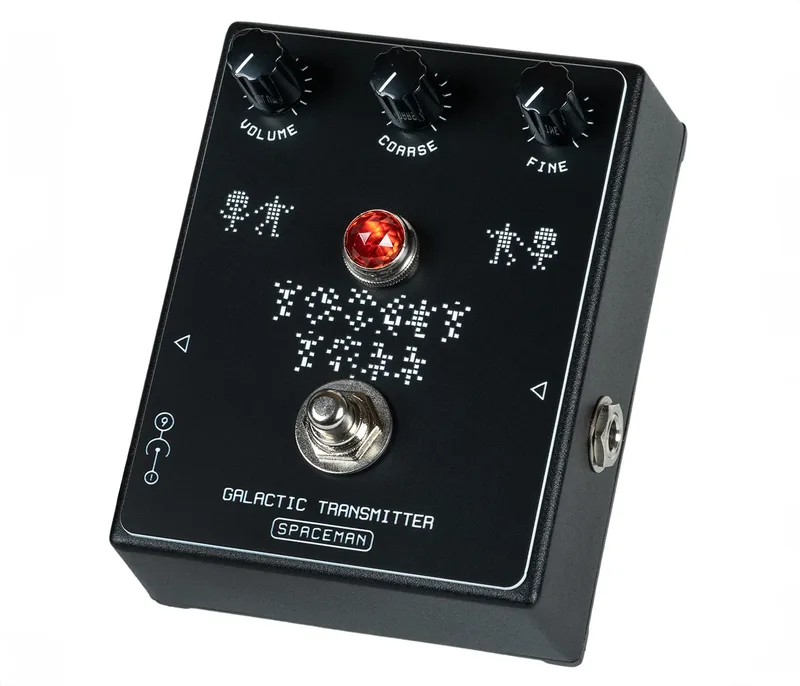

The Spaceman Effects Cosmic Call is a monophonic pitch transposing pedal. Using what the maker calls complex monophonic pitch transposing technology, it converts the guitar tone into a variable frequency binary data stream, placing it among the more unusual entries in the octave and pitch field. Because it is monophonic, it tracks one note at a time rather than processing chords.1
The pedal is currently listed as sold out on the maker's site, at a list price of $259.00 USD as of 26 October 2026.1
What it does
The heart of the Cosmic Call is its internal oscillator, which works on the ELF/VLF band, roughly 40Hz to 4kHz. Spaceman Effects says it can be precisely tuned to any frequency in that range, or swept through its frequency band modulated by the player's picking dynamics, so the sound responds to how hard the strings are played.1
The maker describes the pedal's operation in its own words:
"simple to use and adaptive to each operational mode"
In other words, the knobs take on different functions depending on the mode the pedal is in, rather than each control doing one fixed job.1
Specifications
| Specification | Value |
|---|---|
| Type | Monophonic pitch transposing pedal1 |
| Oscillator band | ELF/VLF, roughly 40Hz to 4kHz1 |
| Input resistance | 1 Meg Ohm1 |
| Input voltage | 9V to 24V DC1 |
| Bypass current draw | 20 mA1 |
| Bypass | True-bypass relay switching, soft-touch footswitch1 |
| Enclosure | Cast aluminum, engraved vinyl faceplate, jewel indicator light1 |
| Origin | Hand-wired in Portland, Oregon, USA1 |
Power, bypass and build
The Cosmic Call accepts an input voltage of 9V to 24V DC, a wider range than most pedals, which typically run at a fixed 9V. Spaceman Effects lists the bypass current draw as 20 mA; the maker's page also carries a higher current figure, and the two do not agree, so a supply with generous headroom is the practical choice.1
The pedal uses true-bypass relay switching with a soft-touch footswitch, so the signal passes untouched when it is off. The wide 9V to 24V DC input range means players should match their supply to the maker's specification rather than assuming a standard 9V setup covers every use.1
On the hardware side, the pedal sits in a cast-aluminum enclosure topped with a durable, engraved vinyl faceplate and a jewel indicator light. It is hand-wired and built in Portland, Oregon.1
Videos
Demos In The Dark
Questions
What voltage does the Spaceman Cosmic Call run on?
The Cosmic Call accepts an input voltage of 9V to 24V DC, according to Spaceman Effects. That range gives players some flexibility in choosing a power supply, though the maker's product page does not specify a current draw figure beyond the bypass draw, so a supply rated comfortably above the pedal's needs is the safe approach.
Is the Cosmic Call true bypass?
Yes. Spaceman Effects states that the Cosmic Call features true-bypass relay switching with a soft-touch footswitch, so the pedal passes the guitar signal untouched when it is off.
Where is the Spaceman Effects Cosmic Call made?
The Cosmic Call is hand-wired and built in Portland, Oregon, in the United States, according to Spaceman Effects.
Is the Cosmic Call polyphonic?
No. Spaceman Effects describes the Cosmic Call as using complex monophonic pitch transposing technology, meaning it tracks one note at a time rather than processing chords or full polyphonic passages.
How much current does the Cosmic Call draw?
Spaceman Effects lists the bypass current draw as 20 mA. The maker's product page also carries a higher current figure, and the two do not agree, so players should treat 20 mA as the confirmed bypass draw and allow headroom in their power supply.
What frequency range does the Cosmic Call oscillator cover?
The internal oscillator works on the ELF/VLF band, roughly 40Hz to 4kHz. Spaceman Effects says it can be precisely tuned to any frequency in that range, or swept through its frequency band modulated by the player's picking dynamics.
Sources (1)
- Cosmic Call, Spaceman Effects