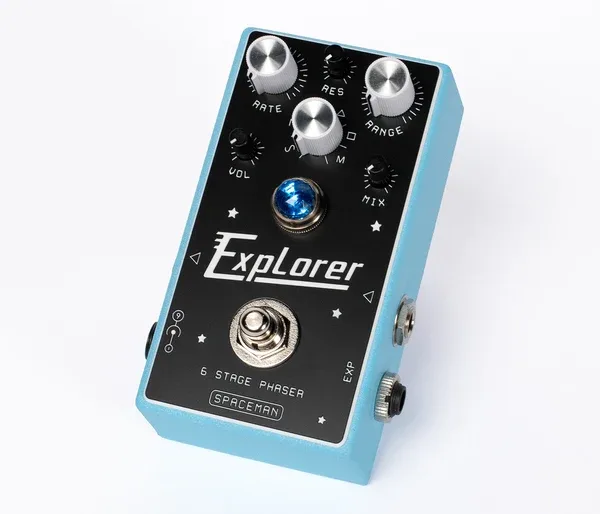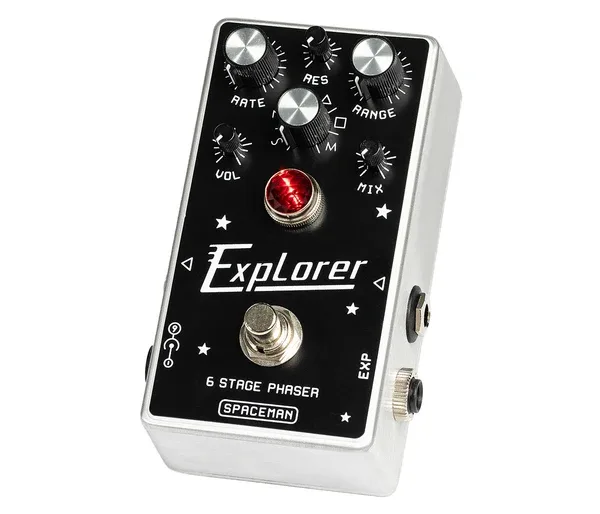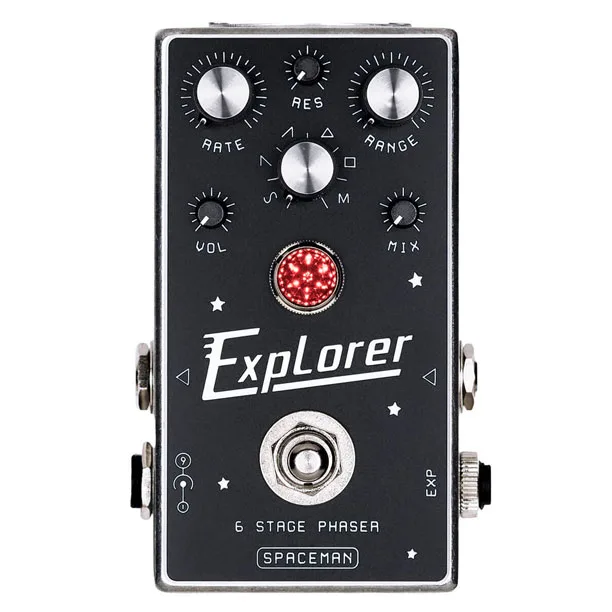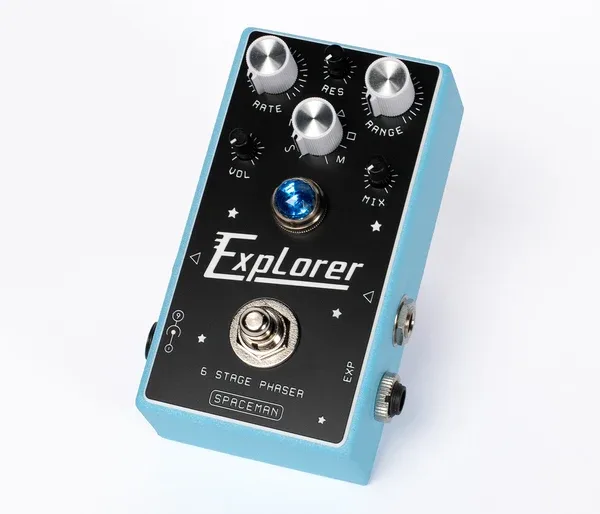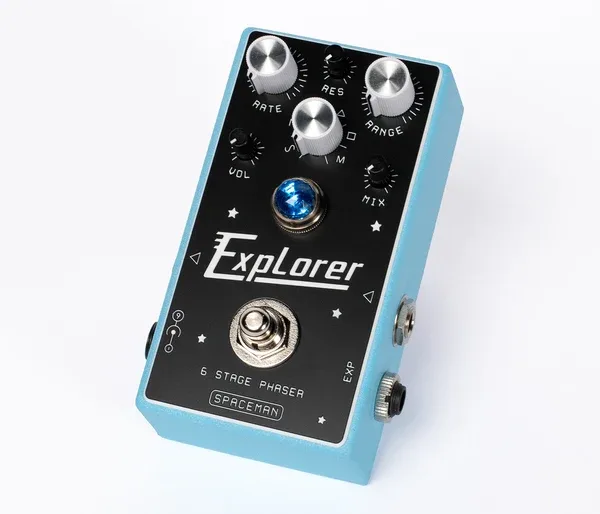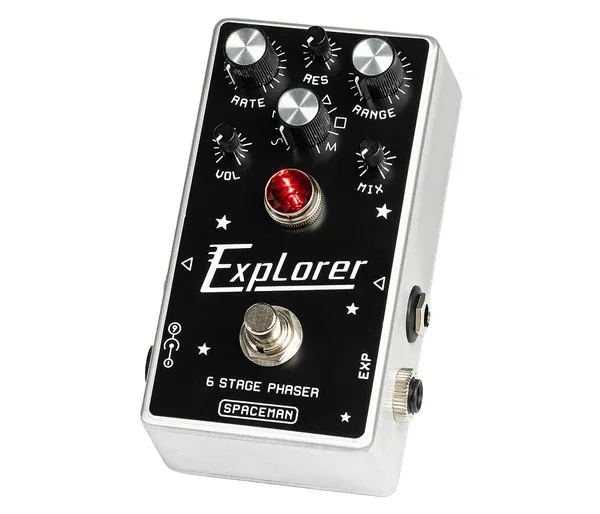
The Spaceman Explorer Cadet is an optical six stage analog phaser from Spaceman Effects, a small form factor reissue of the original Explorer circuit with, in the maker's words, all the deluxe features of the original1. Spaceman named it after the first satellite put into orbit by the United States in 1958, and the Explorer was the first phaser the company launched1. The signal path is all analog, and the phasing is done by six stages of optically swept phase shifting1.
Spaceman's product page lists both 26 mA and 51 mA for current draw, and the two figures have not been reconciled. If your power supply is close to its limit, plan for the higher of the two.
The controls
The Cadet carries five knobs plus the SHAPE selector, giving it a wide range of control for a compact phaser1.
| Control | What it does |
|---|---|
| VOL | Sets the volume of the phase tone1 |
| MIX | Blends in additional dry signal; at 100% wet it has a secondary function of pitch modulation1 |
| RATE | A wide range control allowing extremely slow and extremely fast modulation; in manual mode it sets the highest point of the expression sweep1 |
| RANGE | Controls the low frequency extension of the phasing: lower settings phase only higher frequencies, higher settings reach very low frequencies1 |
| RES | Adds feedback for over-the-top phase tones1 |
| SHAPE | Selects five wave shapes (Sine, Ramp Down, Ramp Up, Triangle, Square) plus a sixth Manual setting that disconnects the LFO and freezes the phase sweep1 |
The RANGE control is the one that sets the Cadet apart from a standard phaser layout: it decides how far down into the low frequencies the phasing reaches, so the same six-stage circuit can be tuned to affect only the top of your sound or to sweep the whole range1. The MIX control lets you blend dry signal back in for a subtler effect, and Spaceman notes that at 100% wet it takes on a secondary function of pitch modulation1.
Manual mode and the expression input
The sixth position of the SHAPE control disconnects the LFO and freezes the phase sweep, turning the Cadet into a manually set filter whose position you choose1. The EXP / Control Voltage jack accepts a 0-5V DC TRS expression pedal or CV source and is protected against over and reverse voltage1. In the LFO modes this input controls the LFO speed; in Manual mode it sweeps the phaser directly, so you can rock the phase point by foot1.
Size, power and switching
The Cadet measures 2.6 inches wide by 4.73 inches deep by 2.17 inches tall (66 x 120 x 55 mm) and weighs 10.5 ounces1. It runs on 9 to 24V DC, negative center, through a 2.1mm jack, with a bypass current draw listed at 26 mA1. Switching is true bypass via a relay operated by a momentary footswitch1. The input resistance is 1Meg Ohm1.
The Cadet draws current even in bypass, so it needs its own supply output rather than sharing with low-current slots on a daisy chain.
Where it came from
The Explorer line began as the Explorer Deluxe, Spaceman's first phaser, and the Cadet is the same circuit brought back in a small form factor reissue with the deluxe features of the original1. Spaceman describes the Cadet Series look as screen printed faceplates on raw metal enclosures1. As for the sound, Spaceman's own description is: "Sometimes liquidy smooth, sometimes chewy and lush, the fluid frequencies squiggle and flourish like the unrelenting ebb and flow of the sonic tide."1
Questions
Is the Spaceman Explorer Cadet true bypass?
Yes. Spaceman specifies true bypass relay switching operated through a momentary footswitch, so the pedal's circuit is removed from the signal path when it is off. The relay design also means the switching is handled electronically rather than by a conventional mechanical stomp switch.
What polarity does the Explorer Cadet use?
The Explorer Cadet runs on 9 to 24V DC with negative center polarity, delivered through a 2.1mm barrel jack. Because it accepts up to 24V, it can share a higher-voltage output on many power supplies, but the negative center polarity means it should not be connected to a positive-tip supply.
Can I connect an expression pedal to the Explorer Cadet?
Yes. The EXP / Control Voltage jack accepts a 0-5V DC TRS expression pedal or CV source and is protected against over and reverse voltage. In the LFO modes the expression input controls the LFO speed, and in Manual mode it sweeps the phaser directly.
What wave shapes does the Explorer Cadet offer?
The SHAPE control selects five LFO wave shapes: Sine, Ramp Down, Ramp Up, Triangle, and Square. A sixth position, Manual, disconnects the LFO and freezes the phase sweep, letting you set the phase point by hand or with an expression pedal.
How big is the Spaceman Explorer Cadet?
Spaceman lists the Cadet at 2.6 inches wide (66 mm), 4.73 inches deep (120 mm), and 2.17 inches tall (55 mm), weighing 10.5 ounces. That is a small footprint by phaser standards, sized to fit a crowded pedalboard.
Is the Explorer Cadet a smaller version of the Explorer Deluxe?
Yes. Spaceman describes the Cadet as a small form factor reissue of the original Explorer circuit with all the deluxe features of the original. The Explorer Deluxe was Spaceman's first phaser, and the Cadet carries the same six-stage optical design into a compact enclosure.
Sources (1)
- Explorer: Optical Phaser by Spaceman, Spaceman Effects