

The Spun Loud Litigator Overdrive is a compact overdrive pedal built around an original, all-analog, transistor-based circuit with two gain stages. Spun Loud Effects announced it in February 2021 and released it on February 11 of that year at a list price of $1351. Where most overdrives in this territory lean on a Tube Screamer-style midrange push, the Litigator takes its cue from the blues rock sounds of Britain in the early 1960s, the tone players call the "beano" or "Bluesbreaker" sound, while using a circuit of its own2.
Delicious Audio describes the result as a creamy, sparkly overdrive with an almost fuzz-like character, with a wide gain range that runs from light crunch to screaming overdrive2. Guitar.com's coverage noted the same fuzz-like voice at low gain settings, voiced after British blues-rock tones of the 1960s3.
What it is and where it came from
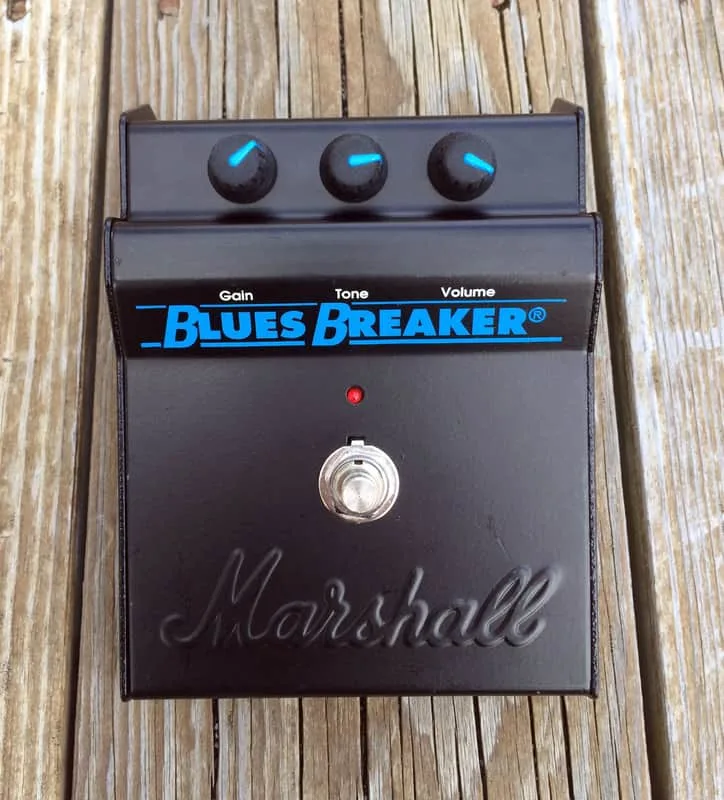
Spun Loud Effects is a small builder whose pedals are designed and built by hand in Bellingham, Washington4. The Litigator arrived as the company's take on the early-1960s British blues-rock sound, but the builder was clear about what it is not. Guitar World reported at the announcement that the Litigator "is not simply a clone of Marshall's often-replicated Bluesbreaker pedal, and instead utilizes an" original transistor-based design42. Guitar.com put it just as directly: "this is not a clone of Marshall's famous and often replicated Bluesbreaker pedal"3.
The distinction matters for players shopping this corner of the overdrive market. Dozens of pedals reproduce the Bluesbreaker circuit; the Litigator instead uses a two-stage gain structure based around transistors, with all-analog circuitry, to reach for the same tonal territory3. Delicious Audio's feature spells out the design brief: an original, transistor-based design with two gain stages delivering a wide palette of tones, from creamy to fuzz-like2.
The controls
The Litigator keeps its panel to three knobs, which Guitar.com called self-explanatory: volume, tone and gain3.
| Control | What it does |
|---|---|
| Volume | Sets the output level3 |
| Gain | Sweeps a wide range, from light crunch to screaming overdrive2 |
| Tone | Cuts high frequencies or boosts them to add sparkle or jangle1 |
The tone control is a cut-or-boost affair rather than a simple high-cut. Premier Guitar's announcement describes it as a control that "will cut high frequencies or boost them to add that perfect sparkle or jangle to your tone"1, and Delicious Audio echoes the same function: cutting highs or adding sparkle2. That range, combined with the wide gain sweep, is what lets the pedal sit anywhere from a light edge to a full drive sound.
Power and connections
The Litigator runs on a standard negative-tip 9V power supply, which is not included with the pedal2. There is no battery option in the reported specifications, so it needs a spot on a power supply or an adapter with the common center-negative arrangement most pedalboard supplies use.
Physically, it is a board-friendly build. The pedal sits in a 125b enclosure with top jacks1, the compact format with jacks on the top face rather than the sides, which saves width on a pedalboard. Guitar.com likewise describes a compact enclosure with top-mounted jacks3. Inside and out, the parts list is aimed at durability: Guitar World's report lists Neutrik jacks, a premium soft-click Gorva footswitch, and high-quality Wurth and WIMA capacitors among the functional appointments4. The enclosure carries original art designed by Seattle artist Daniel Chesney1.
How it compares to a Tube Screamer
The clearest difference from the familiar Tube Screamer family is the EQ curve. Guitar.com reported that the Litigator's EQ is a full-frequency boost, rather than the upper-midrange hump of overdrives that take after the Tube Screamer3. Nick Rogers, owner of Dirty Haggard Audio, put his experience with an early prototype in similar terms:
"The drive character is ... unlike other overdrives I've used, more of a full-spectrum saturation as opposed to a more typical upper-midrange bite."
For a player, that means the Litigator does not thicken the middle the way a Tube Screamer-style pedal does. It saturates across the whole spectrum instead, which suits amps and guitars that already have midrange presence and do not need the extra push. Seattle-based guitarist Gene Johnson, who also tested an early prototype, found the range broad31:
"The Litigator has amazing control, power and nuance, from an edgy clean boost to a serious tube scream"
Johnson also pointed to where the pedal's character lives, tying it back to the sound that inspired it12:
"For me the sweet spot might be a gritty warmth that's like the bark of an old Bluesbreakers record"
Videos
Demos In The Dark
Harsh Tones, Inc.
Working Class Music
Questions
Is the Spun Loud Litigator a Bluesbreaker clone?
No. Spun Loud's design is an original, transistor-based circuit with two gain stages, and multiple reports state plainly that it is not a clone of Marshall's often-replicated Bluesbreaker pedal. It is inspired by the same early-1960s British blues-rock sound, sometimes called the "beano" tone, but the circuit is its own design.
How does the Litigator compare to a Tube Screamer?
The main difference is the EQ curve. Tube Screamer-style overdrives push an upper-midrange hump, while the Litigator delivers a full-frequency boost. Nick Rogers described it as full-spectrum saturation rather than the typical upper-midrange bite, and Gene Johnson found it could go from an edgy clean boost to a serious tube scream.
Where is the Spun Loud Litigator made?
The Litigator is designed and built by hand in Bellingham, Washington, by Spun Loud Effects. Guitar World reported it as hand-built there at the pedal's announcement in February 2021, and Delicious Audio repeated the same origin in 2022.
How much does the Spun Loud Litigator cost?
The Litigator listed for $135 at its launch, a price reported by both Premier Guitar and Guitar.com in February 2021. It went on sale at spunloudeffects.com on February 11, 2021.
Who did the artwork on the Litigator Overdrive?
The original artwork on the enclosure was designed by Seattle artist Daniel Chesney, according to the Premier Guitar announcement and Delicious Audio's product feature. The art sits on a 125b enclosure with top-mounted jacks.
Sources (4)
- Spun Loud Effects Unveils the Litigator Overdrive, Premier Guitar, 2021-02-05
- Spun Loud Effects Litigator Overdrive, Delicious Audio, 2022-04-14
- Spun Loud Effects launch the Litigator Overdrive, Guitar.com, 2021-02-05
- Spun Loud unleashes all-new transistor-based overdrive design, the Litigator, Guitar World, 2021-02-04