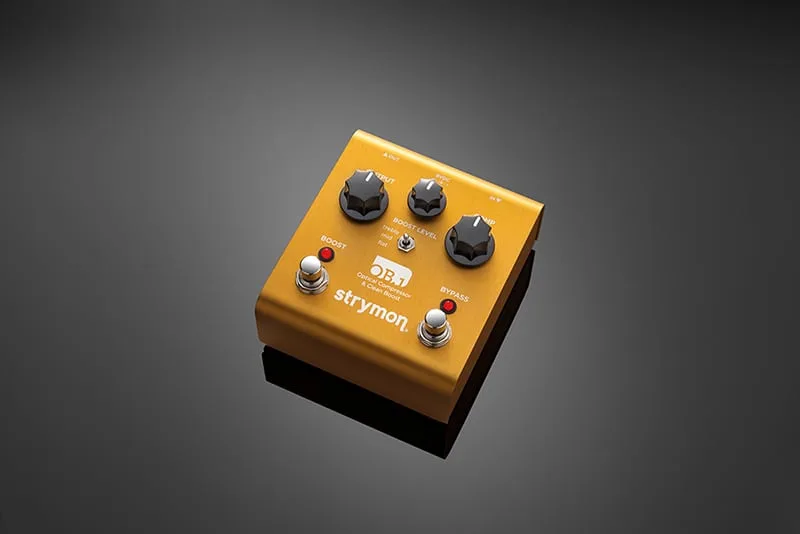


The Strymon OB.1 is a discontinued compressor and clean boost pedal from Strymon, first released in July 20091. It was the first effect pedal released under the Strymon name2, and it put an optical compressor circuit inspired by high-end vintage opto studio compressors together with a transparent clean boost in one box3. Strymon discontinued it in March 20201.
The pedal is fully analog, with a low-noise all-analog signal path and true bypass3. Its optical compression uses Light Dependent Resistors as the sensing element4, the same approach as the vintage studio units Strymon drew on. The compression section provides greater than 20dB of gain-compensated compression, and the integrated clean boost adds up to 10dB of full-frequency, mid or treble boost5.
An optical compressor and clean boost
Strymon launched the OB.1 as an Optical Compressor and Clean Boost pedal, describing it as taking "the greatest qualities of high-end, vintage opto studio compressors and made them available in this" pedal-sized format3. The analog design was done by Gregg Stock, an analog engineer and co-founder of Strymon3; in a later Strymon interview, sound designer Pete Celi noted that "Gregg did the analog design, because OB.1 is a fully analog pedal"8.
The compression side is optical: a Light Dependent Resistor reacts to the signal and controls the gain reduction, the same element found in the vintage studio compressors the circuit is modeled on4. Strymon rates the compression at greater than 20dB of gain-compensated compression, meaning the output level is raised alongside the compression so the perceived volume stays consistent5.
The boost side is a transparent clean boost that Guitar.com described as designed to "supercharge" an amplifier4. A three-way toggle selects a treble-focused, mid-focused or full-range boost4, and the boost delivers an extra 10dB in whichever of those modes you choose5. Inside the pedal, DIP switches let you fine-tune where those boost frequencies sit9:
The standard version of the pedal was also voiced for guitar specifically: Strymon says it "was designed to start rolling off bass frequencies at about 80Hz, for optimal interaction with high-gain guitar preamps and drive pedals"10. That high-pass filtering keeps the low end tight when the pedal feeds overdrive, distortion or fuzz circuits.
Using it as a pure clean boost
The compressor and boost sections are not fully independent. Strymon's support article is direct about the limitation: the BOOST requires that the BYPASS switch is enabled to affect the signal, so the boost cannot run with the pedal bypassed11. However, you can use the OB.1 as purely a clean boost pedal by turning the compression knob down to its minimum position while engaging the BOOST11.
On bass
Because of the 80Hz high-pass filtering in the standard version, bass players lose some low end through the pedal. Strymon offered a Bass Guitar Modification that removes the high-pass filtering, expanding the low-end range for bass use10.
Power and connections
The OB.1 is one of the few Strymon pedals that runs on a battery. Because it is all analog, its power requirement is much lower than Strymon's digital pedals: 9V DC with a current draw under 20mA, and it can be powered by a 9V battery6. It is also excluded from the mono or stereo connection ability of Strymon's digital effect pedals12.
What reviewers and players said
Premier Guitar published a review of the OB.113. Strymon's own pedalboard feature on Ethan Tufts lists the OB.1 as "always on" in his guitar signal chain14.
Why Strymon discontinued the OB.1
Strymon announced the discontinuation on March 13, 2020, explaining that it had been unable to maintain a consistent supply of Light Dependent Resistors, the optical element within the OB.1, and had not been able to build pedals in regular quantities1. Guitar.com quoted the company's statement directly4:
"we have been unable to maintain a consistent supply of Light Dependent Resistors, the optical element within OB.1"4
Gearnews reported that Strymon said these components are no longer available, making the product no longer feasible to offer2. At the time of the announcement, Strymon had no quantity of OB.1 available in its online store and directed interested buyers to authorized dealers for remaining stock1.
MusicRadar later summed up the situation: "the optical parts became hard to source and so it was back to the drawing board"15.
What replaced it
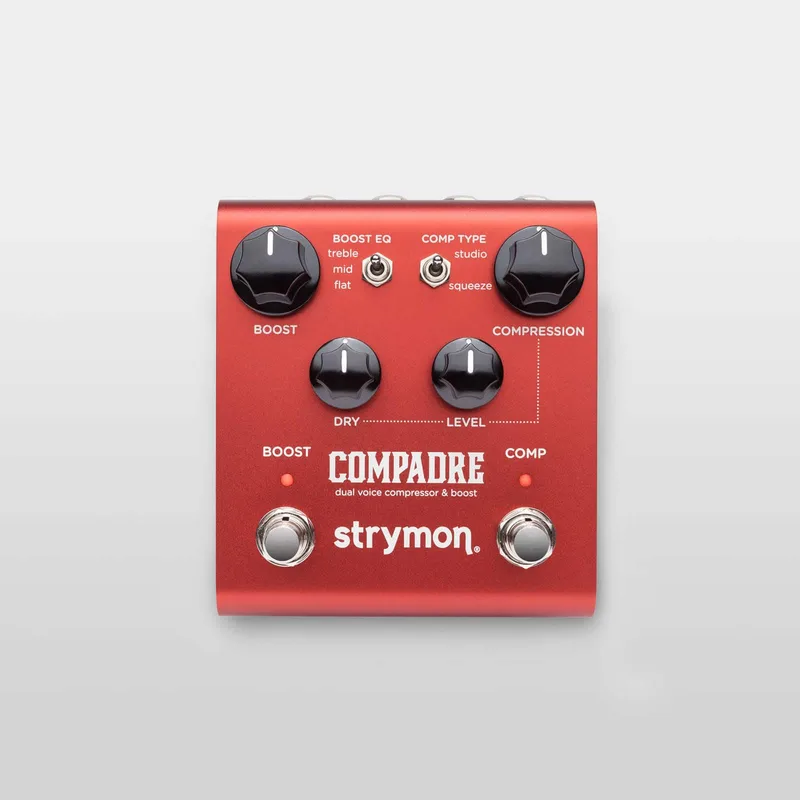
The gap left by the OB.1 was filled by the Strymon Compadre, a compressor and boost pedal from the same maker15. The Compadre moves from the OB.1's optical circuit to a VCA compressor, and like the OB.1 it pairs compression with a boost section15.
The OB.1 is discontinued and has been since March 20201. Remaining stock sold through authorized dealers at the time1, so units on the secondhand market are the main way to find one today.
Videos
Reverb
LOW GAIN EXPERIMENTS
BB FIRE
Questions
Can the Strymon OB.1 run on a 9V battery?
Yes. Strymon's customer support manager confirmed that the OB.1 can be powered by a 9V battery. It is an all-analog pedal with a low power requirement of 9V DC and a current draw under 20mA, so a battery is a practical option, unlike with Strymon's higher-draw digital pedals.
Is the Strymon OB.1 true bypass?
Yes. Strymon's launch announcement for the OB.1 specified true bypass with a premium all-analog signal path. Note that the BOOST function requires the BYPASS switch to be engaged in order to affect the signal, so the boost cannot run with the pedal bypassed.
Can you use the Strymon OB.1 on bass?
The standard OB.1 rolls off bass frequencies starting around 80Hz, which Strymon designed for optimal interaction with high-gain guitar preamps and drive pedals. Strymon also offered a Bass Guitar Modification that removes the high-pass filtering and expands the low-end range for bass players.
What replaced the Strymon OB.1?
The Strymon Compadre, a Dual Voice VCA Compressor and Boost pedal released in April 2020, filled the gap left by the discontinued OB.1. MusicRadar describes the Compadre as the pedal that arrived after the OB.1's optical parts became hard to source.
Can the OB.1 be used as just a clean boost?
Yes. Strymon says you can use the OB.1 as purely a clean boost pedal by turning the compression knob down to its minimum position while engaging the BOOST. The boost offers up to 10dB of full-frequency, mid or treble boost.
Sources (15)
- Saying Goodbye to OB.1, Our First Ever Pedal, Strymon, 2020-03-13
- Strymon says goodbye to the OB.1 Compressor & Clean Boost, gearnews.com, 2020-03-15
- Introducing the OB.1 Optical Compressor, Strymon, 2009-07-07
- Strymon’s first-ever pedal, the OB.1, has been discontinued, Guitar.com, 2020-03-20
- How much boost can I get with OB.1?, Strymon, 2021-07-08
- Gear Guide: Using the Right Strymon Power Supply, Strymon (www.strymon.net), 2014-06-30
- What are the dimensions of my pedal?, Strymon, 2021-07-20
- The Sound of Strymon: Sound Designer Pete Celi, Strymon (www.strymon.net), 2015-11-12
- What are the DIP switches inside my OB.1 for?, Strymon, 2021-07-08
- Optical Compression for your Pedalboard: OB.1 Guitar and Bass Compressor, Strymon, 2017-06-22
- Can the boost run independent of the compressor?, Strymon, 2021-07-08
- Mono and Stereo Connections, Strymon (www.strymon.net), 2022-11-10
- OB.1 Review in Premier Guitar, Strymon (reposting Premier Guitar review), 2009-10-22
- Pedalboard Feature: Strymon's Ethan Tufts, Strymon (www.strymon.net), 2016-05-02
- Strymon Compadre review, MusicRadar, 2020-08-17