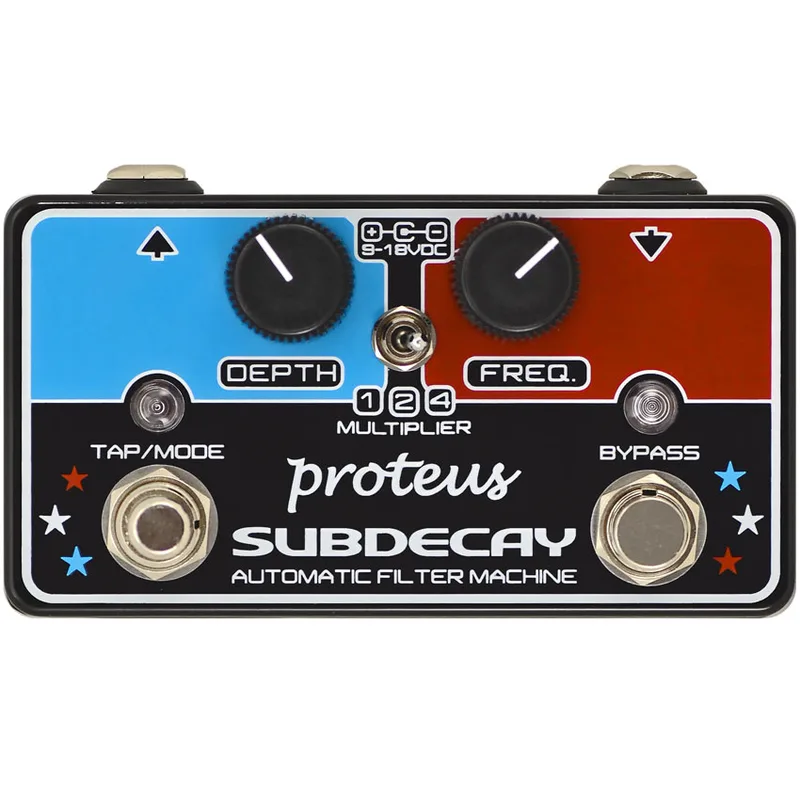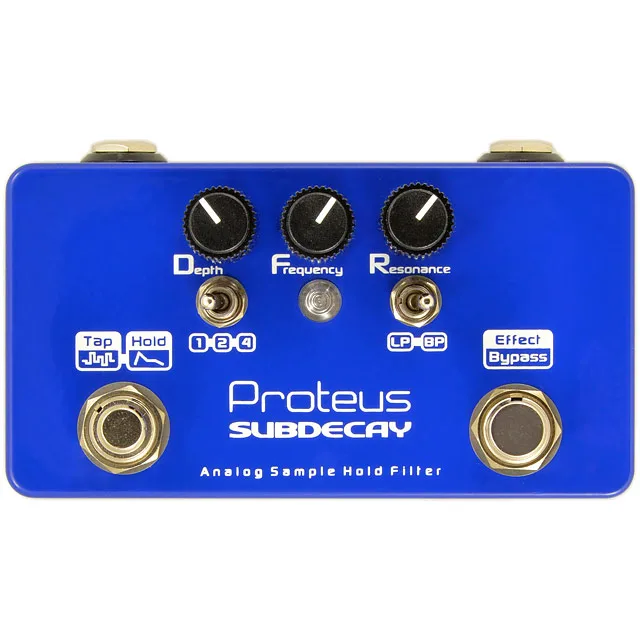


The Subdecay Proteus is an envelope and sample/hold filter in one compact pedal. In its current mkII form it combines two ways of sweeping a filter: an envelope follower that reacts to how hard you pick, and a random sample/hold mode that jumps the filter to random pitches in time with your tempo. Subdecay describes it as their "plug and play filter," a simpler take on the ideas behind their earlier Prometheus pedals1.
At the heart of the pedal is an analog OTA based filter design similar to vintage Maestro units, with an all analog signal path. The digital side is control only: it handles tap tempo and the switching between envelope and random sample/hold filtering2.
What it does to your sound
An envelope filter listens to your picking and opens and closes a filter in response, the effect behind classic funk auto-wah sounds. A sample/hold filter instead jumps the filter's cutoff to random values on a clock, producing the stepped, synth-like burbles heard on records from the 1970s. The Proteus mkII gives you both in one compact pedal, with digital control for switching between envelope and random sample/hold filtering2.
Subdecay positions the two modes with distinct characters. On the earlier Proteus Auto Filter, the maker described the envelope mode as "much more 'funk' than 'shoegaze'" and the step filtering as "pure random sample hold"4. The mkII keeps that split: envelope mode for touch-responsive sweeps, sample/hold mode for randomized, arpeggiated filter jumps.
The resonance control shapes how much the filter emphasizes its own cutoff point. Subdecay says it "allows the filter to go from subtle to nasty greasy synthesizer grit," and that the control "adds a new dimension to the effect that goes from subtle to greasy gritty synth tones"2.
Controls
| Control | What it does |
|---|---|
| Depth | Filter modulation range for both envelope follower and sample/hold mode2 |
| Resonance | From subtle to "nasty greasy synthesizer grit"2 |
| 1-2-4 | Step multiplier: one, two or four steps per beat (quarter, eighth and sixteenth notes), sample/hold mode only2 |
| LP - BP | Selects low-pass or band-pass filter2 |
| Bypass Switch | Turns the effect off or on2 |
| Tap/Mode Switch | Tap 2-4 times to start the tap tempo random arpeggiator (sample/hold); hold one second to return to envelope mode2 |
The dual color LED gives status at a glance: green when the effect is on, red to show the filter's modulation, so you can tell whether you are in envelope or sample/hold mode even when the filter is bypassed2.
How tap tempo works
Tap the Tap/Mode switch two to four times in time and the pedal starts a tap tempo random arpeggiator, its name for the sample/hold mode. The filter then steps to random positions on a clock locked to your tempo. Hold the switch down for one second and the pedal reverts to envelope filter mode2.
The 1-2-4 control sets the step rate: one step per beat, two, or four, which Subdecay describes as quarter, eighth and sixteenth notes. It affects sample/hold mode only2.
On That Pedal Show, Dan and Mick walked through the earlier version's tap function, noting that you have to hit the switch four times to start the random filtering5.
Where it came from
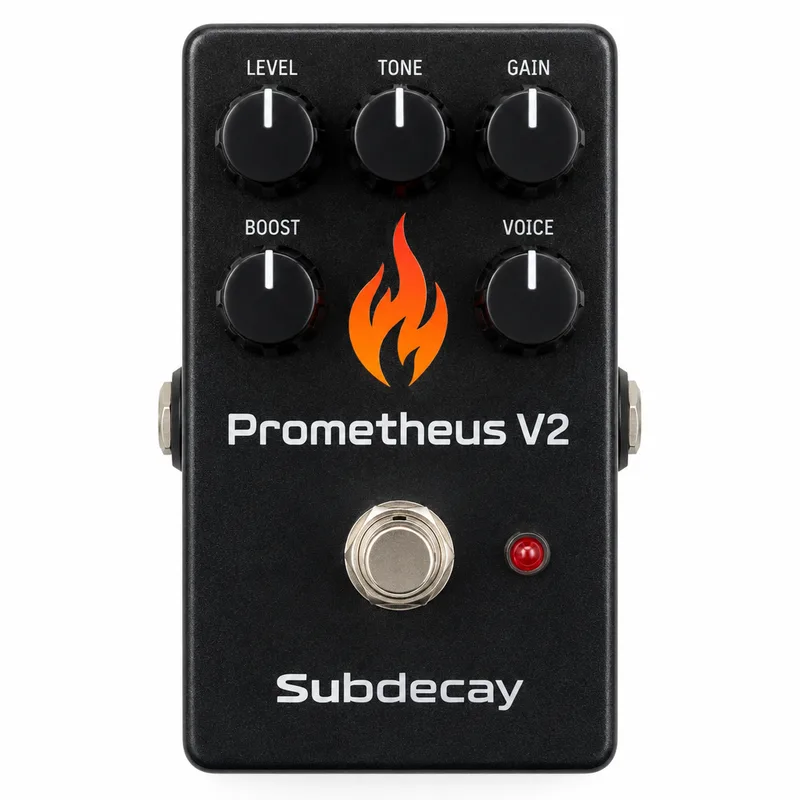
The Proteus grew out of Subdecay's Prometheus line. The original Prometheus was a highly regarded analog envelope filter whose step sequencer and random sample/hold features set it apart from more traditional auto-wah pedals6, but it was a deep pedal to learn. Subdecay has said the Proteus came "from the ashes of the original Prometheus" and "embraces a very different philosophy," describing it as what many people wished the Prometheus had been: simpler and easier to use on the fly4. The filter circuit in the original Proteus was exactly the same as the Prometheus's4.
The Proteus was the product of a multi-product R&D effort Subdecay called Project Quasar, designed as an "Anti-Prometheus" focused on ease of use4. In Subdecay's company history, Brian Marshall writes that the pedal took over a year from the initial vision to complete and became a big hit, changing the company's direction and its approach to laying out functionality for more complicated products7.
The mkII, introduced in 2019, is a redesign rather than a reissue. Subdecay's changes from the original Proteus include a new design closer to the Maestro Filter Sample/Hold and a switchable band-pass and low-pass filter1.
The Maestro connection
The Maestro Filter Sample/Hold is the pedal the Proteus mkII's new design is described as coming closer to12. Subdecay says the mkII is a new design closer to the Maestro Filter Sample Hold rather than a copy of the original Proteus circuit2.
The Proteus is related rather than a clone. Subdecay says the mkII is "a new design closely related to the original Filter Sample/Hold," built on an analog OTA based filter similar to vintage Maestro units2. For players chasing the original, the Maestro's own sample/hold behavior even has a dedicated internal trimmer, R26, a 100k part that affects only the Sample & Hold function8.
Power
The mkII can be powered at up to 18 volts for maximum headroom2. This is a change from the original Proteus Auto Filter, which ran on an external regulated 9VDC to 12VDC adapter with a negative center 2.1mm barrel plug and had a 1M input impedance4.
If you are shopping used, check which version you are looking at: the original Proteus Auto Filter is rated for 9 to 12VDC, while the mkII accepts up to 18 volts. Feeding the older pedal 18V exceeds its rating.
Versions and pricing
| Version | What changed | Price |
|---|---|---|
| Proteus Auto Filter (2017) | Same filter circuit as the Prometheus, simpler controls, 9-12VDC power4 | $179.00 (2020)9 |
| Proteus mkII (2019) | New design closer to the Maestro Filter Sample/Hold, switchable band-pass and low-pass, resonance knob1 | $179.00 (2026)2 |
B-stock mkII units have appeared at $135.00, fully functional and covered by Subdecay's standard 3 year warranty1.
Related Subdecay filters
The Proteus sits in a wider filter family from the maker:
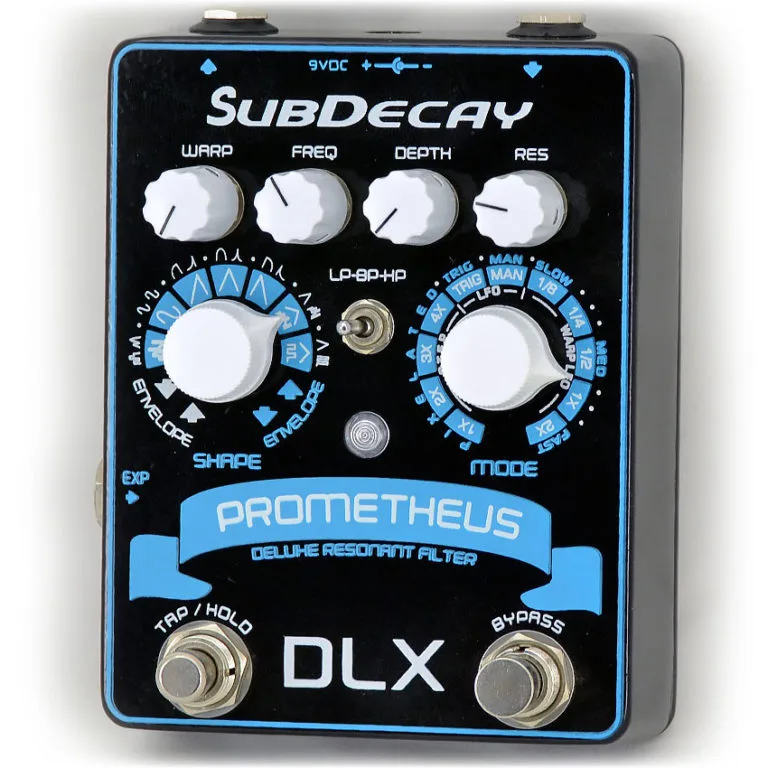
- Prometheus DLX: a resonant filter pedal that also operates at 18 volts for more headroom10
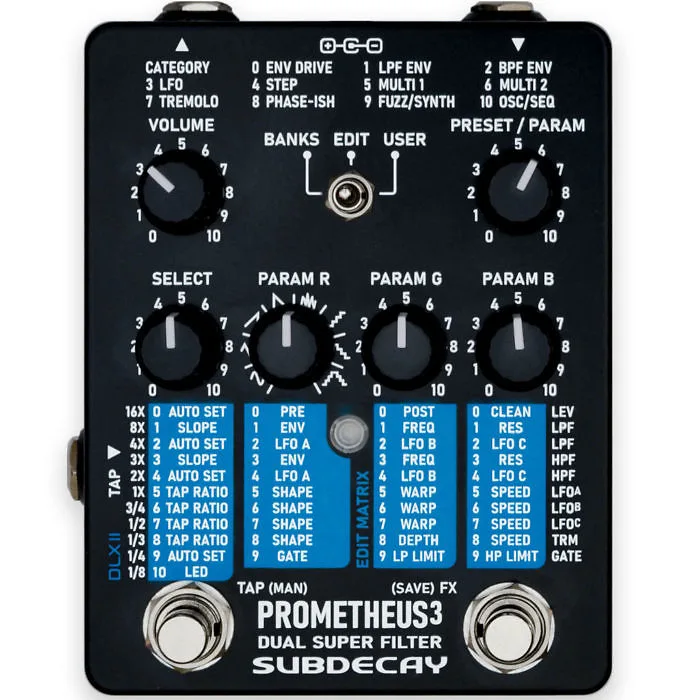
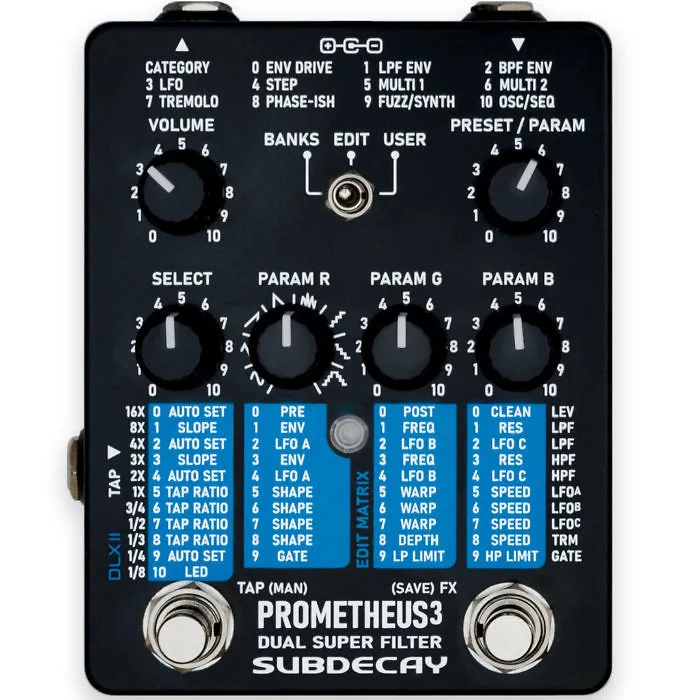
- Prometheus 3 Dual Super Filter: keeps the random sample/hold filter on the menu among its modes11
- Proteus Auto Filter: the original, simpler version of this pedal4
For a broader look at the category, see filter pedals.
Videos
ProGuitarShopDemos
Subdecay
Brett Kingman
Questions
What is the difference between the Proteus and the Proteus mkII?
The mkII is a redesign rather than a reissue. Subdecay says the new design is closer to the Maestro Filter Sample/Hold, and it adds a resonance knob, switchable band-pass and low-pass filter modes, and the ability to run at up to 18 volts for extra headroom. The original Proteus Auto Filter ran on 9 to 12VDC and had a simpler control set.
Is the Subdecay Proteus analog?
Yes. Subdecay describes the Proteus mkII as having an all analog signal path, built around an analog OTA based filter design similar to vintage Maestro units. The digital part is only the control layer, which handles tap tempo and switching between envelope and random sample/hold filtering.
How does tap tempo work on the Proteus?
Tap the switch two to four times in time and the pedal starts a tap tempo random arpeggiator in sample/hold mode. Hold the switch down for one second and it reverts to envelope filter mode. The 1-2-4 control sets whether the filter takes one, two or four steps per beat, the equivalent of quarter, eighth and sixteenth notes.
Is the Proteus based on the Maestro Filter Sample/Hold?
It is related rather than a clone. Subdecay says the mkII uses a new design closely related to the original Filter Sample/Hold, with an analog OTA based filter similar to vintage Maestro units. The Maestro itself used the same circuit as the Oberheim Voltage Controlled Filter.
Sources (11)
- Proteus (b-stock), Subdecay, 2019-01-11
- Proteus Sample Hold filter, Subdecay, 2026-04-27
- proteus-filter, Subdecay, 2017-11-15
- Proteus Auto Filter, Subdecay, 2017-03-30
- TPS Pick'N'Mix, That Pedal Show (YouTube), 2017-12-05
- Prometheus V2 by Subdecay, RockBoard (PedalPedia), 2026
- A little about us..., Subdecay, 2012-11-26
- Maestro™ Filter Sample/Hold™ Clone: DIY Kit, PCB & Schematic, General Guitar Gadgets, 2014-05-14
- Octave Theory, Subdecay, 2020-07-03
- Prometheus DLX, Subdecay, 2019-04-12
- Prometheus 3 Dual Super Filter, Subdecay, 2023-12-07