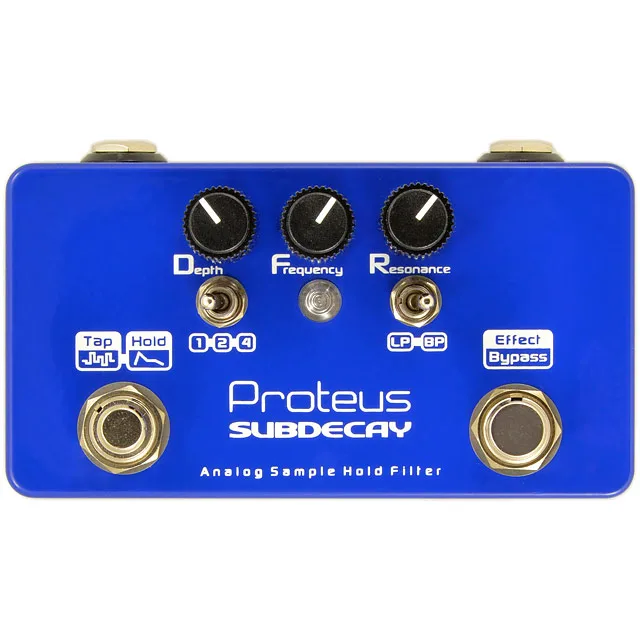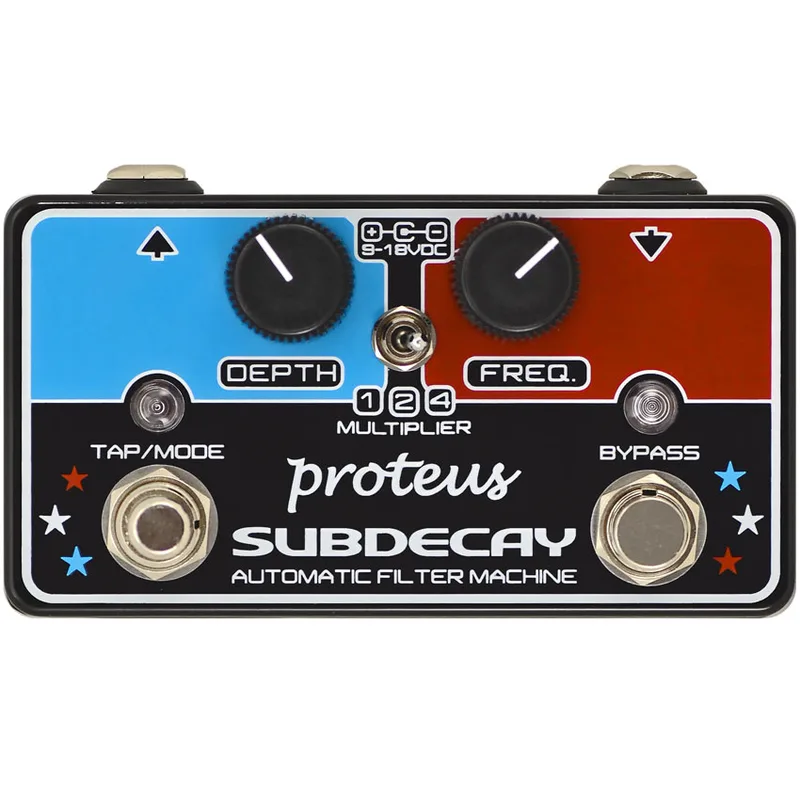


The Subdecay Proteus Auto Filter is a compact auto filter pedal from Subdecay, the Oregon builder better known for its Prometheus line of filter pedals. It does two things: an envelope filter mode that follows your picking, and a step filtering mode built on random sample and hold, where the filter jumps to new settings on its own. Subdecay describes the envelope filter mode as much more "funk" than "shoegaze," and the step filtering as pure random sample hold1.
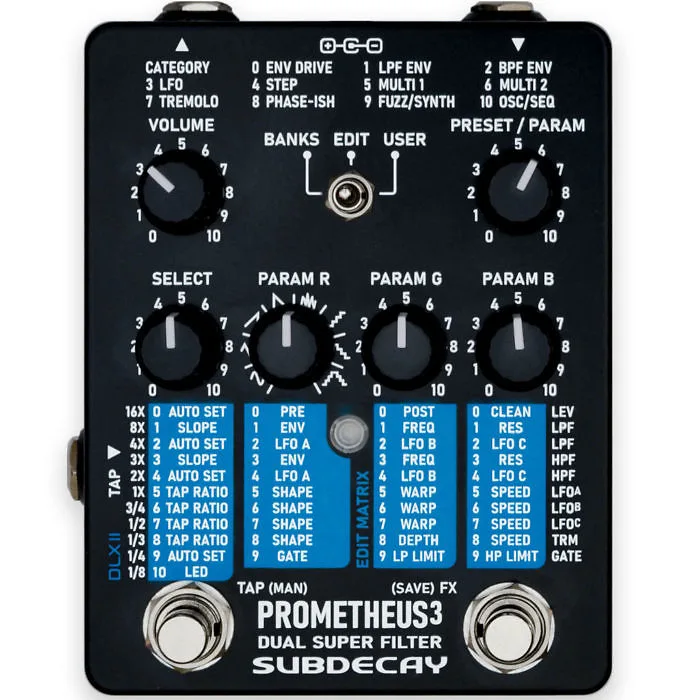
The pedal is retired. Subdecay's product page lists it as out of stock and states plainly that "This version of the Proteus has been retired"1. It was hand made in Oregon1, and used examples are the only route to one today. For a current take on the same family of sounds, Subdecay now offers the Prometheus DLX and the Prometheus 3 Dual Super Filter, the latter of which keeps a random sample/hold filter "on the menu"2.
What it does to your sound
The Proteus covers two filter behaviors in one small box. In envelope filter mode, the filter opens and closes with your playing dynamics, the classic auto-wah territory that sits under funk rhythm playing. Subdecay's own framing puts it firmly on the funk side rather than the washed-out shoegaze side of the filter family1. In step filtering mode, the pedal draws from random sample and hold, so the filter position steps to new values in a way that is not tied to your picking. That is the sound players associate with synth-style filter sequences, and it is the same territory the Prometheus line explores1.
An internal switch adds a third option: a band pass filter response. Subdecay calls this a bonus feature, reached by opening the pedal rather than a panel control1.
A simpler pedal built on the Prometheus filter
The Proteus exists because of the original Prometheus. Subdecay introduces it as coming "from the ashes of the original Prometheus," with what it calls a very different philosophy, and sums the intent up directly1:
"In short, the Proteus is what many people wished the Prometheus had been: simpler and easier to use on the fly."
The important detail for players comparing the two is that the filter circuit itself did not change. Subdecay states that "the filter circuit in Proteus is exactly the same" as the Prometheus1. What changed is the interface around it: fewer controls, aimed at dialing in a usable sound quickly at a gig or rehearsal rather than programming deeper filter behavior.
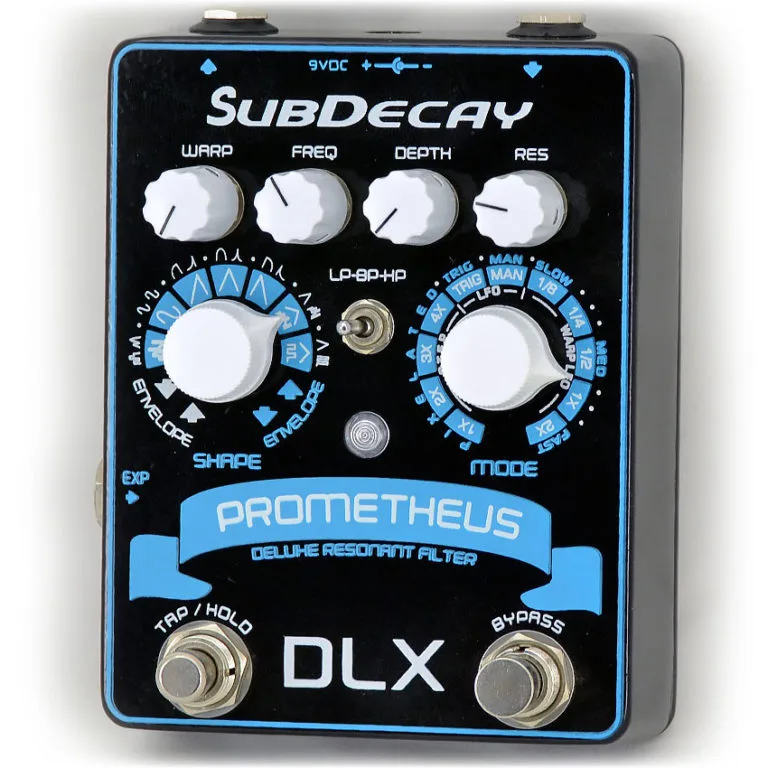
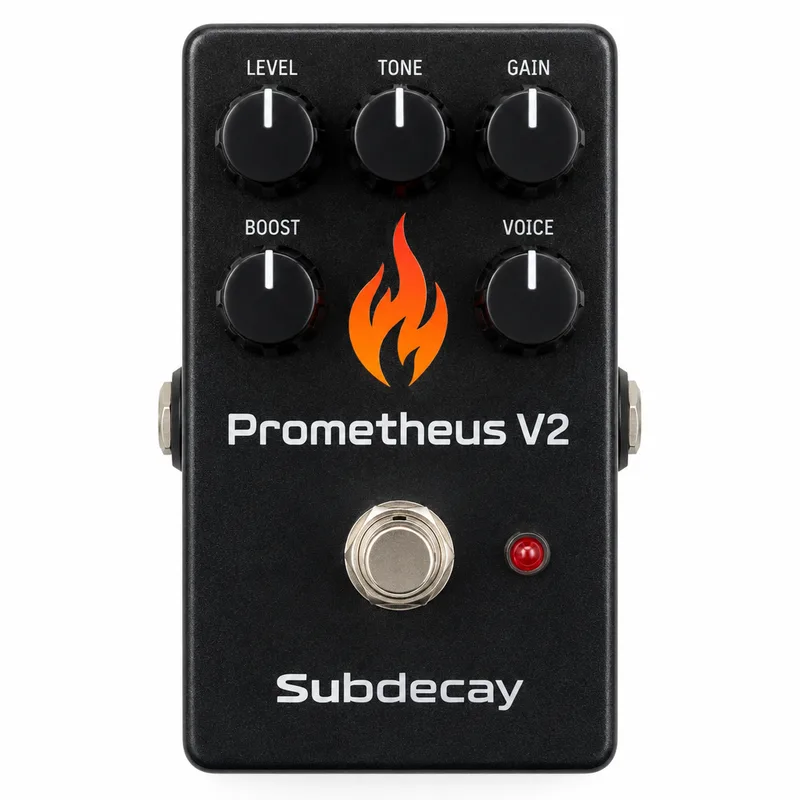
The Prometheus line has since grown in the other direction. The Prometheus DLX is a resonant filter pedal with lowpass, bandpass and highpass modes, a Pixilated Envelope mode that Subdecay describes as sample/hold envelope control, and an Envelope to LFO mode where the envelope drives LFO speed with variable sensitivity3. The Prometheus 3 Dual Super Filter carries the line forward with two filter engines and the random sample/hold filter among its options2. Where those pedals trade control depth for a bigger footprint and a deeper learning curve, the Proteus was the stripped-down member of the family.
Controls, power and practical details
The front panel is minimal. The bypass switch turns the effect off or on, and switching is true bypass through 3PDT switches, so the filter circuit is fully out of the signal path when disengaged1.
Power comes from an external regulated adapter, 9VDC to 12VDC, with a negative center 2.1mm barrel style plug. Current draw is less than 25mA, which is light enough for a single output on a typical pedalboard power supply1.
The Proteus is no longer in production. Subdecay lists this version as retired, so specifications here come from the maker's page for the pedal as it was sold1.
The pedal is built around a die cast metal enclosure, which Subdecay cites for durability, and it carries a three-year limited warranty1. Its footprint is small at 2.3" by 4.4" with a 1.0" height, and it weighs 12 oz1.
For where the Proteus sits among filter pedals generally, see the Filter Pedals type page.
Videos
ProGuitarShopDemos
Subdecay
Brett Kingman
Questions
Is the Subdecay Proteus true bypass?
Yes. Subdecay specifies 3PDT switches for true bypass switching on the Proteus. The bypass switch simply turns the effect off or on, so when the pedal is off your guitar signal passes through without the filter circuit in the way.
What power supply does the Proteus use?
The Proteus runs on an external regulated 9VDC to 12VDC adapter with a negative center 2.1mm barrel style plug. Current draw is less than 25mA, so a standard pedalboard supply output can handle it.
What is the difference between the Proteus and the Prometheus?
The Proteus came out of the original Prometheus with a different philosophy: Subdecay describes it as simpler and easier to use on the fly. The filter circuit itself is exactly the same, but the Proteus pairs it with a funk-leaning envelope filter mode and pure random sample hold step filtering instead of the Prometheus's deeper control set.
Can the Proteus run as a band pass filter?
Yes. As a bonus feature, an internal switch on the Proteus selects a band pass filter option. Out of the box it runs its standard filter response, and opening the enclosure gives access to the switch.
Is the Subdecay Proteus still made?
No. Subdecay's product page lists the Proteus as out of stock and states that this version of the Proteus has been retired. The pedal was hand made in Oregon, and the company's current filter line has moved on to the Prometheus DLX and Prometheus 3.
Sources (3)
- Proteus Auto Filter, Subdecay, 2017-03-30
- Prometheus 3 Dual Super Filter, Subdecay, 2023-12-07
- Prometheus DLX, Subdecay, 2019-04-12