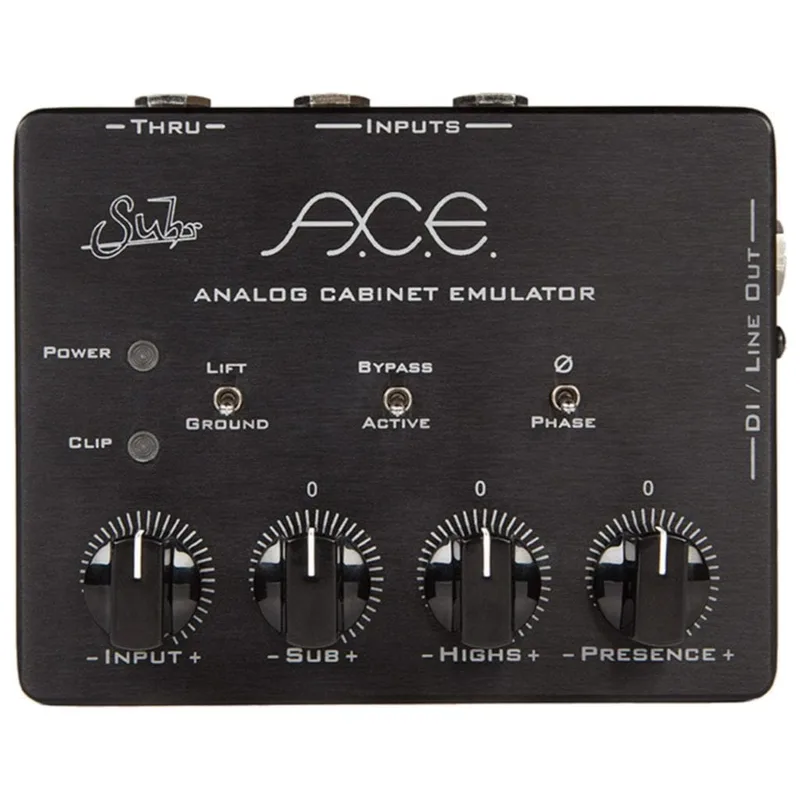


The Suhr A.C.E. (Analog Cabinet Emulator) is an active analog cabinet emulator from Suhr, designed to give guitarists a mic'd-cabinet sound for recording, silent practice and live performance without putting a microphone in front of a speaker12. Where most modern cab sims load digital impulse responses, the A.C.E. does its work entirely in the analog domain: Suhr describes it as a "100% pure analog signal path from start to finish," using an analog Multi-Stage Filtering (MSF) network to generate the speaker cabinet simulation12.
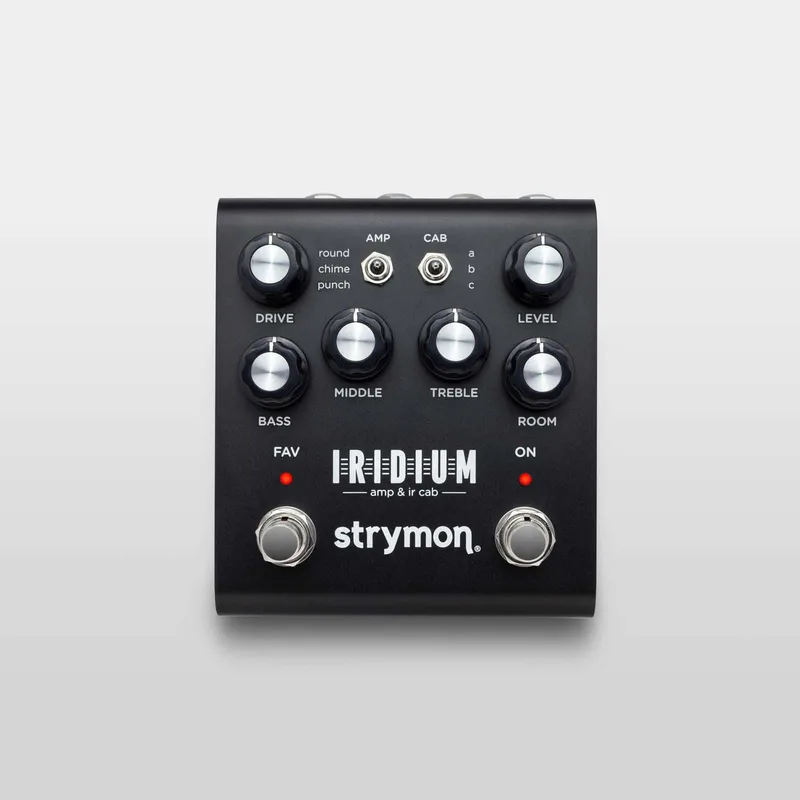
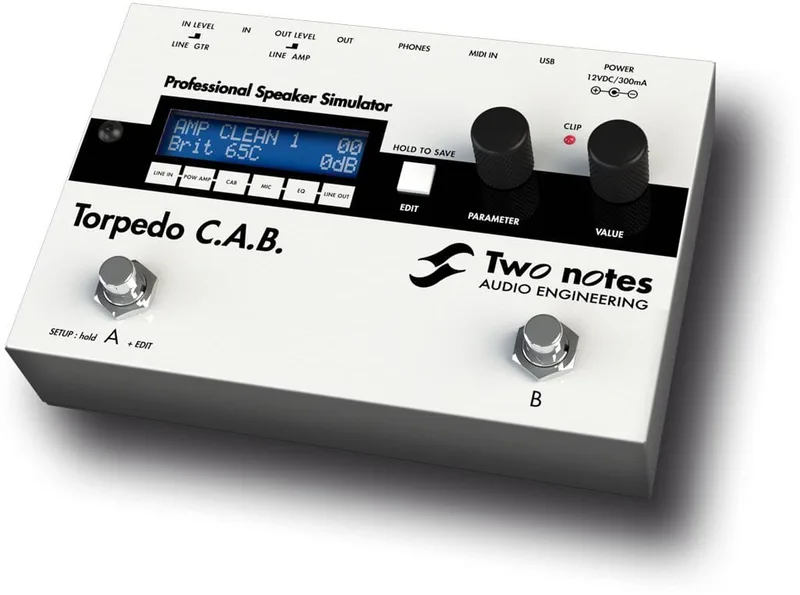
Suhr says the A.C.E. aims to "capture/bring to life all the warmth, punch and character of a mic'd speaker cabinet to any performance without the assistance" of a microphone, and positions it for both silent or studio recording and live use1. It sits in the wider field of speaker simulation pedals, but its all-analog filtering sets it apart from IR-based units like the Strymon Iridium or Two Notes Torpedo C.A.B..
What the A.C.E. does
The A.C.E. replaces the microphone-and-cabinet stage of a guitar rig. You feed it either a speaker-level signal from an amplifier or a line-level signal, and its MSF filter network shapes the tone into what a mic'd speaker cabinet would deliver, which you then send to a mixing desk or recording interface12. Because the filtering is analog, there are no impulse response files to load, edit or swap; the cabinet character is fixed by the circuit itself.
The unit is built into a compact half-rack enclosure, measuring 4.875" wide x 3.875" deep x 1.375" high and weighing 1.05 lbs, so it can sit on a desk or pedalboard rather than needing a rack shelf1.
Controls
| Control | What it does |
|---|---|
| INPUT | Sets the volume of the amp signal before it goes through the filter. Functions only with the From Amp input and is bypassed on the line input. Turn it counter-clockwise if the Clip light turns on23 |
The Clip light is the practical guide to setting the INPUT control: if it illuminates, the amp signal is too hot for the filter stage and the knob should be reduced3.
Inputs, outputs and connections
The A.C.E. has two ways in and three ways out1:
- Amplifier input: for a speaker-level signal taken from an amp.
- Line Level input: for line-level sources, where the INPUT control is bypassed2.
- 1/4" DI/Line output: unbalanced.
- XLR DI/Line output: balanced, with Phase and Ground Lift functions.
- 1/4" Thru output: passes the signal on, for example back to a real cabinet.
The Phase and Ground Lift functions on the XLR output address the two common problems when DI'ing a guitar signal at a venue: phase cancellation against other sources, and ground-loop hum1. Input impedance is 100KΩ and output impedance is 600Ω1.
Power and battery
The A.C.E. runs on a 9V DC regulated supply, center negative, with a 2.1mm x 5.5mm connector, drawing 80mA; the maximum voltage it will accept is 10V DC1. It also runs on an internal battery, with Suhr estimating 4.5 hours of continuous use1.
The 80mA draw and 9V DC requirement mean the A.C.E. can share a standard pedalboard power supply's 9V outputs, but the 10V DC maximum rules out higher-voltage outlets.
Price
Suhr lists the A.C.E. at a street price of $299 (as listed on the Suhr product page, October 2026)1.
Videos
Premier Guitar
Suhr Custom
Questions
Does the Suhr A.C.E. use DSP or impulse responses?
No. Suhr describes the A.C.E. as a 100% pure analog signal path from start to finish, with no DSP. Instead of loading impulse responses, it uses an analog Multi-Stage Filtering (MSF) network to generate its speaker cabinet simulation.
Can the Suhr A.C.E. take a speaker-level signal from an amp?
Yes. The A.C.E. has a dedicated Amplifier input alongside a Line Level input, so it can be fed straight from an amp's speaker output. An INPUT control sets the level of the amp signal before the filter, and you turn it down if the Clip light comes on.
Does the Suhr A.C.E. have an XLR output?
Yes. The DI/Line Output section has both a 1/4 inch unbalanced output and a balanced XLR output, with Phase and Ground Lift functions on the XLR. There is also a 1/4 inch Thru output for passing the signal on.
How long does the Suhr A.C.E. run on a battery?
Suhr estimates 4.5 hours of continuous use on battery. It can also run on a 9V DC center negative power supply drawing 80mA, with a maximum voltage of 10V DC.
How much does the Suhr A.C.E. cost?
Suhr lists the A.C.E. at a street price of $299 (as listed on the Suhr product page, October 2026).
Sources (3)
- Suhr ACE, Suhr (www.suhr.com)
- ACE-User-Guide-100120.pdf, Suhr (JS Technologies, Inc.), 2020-10-01
- ACE_Manual-1.pdf, Suhr (JS Technologies, Inc.), 2022