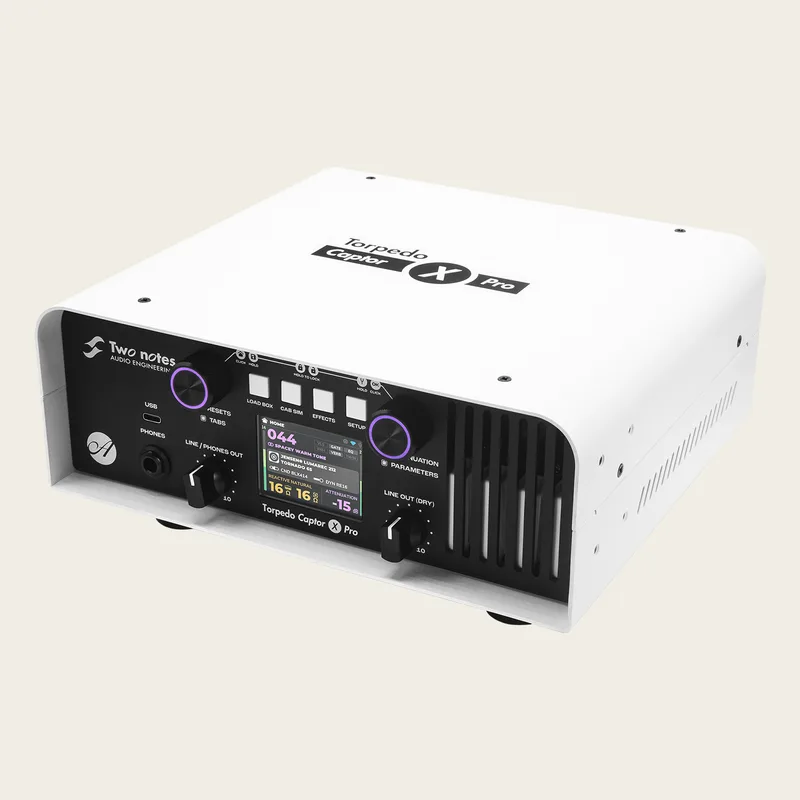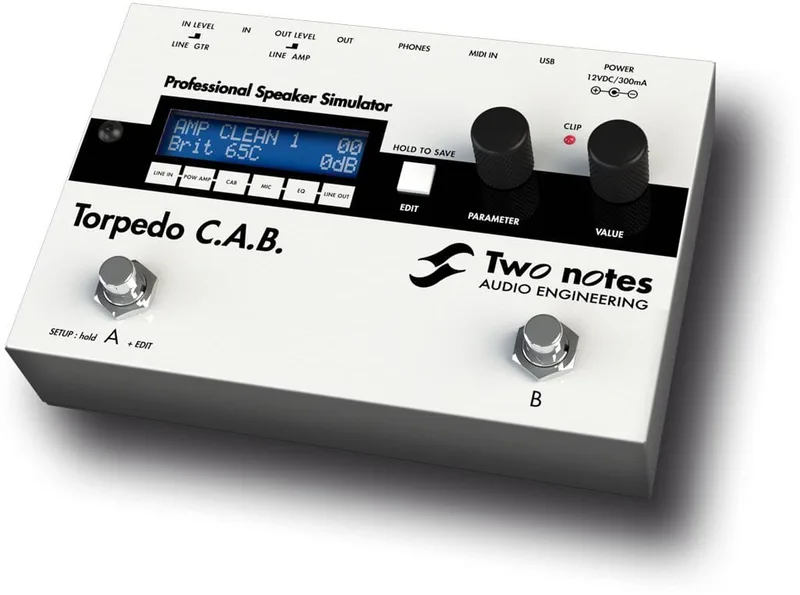


The Two Notes Torpedo C.A.B. (Cabinets in A Box) is a speaker cabinet simulator in stompbox form, a pedal version of the Two Notes Torpedo hardware series that the maker describes as optimized for live playing1. It is a digital audio signal processor1 that takes the place of a miked guitar or bass cabinet: feed it an instrument, a pedalboard or an amplifier's speaker output, and it outputs a balanced signal that behaves like a mic placed on a cab, ready for a PA, recorder or headphones12.
Two Notes positions the C.A.B. as a pedalboard-format miked cab simulator, dual-IR loader and reverb for home, live and studio use2. In a Sweetwater demo, Mitch Gallagher described what it does in practice:
"all this comes together to recreate the effect of putting a real microphone on the amplifier gives you a very authentic result"
The original Torpedo C.A.B. has been upgraded and replaced by the Two Notes Torpedo C.A.B. M, which Two Notes calls "infinitely more powerful and user friendly"4. The C.A.B. M was itself succeeded by the C.A.B. M+, and a free firmware update brings a C.A.B. M up to C.A.B. M+ specifications.
What it does: DynIR cab simulation on a pedalboard
The Torpedo line is built around Two Notes' DynIR virtual cabinet technology, and the C.A.B. brought it to the pedalboard4. Two Notes says the C.A.B. "quickly became the industry standard on pedal board cab emulation"4. Where a conventional impulse response (IR) pedal loads static captures, DynIR cabinets are captured with eight microphones each and let you move them: front or back of the cabinet, distance from close miking to room tone, and axis from cone center to speaker edge5.
The C.A.B. also simulates the power amp stage driving the cabinet, with eight models: SE 6L6, SE EL34, SE EL84 and SE KT88 in single-ended Class A, and PP 6L6, PP EL34, PP EL84 and PP KT88 in push-pull Class AB1. Presets run in three modes: Simulation, Arcade and IR Loader1, and in IR Loader mode two IRs can be selected and used at the same time, mirroring the dual-miking option in simulation mode6.
On the input side, an IN LEVEL selector switch sets gain for instrument (GTR) or line level sources1. The input is a 1/4" balanced TRS jack, with a maximum input level of 4.7 dBu at 100 kOhms in GTR mode and 10.3 dBu at 10 kOhms in LINE mode1. Output is a 1/4" balanced TRS jack at 470 Ohms, with the OUT LEVEL switch setting the level: in AMP mode up to 10.7 dBu, in LINE mode up to 16.5 dBu1. There is also a 1/4" stereo TRS headphones output1.
The converters run at 96 kHz with 24-bit resolution, a 100 dB signal-to-noise ratio on the ADC side, and a frequency response of 12 Hz to 19 kHz, with 1.7 ms latency from line input to line output1.
The controls
Most editing on the C.A.B. happens through its preset parameters rather than a row of knobs. Each preset stores a cabinet, two virtual microphones with distance, center and position settings, level, phase and mute per mic, a five-band EQ, reverb and output level1.
| Parameter group | What it controls |
|---|---|
| Mic A / Mic B | Microphone selection, 8 choices per DynIR cabinet51 |
| Distance A / B | 0 to 127, close miking to room tone51 |
| Center A / B | 0 to 127, position across the speaker1 |
| Position A / B | Back or front of the cabinet1 |
| Level A / B | 0 to 107, -95 dB to +12 dB1 |
| Phase / Mute A / B | Phase invert and mute per microphone1 |
| EQ | Mode (Guitar, Bass, Custom) plus gain for Low, Low Mid, Mid, High Mid and High, each -20 dB to +20 dB1 |
| Out Level | 0 to 107, -95 dB to +12 dB1 |
The EQ's Mode parameter switches between a Guitar curve, a Bass curve and a Custom setting1, and the same parameter map is exposed over MIDI for remote control, including preset selection and bypass1.
From the Torpedo C.A.B. to the C.A.B. M+
Two Notes replaced the C.A.B. with the smaller C.A.B. M4. Both use DynIR virtual cabinet technology4. The C.A.B. M added a balanced XLR DI output alongside its balanced TRS jack output6, and its two outputs allow a wet/dry/wet setup, though it remains a mono pedal7.
The current C.A.B. M+ builds on the C.A.B. M with what Two Notes calls "a stunning clean preamp, refined power amps, enhancer, tuner, expanded reverbs and noise gate"5. Its preamp section offers Gain, Volume, Bass, Medium and Treble controls in guitar and bass modes5. The power amp section models four tube types (EL84, EL34, 6L6, KT88), two circuit types (Class A single-ended and Class A/B push-pull), two tube modes (pentode and triode), with Volume, Contour and Depth controls5. The enhancer provides frequency and dynamic shaping with Thickness, Brilliance and Body controls5, and the reverb section grew to 12 types: Spring, Plate, Tile, Echo, Studio A, Studio B, Loft, Cathedral, Basement, Hall A, Hall B and Crypt5. The noise gate has a noise level "learn" function and Hard / Soft modes5.
| Torpedo C.A.B. | Torpedo C.A.B. M+ | |
|---|---|---|
| Signal | Mono, stereo input converted to mono1 | Mono, aux input downmixed to mono8 |
| Inputs | 1/4" TRS, GTR or LINE level1 | Amp/Instrument/Line input with three IN LEVEL settings, plus aux in9 |
| Outputs | 1/4" TRS line out, headphones95 | Speaker Out, balanced TRS line out, balanced XLR DI out, headphones9 |
| Cabinets | DynIR virtual cabinets4 | 32 DynIR cabinets loaded at full internal memory capacity9 |
| Power | 12V DC, 300mA1 | 12V DC, 140mA typical, 200mA max9 |
| Latency | 1.7 ms line in to line out1 | 2.2 ms line in to line out9 |
| Weight | 750 g1 | 450 g9 |
The C.A.B. M+ input's IN LEVEL switch affects sensitivity and impedance: +12dB gives a maximum level of 4 dBu at 1 MOhm, 0dB gives 16 dBu at 57 kOhms, and -24dB gives 40 dBu at 47 kOhms9. Its Speaker Out is unprocessed, unbuffered and directly connected to the amp input, which is what lets the unit sit between an amp head and a cabinet9. When using it with an amp, Two notes recommends switching the Preamp and Power Amp simulation sections off9. The XLR DI output is protected against +48V phantom power9.
The M+ also carries a ground lift switch9, a USB 2.0 Micro-B connector5, and a 256Mb Micro-SD card included with support for cards up to 32Gb5. In IR Loader mode it stores hundreds of static IRs on the memory card, blends two standard .wav IRs, and supports IR lengths up to 200ms5. The first six preset slots are accessible from the front panel PRESET knob9. Two Notes supplies or recommends its own 12V power supply for pedal format products for both the C.A.B. and the C.A.B. M+10.
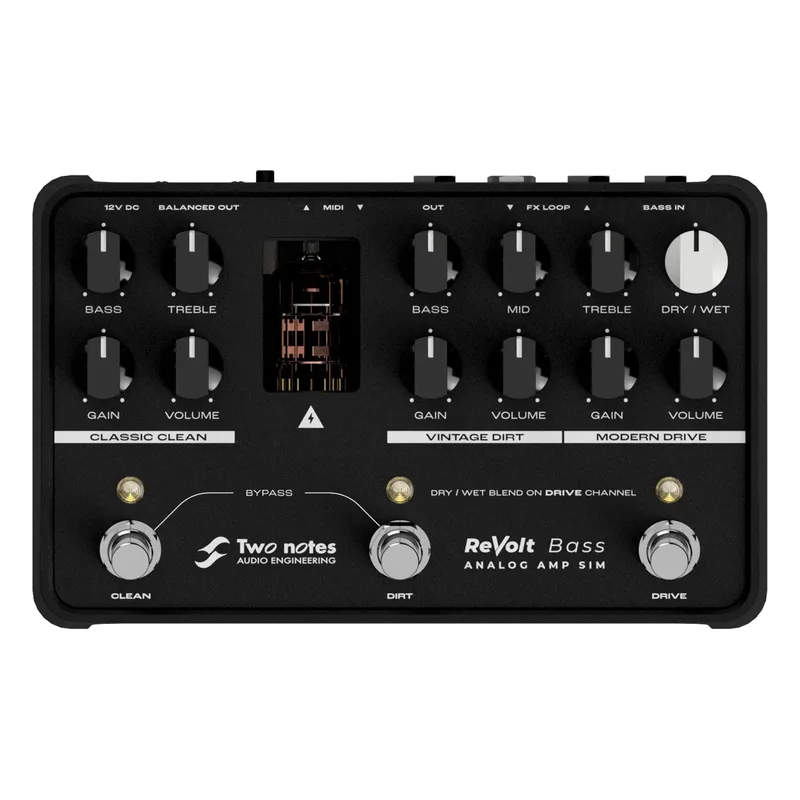
MusicRadar's Rob Laing, reviewing the Two Notes ReVolt pedal, credited the company's cab modeling pedigree along the way, calling the C.A.B. M+ "one of the best pedal platform cab modellers out there" and "a market-leading example of a designated IR platform"11.
Both the C.A.B. and the C.A.B. M+ carry a two-year warranty covering parts and workmanship for the original purchaser from an authorized dealer9, with technical support handled through the Two notes Help Desk rather than by e-mail19.
Videos
Pete Thorn
ProGuitarShopDemos
Sweetwater
Questions
Can the Torpedo C.A.B. M go between an amp head and a cabinet?
Yes. The C.A.B. M and C.A.B. M+ have an Amp/Instrument/Line input that accepts an amplifier speaker output, plus a Speaker Out jack that passes the unprocessed, unbuffered signal straight through to the cabinet. Two notes recommends switching the Preamp and Power Amp simulation sections off when using the unit with a real amp, so only the cabinet simulation is active.
What is the difference between the C.A.B. M and the C.A.B. M+?
The C.A.B. M+ builds on the C.A.B. M with a clean preamp, refined power amp simulations, an enhancer, a tuner, expanded reverbs and a noise gate. Two notes has stated that a free firmware update brings the C.A.B. M entirely up to C.A.B. M+ specifications, so an updated C.A.B. M is functionally the same product.
Does the Torpedo C.A.B. M have an XLR output?
Yes. Both the Torpedo C.A.B. M and the C.A.B. M+ carry a balanced XLR DI output alongside a balanced TRS jack line output. On the C.A.B. M+ the XLR output is specified at a maximum level of 10 dBu with 300 Ohms impedance and is protected against +48V phantom power from a mixing console.
What power supply does the Torpedo C.A.B. M use?
The C.A.B. M+ runs on 12V DC through a 2.1mm x 5.5mm center negative connector, drawing about 140mA typical and 200mA maximum, and it ships with a 100-240V AC to 12V DC 1A adapter. Two notes supplies or recommends its own 12V power supply for its pedal format products rather than a standard 9V pedal supply.
How many cabinets come loaded in the C.A.B. M+?
The C.A.B. M+ ships with its internal memory for virtual cabinets at full capacity, holding 32 DynIR cabinets already loaded. A 256Mb Micro-SD card is included and cards up to 32Gb are supported, so more cabinets and static IR files can be added. The first six preset slots are reachable from the front panel PRESET knob.
Is the Two Notes Torpedo C.A.B. stereo?
No. The original Torpedo C.A.B. is a mono unit, and any stereo signal sent into it is converted to mono. The C.A.B. M is also described as a mono pedal, though its two outputs allow a wet/dry/wet setup when a second unit or suitable routing is used. The C.A.B. M+ aux input is likewise downmixed to mono.
Sources (11)
- Torpedo C.A.B. User's Manual, Two notes Audio Engineering (OROSYS SAS), 2024-01-17
- Two notes Audio Engineering, Two notes Audio Engineering, 2025-08-01
- Two Notes Torpedo C.A.B. M Speaker Simulator Pedal Demo, Sweetwater, 2019-09-27
- Differences between the C.A.B. M+ and C.A.B., Two notes, 2020-11-05
- Torpedo C.A.B. M+, Two notes, 2025-08-01
- Torpedo C.A.B. M User's Manual, OROSYS SAS (Two notes Audio Engineering), 2024-01
- TECH TIPS: Stereo Direct Rigs, Origin Effects, 2022-11-10
- Torpedo C.A.B. M+, Two notes, 2025-08-01
- Torpedo C.A.B. M+ User's Manual, OROSYS SAS (Two notes Audio Engineering), 2023-11-24
- Two notes 12V Power Supply for Pedal Format Products, Two notes, 2026-04-24
- Two Notes ReVolt Guitar Analog Amp Sim pedal review, MusicRadar, 2023-02-20