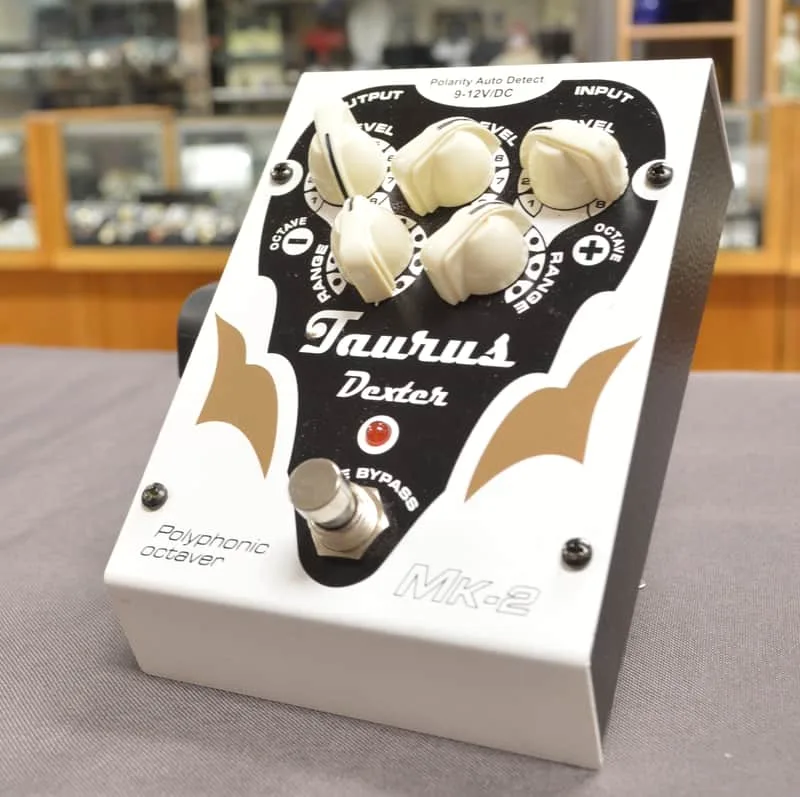


The Taurus Dexter Mk-2 is a polyphonic octaver from Taurus, a pedal that transposes the note you play one octave up and one octave down at the same time, and works on chords as well as single notes. Guitar Interactive Magazine's press release describes it as "a polyphonic Octaver which allows transposing an original note of one octave up and down," with a 24-bit DSP handling the polyphony1. It belongs to the family of octave and pitch pedals and was reviewed for bass and guitar use.
What it does to your signal
Because the tracking is polyphonic, the Dexter Mk-2 can follow chords and add octave voices to every note in them, not just single-note lines. The two octave voices are flexible: "Both octaves can be used separately, mixed together as well as mixed with the original notes," according to the Guitar Interactive press release1. Billy Voight's Guitar World review of the original Dexter described the same approach: "Choose to use one octave or both octaves at once"3.
The controls
Each octave voice has its own pair of knobs, so the up and down voices are set independently21.
| Control | What it does |
|---|---|
| Level (per octave) | Sets the volume of that octave voice1 |
| Range (per octave) | Controls the octave's bandwidth to eliminate unwanted tones1 |
The Range control is the one worth understanding. Premier Guitar's reviewer called the range controls the original Dexter's "secret weapons," explaining that they "limit the frequencies processed by the octave generators," which predetermines the note range each voice tracks2. In practice, narrowing the range keeps the octaver from trying to track frequencies you do not want octaved, which is where polyphonic units usually get muddy. The original Dexter also had an out level knob for overall volume2.
Power: 9-12V, DC Assistant and polarity detection
The Mk-2 series was designed around easier power. Guitar Interactive Magazine states that the new model, "like the whole MK-2 series can be powered in the range 9-12V," and that the series pedals "additionally have Polarity Auto Detection, which solves the issues with using various types of power supplies"1.
The Dexter Mk-2 includes a DC Assistant: if the power supply is lost or the voltage is too low, the effect automatically switches to bypass mode1. That keeps your signal path from cutting out mid-song if power fails, rather than dropping the pedal out of the chain entirely.
The pedal also has a DC Assistant. If the power supply is lost or the voltage drops too low, the effect is automatically switched to bypass mode, so it stops processing rather than passing a broken signal1.
The earlier Dexter and the Mk-2
The first Dexter was released in 2014, when Guitar World reviewed it as a newly released polyphonic octave pedal with octave-up and octave-down voices3. Premier Guitar later reviewed it as "Dexter from Taurus Amplification," a "polyphonic octave generator that provides multiple octave voices"2. That review also noted the pedal shipped with stick-on rubber feet and an instructional manual in the box3.
The Mk-2, announced in March 2015, is a redesign. Guitar Interactive Magazine says "The Taurus Dexter Mk-2 is significantly smaller and it was enriched with additional features," the additions being the wider 9-12V power range, Polarity Auto Detection and the DC Assistant described above1. In the United States, Premier Guitar pointed players to Taurus's U.S. distributor, Osiamo, at osiamo.com, for support on the Dexter2.
Videos
BassTheWorld.com
Fred Brum
Darek Wawrzyniak (Darius Wave)
Questions
Is the Taurus Dexter Mk-2 analog or digital?
It is digital. Guitar Interactive Magazine's press release states that a 24-bit high quality DSP is responsible for the polyphony of the effect, meaning the pedal can track full chords rather than single notes. Premier Guitar's review of the original Dexter likewise describes a 24-bit DSP processor that tracks incoming audio and adds octave voices.
What voltage does the Dexter Mk-2 run on?
Like the whole MK-2 series, it can be powered in the range of 9 to 12V, according to Guitar Interactive Magazine. That is wider than the original Dexter, which Premier Guitar noted used a 12-volt, tip-positive supply that could make pedalboard integration difficult.
Does the Dexter Mk-2 care about power supply polarity?
No. The Mk-2 series has Polarity Auto Detection, which Guitar Interactive Magazine says solves the issues with using various types of power supplies. The pedal also has a DC Assistant that switches it to bypass mode if power is lost or the voltage is too low.
Can the Dexter Mk-2 mix octaves with the original notes?
Yes. Guitar Interactive Magazine states that both octaves can be used separately, mixed together, and mixed with the original notes, so you can run a single octave voice, both at once, or blend them under your dry signal.
What does the DC Assistant do?
The DC Assistant protects your sound when power fails. Guitar Interactive Magazine's press release says that in case of losing the power supply or too low voltage, the effect is automatically switched to bypass mode, so the pedal stops processing rather than passing a damaged signal.
How is the Mk-2 different from the first Dexter?
Guitar Interactive Magazine says the Taurus Dexter Mk-2 is significantly smaller than the previous model and was enriched with additional features. The Mk-2 series also adds 9-12V power operation and Polarity Auto Detection, addressing the power supply limitations reviewers noted on the original.
Sources (3)
- Taurus Dexter Mk-2 Polyphonic Octaver for Bass and Guitar, Guitar Interactive Magazine, 2015-03-05
- State of the Stomp: Dexter the Polyphonic Monster, Premier Guitar, 2013-12-17
- Review: Taurus Dexter Polyphonic Octaver Pedal, Guitar World, 2014-02-06