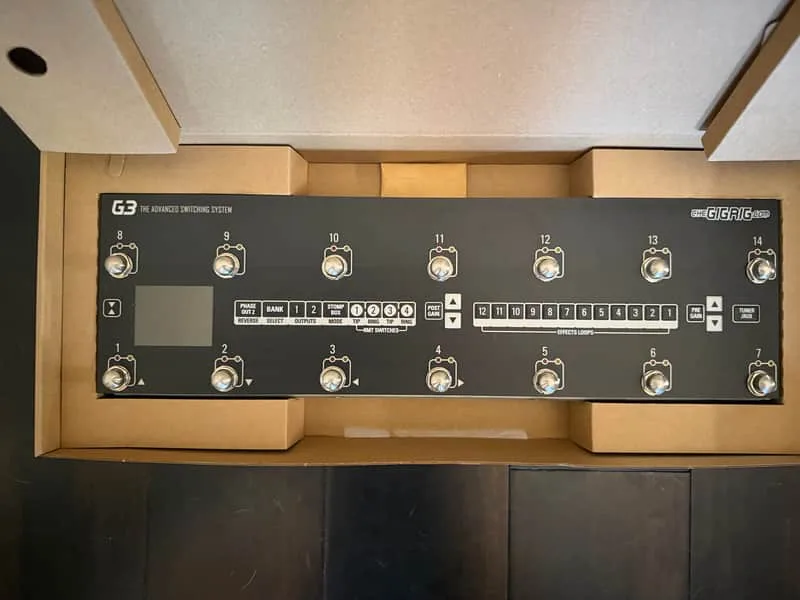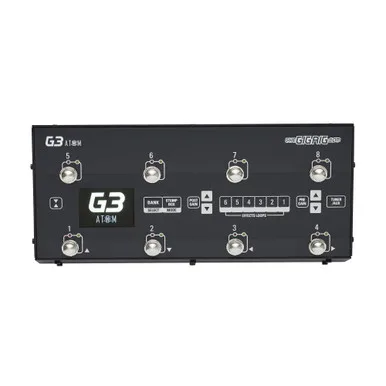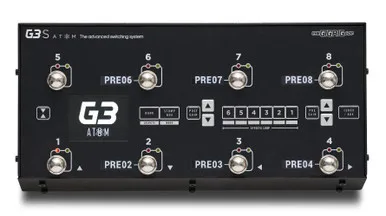


The GigRig G3S Atom is an effects pedal switching system from The GigRig, a compact alternative to the GigRig G3S that keeps the same feature set in a smaller box. It sits at the front of a pedalboard and routes your pedals through six Passive True Bypass Matrix effects loops, storing combinations as presets you can recall from footswitches, each with its own screen showing what it does1.
The GigRig positions it as "built on the legacy of our award winning G2", the earlier TheGigRig G2 switcher, and says the G3 range "will not load or colour your guitar tone, letting you hear your effects and amps as they were designed to sound"1. In true bypass it passes a signal bandwidth of 4Hz to 100KHz and handles a maximum input of 16.5V peak to peak, with a 3.3M Ohm input impedance1.
Loops, presets and screens
The core of the G3S Atom is its six Passive True Bypass Matrix effects loops. Pedals sit in the loops and the switcher brings each one in or out of the signal path, so a pedal that is bypassed is fully out of the chain rather than buffered or half-loaded. Each loop can also be configured for stereo using a TRS cable, which matters for stereo delay and reverb pedals, and the unit passes stereo delay and reverb trails1.
Presets are organized as 99 banks with up to 16 presets per bank, and the whole system can be configured for Preset mode or Stomp Box mode. In Preset mode a footswitch recalls a stored combination of loops; in Stomp Box mode the footswitches behave more like individual pedals you turn on and off1.
Where the G3S Atom gets its name is the screens: seven of them. There is one main screen, 4.9cm by 3.7cm (1.92" by 1.45"), showing the bank and preset number or name, and six smaller OLED preset display screens, 2.6cm by 0.7cm (1.02" by 0.27"), one next to each footswitch, each displaying up to five characters so you can label what each switch does. Brightness is adjustable1.
The footswitches themselves are The GigRig's own OptoKick design, milled from stainless steel, using light instead of mechanics to do the switching1.
Editing does not have to happen on the unit. Built-in Bluetooth connects to the G3 Web Editor or the G3 iOS app for editing and labeling presets, software updates, system backups and song list editing1.
| Feature | Detail |
|---|---|
| Loops | G2 Passive True Bypass Matrix effects loops, TRS remote switching for other gear1 |
| Banks / presets | 99 banks, up to 16 presets each1 |
| Modes | Preset or Stomp Box1 |
| Screens | 1 main (4.9cm x 3.7cm) plus 6 dedicated OLED preset displays (2.6cm x 0.7cm), each up to 5 characters1 |
| Footswitches | OptoKick optical, stainless steel1 |
| Editing | Bluetooth to G3 Web Editor or G3 iOS app1 |
Pre Gain, Post Gain and the two outputs
Every preset carries a programmable Pre Gain stage, which can buffer, attenuate or boost the input to your effects, and can be switched entirely out of the signal path. This is the same Pre Gain concept The GigRig used on the G2 and the G3S, so you can, for example, knock down the signal hitting a fuzz in one preset and boost it in another without touching the pedal itself123.
At the other end of the chain, true stereo programmable Post Gain gives control over the master volume output of each preset, so each stored combination can also store its own output level1.
There are two separate outputs. Out 1 is a true bypass signal path with input and output amps off, and The GigRig notes that Out 1 is earthed and must be connected to ground at all times. Out 2 is a signal path with input and output amps off, buffered and isolated using what the maker calls Hi-Definition Isolation. One of the two outputs is isolated and phase reversible, which The GigRig says means "you'll have no earth hum or phase issues between your amps"1.
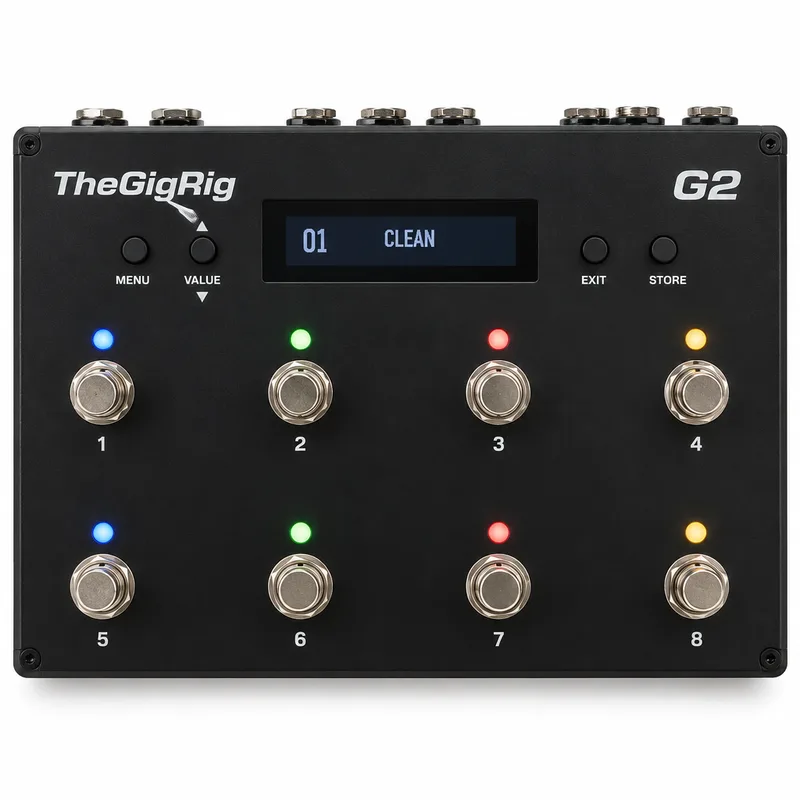
Two outputs for two amps is an idea with a history at The GigRig: the G2 also put two outputs on its rear panel, and as Premier Guitar's review of that switcher noted, "since the rear panel has two outputs, players with two amps can specify whether each program feeds amp A, amp B, or both"4. On the G3S Atom the two outputs behave differently: with the input and output amps off, Out 1 is true bypass, while Out 2 is buffered and isolated using Hi-Definition Isolation1.
Out 1 is earthed and must be connected to ground at all times, per The GigRig's product page. If you run two amps, keep this in mind when wiring the second output1.
Power and connections
The G3S Atom runs on 9V DC from a 2.1mm center negative connector and draws 850mA1. That is a substantial draw for a switcher, and The GigRig recommends its Generator power supply, the one supplied with The G3 Switching System1.
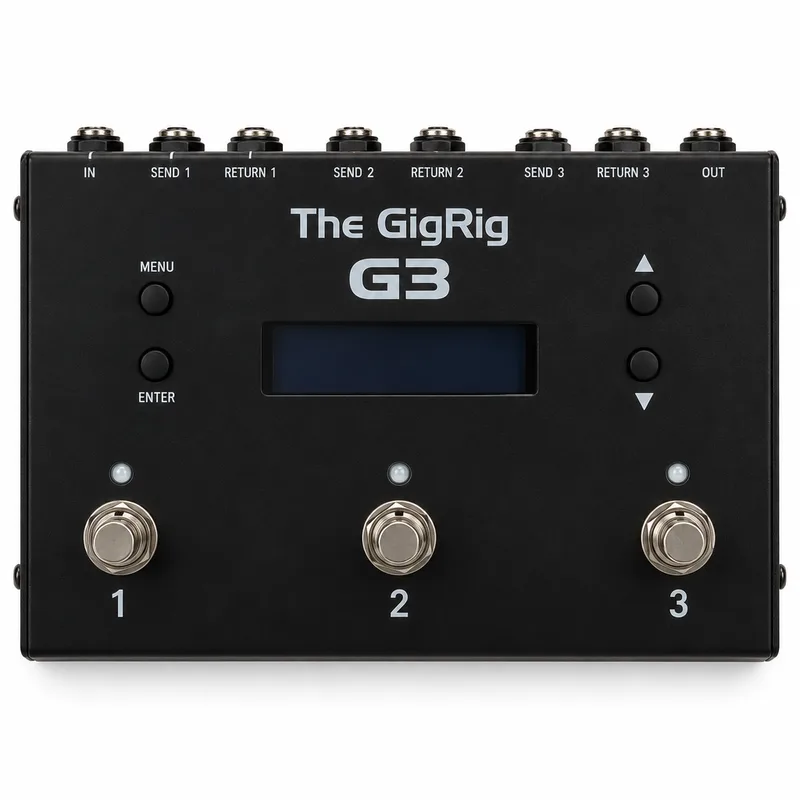
For comparison within the range, the full GigRig G3S draws 950mA at the same 9V DC center negative spec2, and the older G2 draws 650mA at 9V DC3.
| Model | Power | Current draw |
|---|---|---|
| G3S Atom | 9V DC, 2.1mm center negative1 | 850mA1 |
| G3S | 9V DC, 2.1mm center negative2 | 950mA2 |
| G2 | 9V DC3 | 650mA3 |
Beyond audio, the G3S Atom has full MIDI In and Out. Each preset can send up to 20 separate mappable PC and CC MIDI messages, and there are two expression pedal inputs for realtime CC message control, so expression pedals can drive parameters on MIDI-equipped pedals in the loops1. It also offers TRS remote switching for other gear1.
Where it came from
The G3S Atom descends from the G2: The GigRig describes it as "built on the legacy of our award winning G2"1, and its loop switching uses the G2 Passive True Bypass Matrix effects loops carried over from that earlier design1. The TheGigRig G2 is the switcher that design came from.
The G3 range's design goal, in the maker's words, is that it "will not load or colour your guitar tone, letting you hear your effects and amps as they were designed to sound"1. The G3S Atom carries that circuit approach over into a unit with a main screen and a smaller screen beside each footswitch1.
Videos
TheGigRig
Signal Theory
Vertex Effects
Questions
What is the difference between the GigRig G3S and the G3S Atom?
The G3S Atom is a compact alternative to the G3S that, in The GigRig's words, does not compromise on any of its features. Both have screens next to each footswitch, the same MIDI capability of up to 20 PC and CC messages per preset, and two expression pedal inputs. The G3S Atom draws 850mA where the G3S draws 950mA, both at 9V DC center negative.
Does the G3S Atom work in stereo?
Yes. Each of its six loops can be run in stereo using a TRS cable, it passes stereo delay and reverb trails, and it has true stereo programmable Post Gain. It also has two separate outputs, one of which is isolated and phase reversible, so two amps can be run without earth hum or phase issues between them.
Can the G3S Atom send MIDI to other pedals?
Yes. It has full MIDI In and Out, and each preset can send up to 20 separate mappable PC and CC MIDI messages. It also has two expression pedal inputs for realtime CC message control, so expression pedals can drive parameters on MIDI-equipped pedals.
What power supply does the G3S Atom need?
It runs on 9V DC from a 2.1mm center negative supply at 850mA. The GigRig recommends its Generator power supply, which is supplied with The G3 Switching System. At 850mA it needs a dedicated output on a power brick rather than a low-current daisy chain tap.
How many loops does the GigRig G3S Atom have?
It has six Passive True Bypass Matrix effects loops, each of which can be configured for stereo using TRS cables. That is fewer than the ten loops of the earlier GigRig G2, two of which were stereo, but each G3S Atom loop can be stereo.
Sources (4)
- The GigRig, The GigRig
- The GigRig, The GigRig
- The GigRig, TheGigRig
- GigRig’s G2 Advanced Switching System Review, Premier Guitar, 2015-09-01