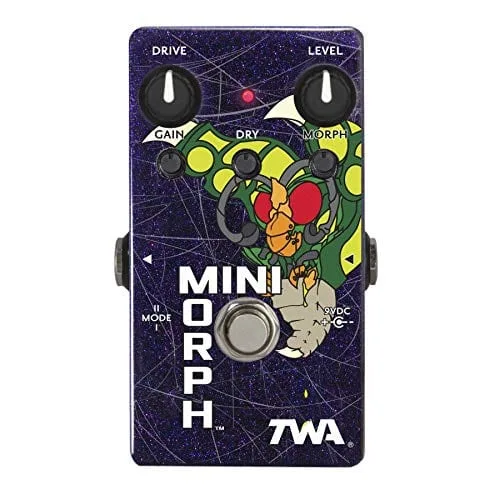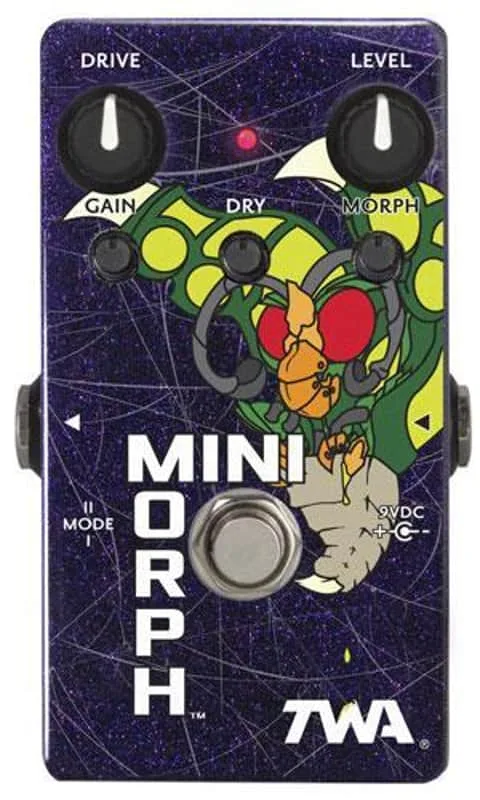


The TWA MiniMorph Dynamic Waveshaper is a compact distortion pedal whose drive circuit is tied to how hard you play. Rather than a fixed amount of saturation, it uses an envelope-dependent drive circuit that links the amount and type of saturation to the input signal level, so picking dynamics reshape the distortion itself. gearnews called it "a compact creative sound mangling tool for guitar" and listed it at an RRP of USD 189 in February 20191. Pedal of the Day summed up the MM-01 as "an envelope-dependent overdrive, with bits of filter, fuzz, distortion and more locked inside"2.
How the circuit works
Guitar.com's news piece on the launch explains the topology: "The circuit features a string of full-wave rectifiers, which sit behind two high-gain preamps that are set in series." The result, the site says, is a distortion where the amount and type of saturation is linked to the input level, producing multi-layered, complex waveforms that twist the instrument's harmonic structure3. gearnews puts the same idea in playing terms: "The Minimorph reacts in each of the settings to the player's attack intensity," making it highly touch sensitive1.
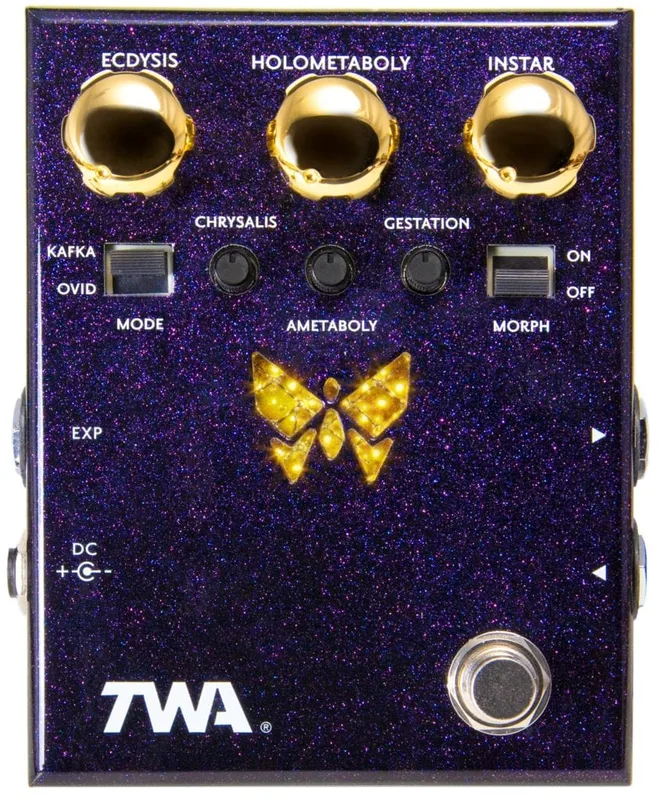
That envelope-driven approach is the family trait. The larger DynaMorph, from which the MiniMorph descends, was built around an envelope-detection circuit that controls distortion events via playing dynamics, as Premier Guitar reported at its 2017 release4, and Guitar Interactive Magazine described its switchable Morph function as allowing envelope control of the distortion effect5. Delicious Audio noted that this interaction with the player's style is what justifies the "Dyna" part of the name6.
Controls: Gain, Drive and Morph
The MiniMorph keeps its controls to the Gain and Drive knobs, which govern two high-gain preamps connected in series, plus a Morph pot that controls the output of the main distortion effect, all working within an envelope-dependent drive circuit13.
| Control | What it does |
|---|---|
| Gain | One of two controls over the two high-gain preamps connected in series1 |
| Drive | The second preamp control1; sets the diode array's output level, and as it increases the signal "morphs" as the distortion's EQ components change2 |
| Morph | Controls the output of the main Distortion effect1 |
The Drive control is where the pedal's name shows up in practice: Pedal of the Day describes the signal literally morphing as the knob rises, because the changing diode array output alters the EQ character of the distortion2.
Bypass and switching
The MiniMorph is true-bypass according to gearnews1. Pedal of the Day adds the detail behind that: TWA's proprietary S3 "Shortest Send Switching", a form of relay-based true bypass switching, which also automatically reverts the pedal to bypass mode if power is lost2. That last point is worth knowing on a gig: a dying power supply takes the pedal out of your signal path rather than leaving it engaged.
The MiniMorph is a compact take on the more elaborate DynaMorph. Pedal of the Day calls the MM-01 "a younger brother, per se, to the DynaMorph"2, and gearnews notes it is based on the DynaMorph "just in a smaller format"1.
What reviewers said
- gearnews's reviewer liked the synth-like sounds and found the pedal versatile, but added: "It looks very versatile, but possibly a little erratic as well."1
- Pedal of the Day's reviewers called it "multi-layered, complex and an absolute powerhouse of a pedal", in a purple enclosure2.
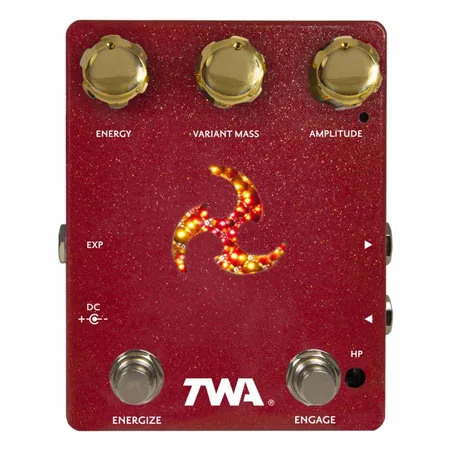
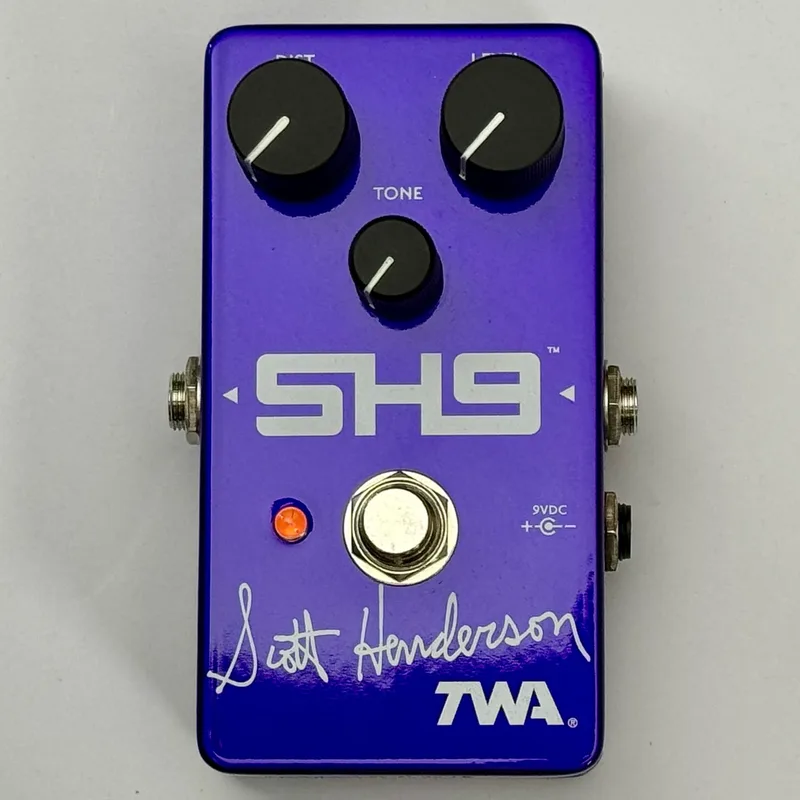
If the envelope-driven distortion idea interests you, the wider distortion field includes more conventional touch-sensitive options, and TWA's own range runs from the Triskelion TK-01 to the SH9 Scott Henderson Signature Distortion.
Videos
Mike Hermans
Distortion LTD
Godlyke Inc.
Questions
What is the difference between the TWA MiniMorph and the DynaMorph?
The MiniMorph is a smaller-format version of the TWA DynaMorph. Pedal of the Day described the MM-01 MiniMorph as a younger brother to the DynaMorph, and gearnews noted that the Minimorph is based on the more elaborate Dynamorph pedal, just in a smaller format. Both use an envelope-dependent drive circuit that ties the amount and type of saturation to the input signal level.
Is the TWA MiniMorph true bypass?
Yes. gearnews reports that the Minimorph is true-bypass. Pedal of the Day adds that it uses TWA's proprietary S3 Shortest Send Switching, a form of relay-based true bypass switching, and that this switching automatically reverts the pedal to bypass mode if power is lost.
Does the MiniMorph respond to picking dynamics?
Yes. gearnews states that the Minimorph reacts in each of the settings to the player's attack intensity, making it highly touch sensitive. The circuit links the amount and type of saturation to the input level, so picking harder or softer changes the distortion itself, not just its volume.
How much does the TWA MiniMorph cost?
gearnews listed the Minimorph at an RRP of USD 189 as of February 2019. Guitar.com likewise reported a retail price of $189, with estimated shipping by 5 March 2019.
Can the MiniMorph make synth-like sounds?
gearnews's reviewer liked the synth-like sounds the Minimorph produced and found the pedal very versatile, though possibly a little erratic in overall sound. Pedal of the Day described it as an envelope-dependent overdrive with bits of filter, fuzz, distortion and more locked inside, which points to the same synth-adjacent territory.
Sources (6)
- TWA Minimorph Dynamic Waveshaper: A compact, creative sound-mangling tool for guitar, gearnews.com, 2019-02-08
- TWA MM-01 MiniMorph™ Dynamic Waveshaper, Pedal of the Day (www.pedal-of-the-day.com), 2019-06-14
- TWA launches MiniMorph Dynamic Waveshaper, Guitar.com, 2019-02-12
- TWA Releases the DM-02 Dynamorph Harmonic Generator, Premier Guitar, 2017-03-27
- TWA Releases New DM-02 Dynamorph Pedal, Guitar Interactive Magazine, 2020-08-02
- New (Crazy) Pedals: TWA Dynamorph, Delicious Audio, 2017-03-12
 Jared Scharff