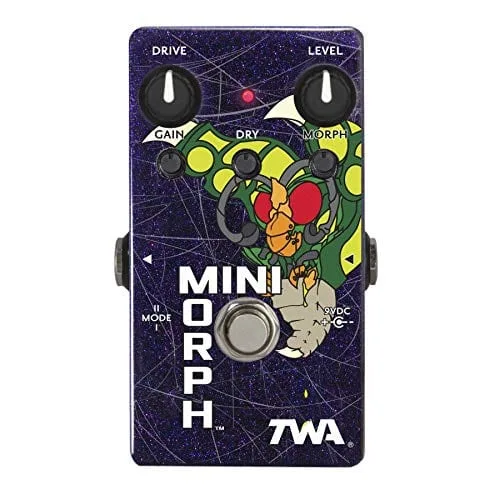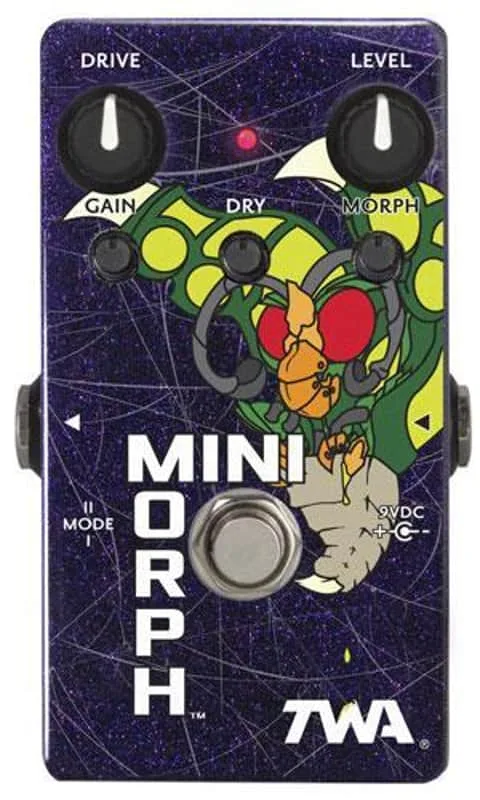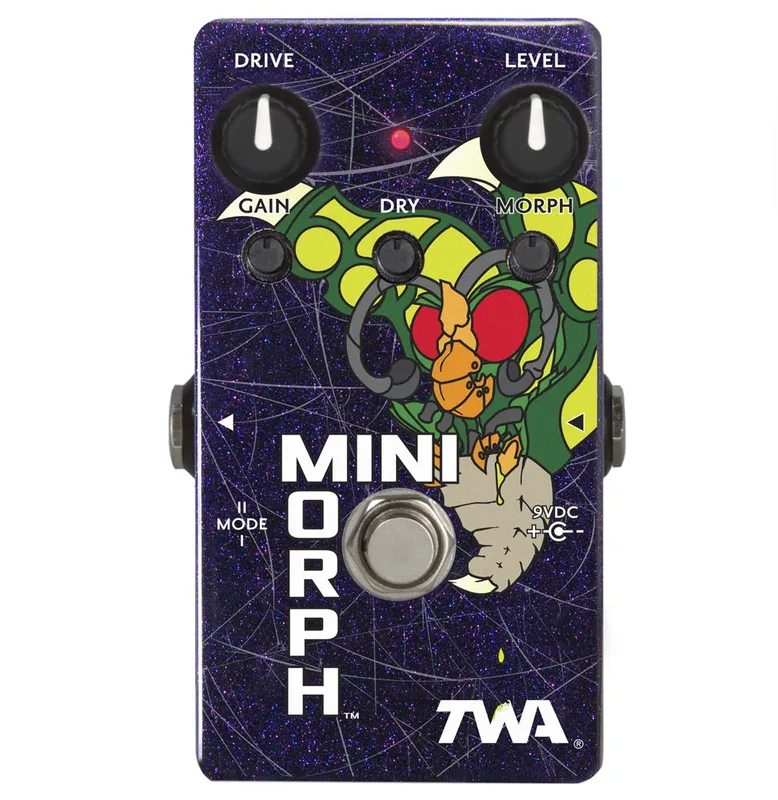


The TWA MM-01 MiniMorph is a dynamic waveshaper pedal from TWA, a maker whose products are distributed by Godlyke. Where a conventional distortion pedal clips your signal the same way no matter how hard you play, the MiniMorph's drive circuit is envelope-dependent: the amount and type of saturation are linked to the level of your input signal, so the character of the effect shifts with your picking dynamics1.
TWA describes the pedal as "the larval offspring of our mind-melting DynaMorph," and the family relationship is central to what the MiniMorph is. As TWA put it in the launch announcement, "We took the original DynaMorph circuit & stripped out the envelope-controlled level section to create a pint-sized power"2. Pedal of the Day called it "a younger brother, per se, to the DynaMorph" and "an envelope-dependent overdrive, with bits of filter, fuzz, distortion and more locked inside"3. It ships in a purple enclosure3.
How the circuit works
At the heart of the MiniMorph is a string of full-wave rectifiers. Two high-gain preamps sit in series in front of the diode array, followed by an op-amp that sums the signal1. The waveshaping happens in the diode array: as the diodes are hit with increasing signal level from the preamps, they bias either positive or negative, or not at all, depending on signal level1. Because the rectifiers fold the waveform rather than simply clipping it, the result is unusual. Delicious Audio described the output waveform as "a combination of many, including sine, triangle, square, and interactions of all of these"4.
The envelope dependence comes from that same signal-level behavior. Since the diodes' bias state follows your input level, the saturation character changes as you play harder or softer and as a note decays1.
What it does to your sound
TWA describes the audible result in concrete terms: increased Drive settings create higher-order harmonics that subsequently drop in pitch as the note decays, like a swept resonant filter. Double stops and chords generate intermodulation effects TWA describes as bordering on ring modulation, but with less dissonance1. Delicious Audio summed up the character as "Multi-layered, highly complex waveforms meet & morph to create sizzling, splatter-full effects bordering on the bizarre"4.
Controls and switching
The MiniMorph keeps its control set small:
| Control | What it does |
|---|---|
| Gain | Sets the output level of the preamp3 |
| MORPH (Effect Level) | Controls the output level of the distortion effect; turn clockwise for more volume1 |
| Mode switch (side-accessed) | Selects between two different overall EQ settings1 |
The dual mode switch gives two different EQ curves for added tonal options2.
The pedal uses TWA's proprietary S3 "Shortest Send Switching," a form of relay-based true bypass switching that TWA says provides the most transparent bypass sound available1. The switching also automatically reverts the pedal to bypass mode if power is lost, so your signal keeps reaching the amp3.
MiniMorph and DynaMorph
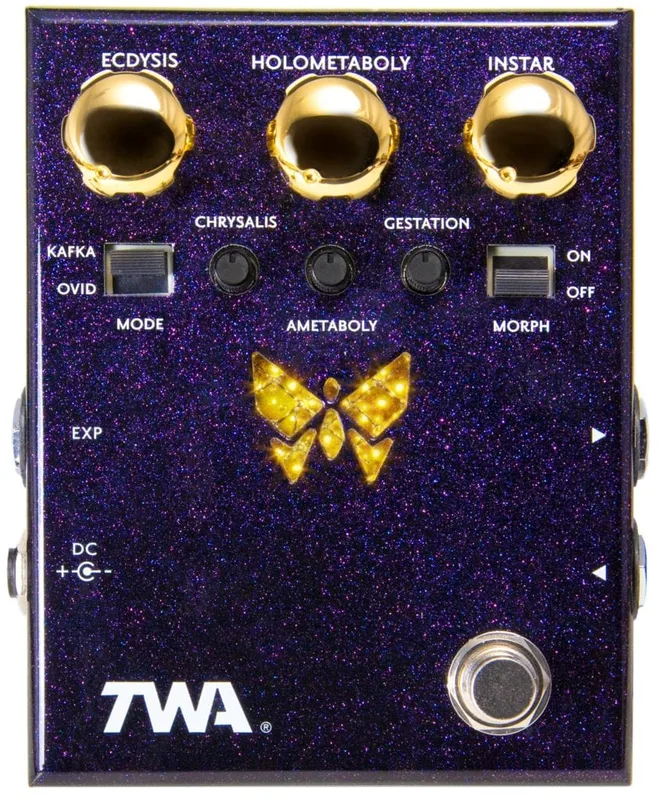
The TWA DynaMorph is the larger sibling. It creates multi-layered, highly complex waveforms that TWA says "twist and morph your instrument's harmonic structure in bizarre yet decidedly musical ways"5. Where the MiniMorph's envelope dependence is fixed into the circuit, the DynaMorph carries a switchable Morph function that allows envelope control of the distortion effect, plus an envelope-detection circuit that controls distortion events via playing dynamics6. The current DynaMorph version lists improved envelope function among its features5.
In short: the DynaMorph is the full instrument with switchable envelope control of level and distortion; the MiniMorph is the same core waveshaping topology with the envelope-controlled level section stripped out, in a smaller box241.
What the press said
Premier Guitar's 2021 review found a lot to like, with a few caveats. The reviewer's pros and cons7:
| Pros | Cons |
|---|---|
| "Wide range of wacky, ear-perking sounds." | "Some learning curve." |
| "Great dynamic sensitivity." | "Envelope sensitivity fast exposes poor technique." |
| "High-quality build." | 7 |
That last con is the flip side of the pedal's core idea: because the waveshaping tracks your input level so closely, sloppy picking shows up in the sound. Pedal of the Day's earlier review was enthusiastic, calling the MiniMorph "multi-layered, complex and an absolute powerhouse of a pedal"3.
Videos
Mike Hermans
Distortion LTD
Godlyke Inc.
Questions
What is the difference between the TWA MiniMorph and the DynaMorph?
The MiniMorph is built from the original DynaMorph circuit with the envelope-controlled level section removed, making it a smaller, simpler pedal. The DynaMorph keeps a switchable Morph function that allows envelope control of the distortion effect, while the MiniMorph's envelope dependence is baked into its waveshaping circuit.
Is the TWA MiniMorph true bypass?
Yes. It uses TWA's proprietary S3 Shortest Send Switching, a form of relay-based true bypass switching that TWA describes as providing the most transparent bypass sound available.
What happens to the MiniMorph if power is lost?
The switching automatically reverts the pedal to bypass mode if power is lost, so your signal still passes through to the amp.
Is the TWA MiniMorph still available?
As of October 2026, TWA's product page lists the MiniMorph as sold out. It was announced in January 2019 and reported ready for shipping in June 2019.
Sources (7)
- TWA MINIMORPH™, Godlyke Distributing, Inc.
- TWA Releases the MM-01 MiniMorph Dynamic Waveshaper, Premier Guitar, 2019-02-07
- TWA MM-01 MiniMorph™ Dynamic Waveshaper, Pedal of the Day (www.pedal-of-the-day.com), 2019-06-14
- New Pedal: TWA Mini Morph, Dynamic Waveshaper, Delicious Audio, 2019-06-10
- DYNAMORPH®, Godlyke Distributing, Inc.
- TWA Releases the DM-02 Dynamorph Harmonic Generator, Premier Guitar, 2017-03-27
- TWA MM-01 MiniMorph Review, Premier Guitar, 2019-09-06