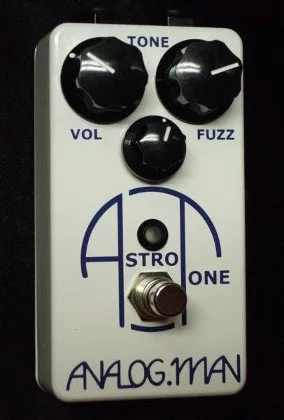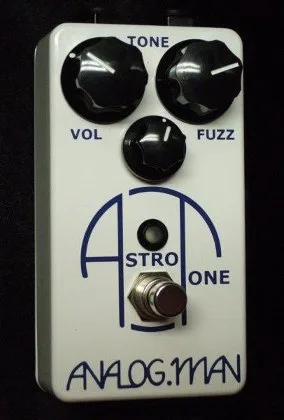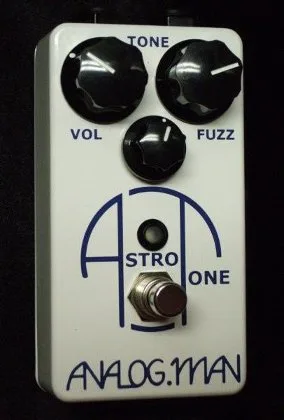
The Astrotone Fuzz is a fuzz pedal from the mid-1960s, built by the Universal Amplifier Company in New York City between 1966 and 196812. It was also sold under the Sam Ash name, and the two are the same pedal: in a JHS Pedals video, Josh said "the astrotone fuzz was the same pedal" as the Sam Ash Fuzz3. Analog Man's Mike Piera, who has worked on originals and built a reissue, dates the Sam Ash version to New York City in 1966-68 and attributes it to the Astro Amp company4.
A New York fuzz with an early tone knob
The Astrotone holds a place in pedal history for its control layout. Aion FX calls it "one of the first effects pedals to feature a tone knob," which was unusual for a fuzz of that era1. That knob is also the pedal's most discussed shortcoming: Aion FX says it is "not particularly effective in this circuit (at least not without some modifications)"1. Players chasing tonal shaping from a stock Astrotone should expect the control to do less than a modern tone stack.
Silicon or germanium?
The clipping question is a common one for 1960s fuzzes, and the Astrotone's answer is not obvious at a glance. Aion FX reports that "photos of original Astrotone units show that it used DO-7 glass case diodes, which are usually associated with germanium," but concludes the diodes are silicon12. The transistors were 2N3565 parts, and Aion FX notes they "varied widely in gain," so two original units could behave differently from each other1.
The Sam Ash connection
The pedal reached players under two names. Analog Man's Mike Piera explains the relationship on his Astrotone page: "There were two versions of the Sam Ash case, the boards were the same in both"4. In other words, the Astrotone and the Sam Ash Fuzzz Boxx shared one circuit, with the differences living in the enclosure.
| Astrotone Fuzz | Sam Ash Fuzzz Boxx | |
|---|---|---|
| Maker | Universal Amplifier Company1 | Astro Amp company, per Analog Man4 |
| Years | 1966 to 19681 | 1966-684 |
| Origin | New York City1 | New York City4 |
| Circuit | Same pedal, per JHS's Josh3 | Same boards in both case versions4 |
The original pedal has been out of production since 1968, and Aion FX notes the original trademark had expired, which is why later builders have been able to reuse the Astrotone name1.
Later takes on the circuit
What modern builders have done with the circuit:
- Analog Man's Astro Tone Fuzz, launched in 2010 as the company's first new pedal of that year4
- From 2023, Analog Man used newer transistors of the same type and shape, also with gold legs, instead of original Astrotone stock4
- Guitar Pedal X's Stefan Karlsson wrote that "The AstroTone circuit is one that's often overlooked - but it's for sure one of my favourites - there just aren't many t[akes] in existence"5
Questions
Who made the original Astrotone Fuzz?
The Astrotone Fuzz was manufactured by the Universal Amplifier Company in New York City from 1966 to 1968, according to Aion FX. Analog Man's Mike Piera dates the same pedal, sold as the Sam Ash Fuzzz Boxx, to New York City in 1966-68 and attributes it to the Astro Amp company, so the historical record names both Universal Amplifier and Astro Amp in connection with the circuit.
Does the Astrotone Fuzz use silicon or germanium?
Aion FX notes that photos of original Astrotone units show DO-7 glass case diodes, a package usually associated with germanium, but concludes the diodes are silicon. The pedal used 2N3565 transistors, which varied widely in gain, so individual units could differ from one another.
Is the Astrotone the same as the Sam Ash Fuzz?
Yes. In a JHS Pedals video, Josh said the Astrotone Fuzz was the same pedal as the Sam Ash Fuzz. Analog Man's Mike Piera adds that there were two versions of the Sam Ash case but the boards were the same in both, so the differences were cosmetic.
Why is the tone knob on the Astrotone said to be weak?
Aion FX describes the Astrotone as one of the first effects pedals to feature a tone knob, but says the control is not particularly effective in this circuit, at least not without some modifications. Players looking for tonal shaping from the stock pedal may find the knob does less than expected.
When was the Astrotone Fuzz made?
The Astrotone Fuzz was made from 1966 to 1968 in New York City. Aion FX gives 1966 as the start of production and 1968 as the end, and Analog Man's Mike Piera gives the same 1966-68 window for the Sam Ash version of the pedal.
Sources (5)
- Astra Silicon Fuzz / Astrotone Fuzz, Aion FX, 2021-03-19
- AstroTone Manual.pdf, Analog Man Guitar Effects, 2020-09
- EPISODE 2: Modifying An Electro Harmonix LPB1 Boost Into A Fuzz, JHS Pedals (YouTube channel), 2024-05-09
- Astro Tone Fuzz by aNaLoG.MaN Guitar Effects, analogman.com, 2023
- Guitar Pedal X, Guitar Pedal X, 2023-12-13