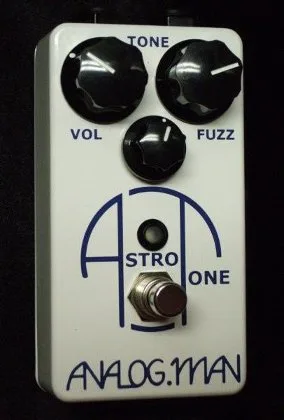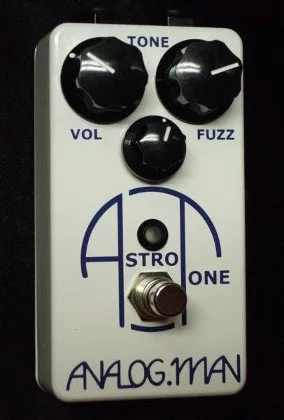


The Analog Man Astro Tone is a hand-wired silicon fuzz pedal that revives a circuit most players have never heard of: the Sam Ash Fuzzz Boxx and Astrotone fuzzes built in New York City by the Astro Amp company in the 1960s1. Analog Man released its version in 20102 and positions it deliberately between categories. As the maker puts it, the sound is "not as compressed as a fuzzface, not SUPER thick and saturated, something between a fuzz and distortion but closer to a fuzz"1.
Premier Guitar's reviewer agreed, writing that "the Astro Tone's basic character resides somewhere between a fuzz and distortion," with a full, crunchy growl3. For a player who finds a Fuzz Face too compressed or a big muff-style fuzz too saturated, that middle ground is the whole point of this pedal.
Between a fuzz and a distortion
The Astro Tone's character is what separates it from the fuzzes most players know. Analog Man's own description is careful: not as compressed as a Fuzz Face, not super thick and saturated, something between a fuzz and distortion1. The manual adds that it is fuzzier into a smaller amp and acts more like a booster into a large distorted amp4.
Premier Guitar found the same thing from the other direction, noting that the pedal "covers that buzzy territory while also being able to deliver thicker, saturated sounds," and that it is great for smaller or cleaner amps while acting more like a booster with a cranked large amp3. The JHS Pedals history of Analog Man's best pedals sums up the character bluntly: "when I play this pedal, it feels more like a distortion than a fuzz"5.
Analog Man also changed the circuit from the originals in one player-relevant way. Premier Guitar reports that the maker improved the vintage circuits, most notably making more bottom end available, a move that lets the pedal sound better with a band3.
"The beauty of the Astro Tone is that it covers that buzzy territory while also being able to deliver thicker, saturated sounds."
On noise, the Premier Guitar reviewer encountered little save for when the Fuzz knob was cranked all the way, and preferred the tone with the Fuzz backed off to about 95%3.
On bass
Analog Man says the pedal "sounds great on bass guitar, preserves your tone, keeps your low end, cleans up if desired, and adds some cool distortion sounds"1. That is unusual for a vintage-style fuzz, and the added low end built into the circuit is part of why it holds up on a bass rig.
The controls: Volume, Fuzz and Tone
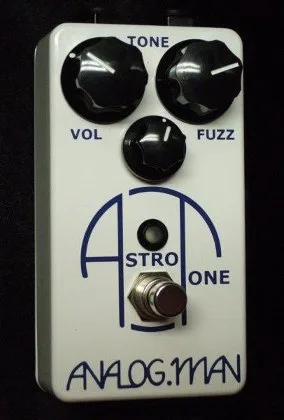
The control set is three knobs: Volume, Fuzz (drive), and Tone14. The manual notes that the Tone knob goes lower than the originals, so the dark end of the range is more usable than on a 1960s Astrotone4.
| Control | What it does |
|---|---|
| Volume | Sets the output level1 |
| Fuzz | Sets the drive; Premier Guitar preferred it backed off to about 95% rather than dimed3 |
| Tone | Rolls the top end; goes lower than the original circuits, and is most effective past the halfway point up to the maximum setting34 |
Delicious Audio's review found the Tone knob "operates over a fairly wide range and can add back some beef to your tone"6.
Practical details from the manual: the jacks sit on the top of the pedal for efficient layout on pedalboards, the power jack is on the side, and the switching is true bypass4. The negative-ground 9V power means no polarity problems with a standard boss-style supply4.
The transistors
The Astro Tone uses silicon, not germanium. The manual lists "Original Fairchild Silicon transistors, not affected by heat like a Germanium fuzz" among the pedal's features4, which matters if you play under hot stage lights where germanium fuzzes can drift.
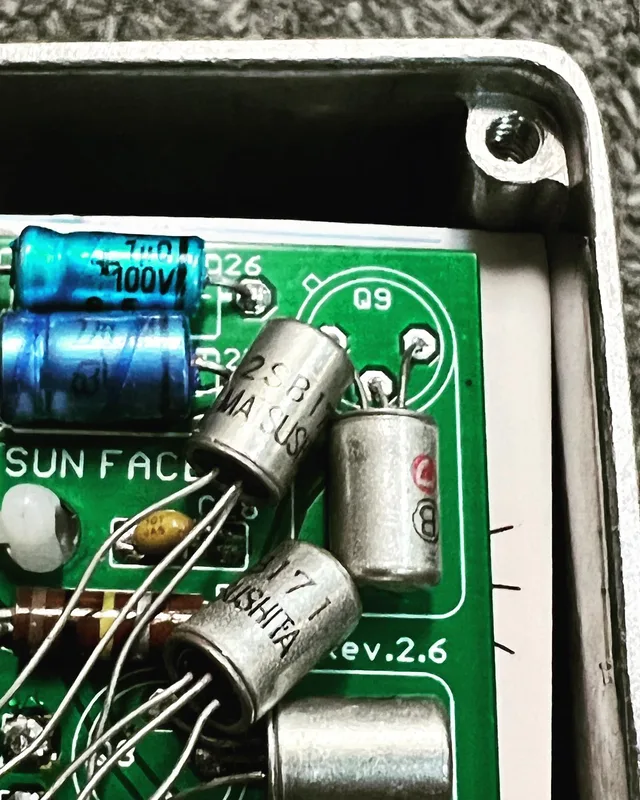
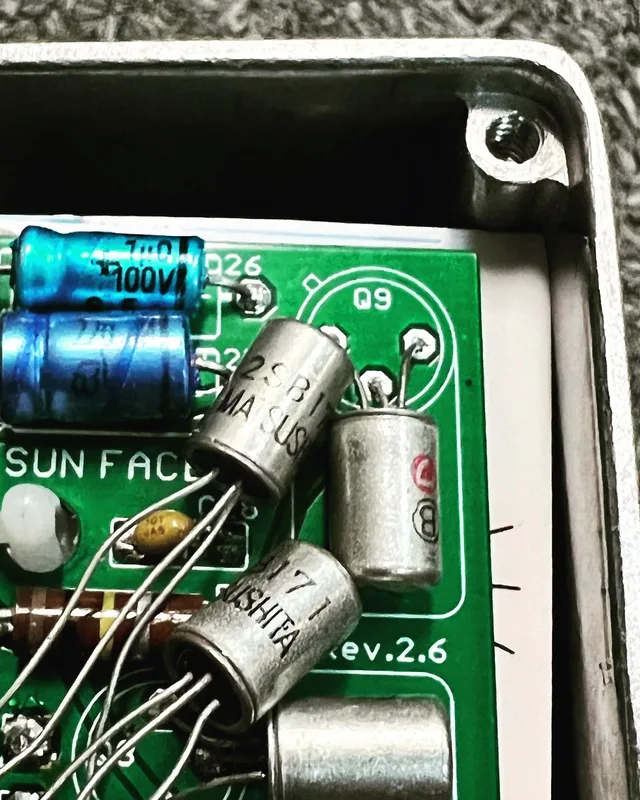
The first few hundred units were built around original 1966 Fairchild Semiconductor silicon transistors, which Premier Guitar called "an essential part of the original Astrotone's sonic signature"3. Analog Man describes them as little plastic, flat, pill-shaped Fairchild transistors with gold plated leads1. From 2023 the company switched to newer transistors of the same type and shape, also with gold legs1. For reference, the original 1960s Astrotone used 2N3565 transistors, which varied widely in gain71.
From the Sam Ash Fuzzz Boxx to the Astro Tone
The circuit's ancestor is one of the stranger footnotes in fuzz history. The Sam Ash Fuzzz Boxx and Astrotone fuzz were made in New York City by the Astro Amp company17, and Tru-Fi's page on its own Sammy fuzz dates the Astrotone's introduction to 19678. The JHS Pedals history puts it plainly: "It's based around the Sam Ash Fuzzz Boxx (no, that's not a typo)"5.
Analog Man came out with the Astro Tone in 20102, with engineer John Foege from Georgia Tech helping with board layout and testing1. A black version with gold graphics like the original was made as a batch in late summer 2011 and remains available as an option1. Premier Guitar noted the case "sports cool graphics that evoke a '60s aerospace company logo" and is built rock solid3.
Notable player
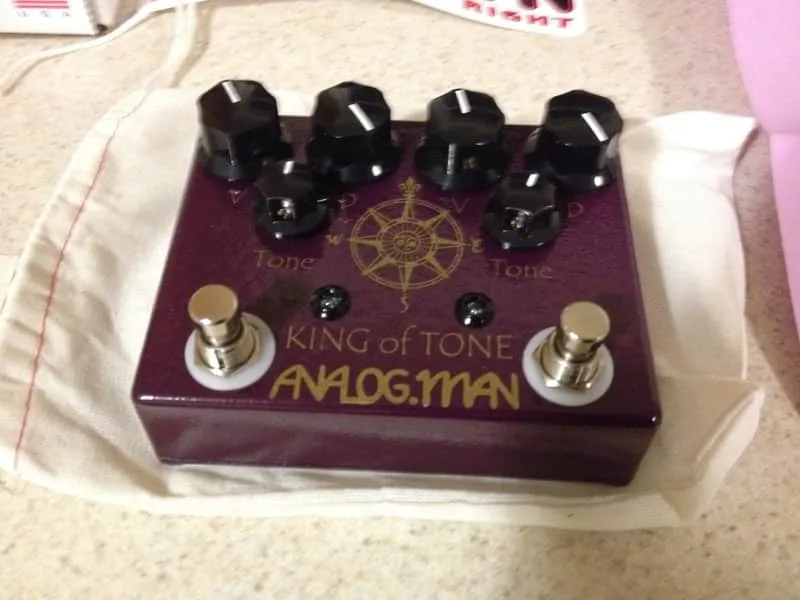
Analog Man's page records that Gary Clark Jr used the Astro Tone for his basic fuzz sound, often in combination with the King of Tone, in a note dated June 20121.
How it compares within the Analog Man fuzz line
Where the Astro Tone sits between fuzz and distortion, Analog Man's other fuzzes chase different targets: the Sun Face is the classic Fuzz Face-style germanium build, the Silicon Sun Face and BC183 Sun Face take that circuit into silicon, and the Peppermint Fuzz and Dark Peppermint Fuzz aim at the big saturated tones the Astro Tone deliberately avoids1.
Videos
Joe Perkins
musictoyznetwork rasch
Guitarsenal
Questions
Does the Astro Tone work on bass?
Yes. Analog Man says the pedal sounds great on bass guitar, preserves your tone, keeps your low end, cleans up if desired, and adds some cool distortion sounds. That makes it one of the few vintage-style fuzzes a bass player can use without losing the bottom of the instrument.
What transistors are in the Analog Man Astro Tone?
Silicon Fairchild transistors. The first few hundred units were built around original 1966 Fairchild Semiconductor silicon transistors, small plastic pill-shaped parts with gold plated leads. From 2023 Analog Man switched to newer transistors of the same type and shape, also with gold legs.
How long does a battery last in the Astro Tone?
A long time. The pedal draws less than 1 mA when off, so Analog Man says an alkaline battery will last a few hundred hours of normal playing time. It also runs from a normal 9V boss type power supply.
Is the Astro Tone like a Fuzz Face?
Not really. Analog Man describes the sound as not as compressed as a Fuzz Face and not super thick and saturated, something between a fuzz and a distortion. It is based on the Sam Ash Fuzzz Boxx and Astrotone circuits, not the Fuzz Face.
Did Gary Clark Jr use the Astro Tone?
Yes. Analog Man's page says Gary Clark Jr used the Astro Tone for his basic fuzz sound, often in combination with the King of Tone, and sounded amazing, in a note dated June 2012.
Sources (8)
- Astro Tone Fuzz by aNaLoG.MaN Guitar Effects, analogman.com, 2023
- Vintage Effect Pot Repair, Analog Man (analogman.com), 2015
- Analog Man Astro Tone Fuzz Pedal Review, Premier Guitar, 2010-10-20
- AstroTone Manual.pdf, Analog Man Guitar Effects, 2020-09
- ANALOG MAN'S BEST PEDALS, JHS Pedals
- Review: Analogman Astro Tone Fuzz, Delicious Audio, 2011-12-21
- Astra Silicon Fuzz / Astrotone Fuzz, Aion FX, 2021-03-19
- Tru-Fi Sammy Fuzz Guitar Pedal, tru-fi.com